Examiner Resurrection: Broken Wings: When A Biker Goes Down Hard – Part 1

November 21st, 2016

OK, it’s Thanksgiving week and I’m going to give myself a break and go completely with these Examiner Resurrections. But that’s great, because this three-part piece that I will post on Monday, Wednesday, and Friday is what I consider one of the very best things I ever did in eight years writing for Examiner.

A bit of an update is in order, however. Randy and Joan have since divorced, and Randy is no longer active in ABATE. He does still hold the Randy Run for Fallen Bikers.
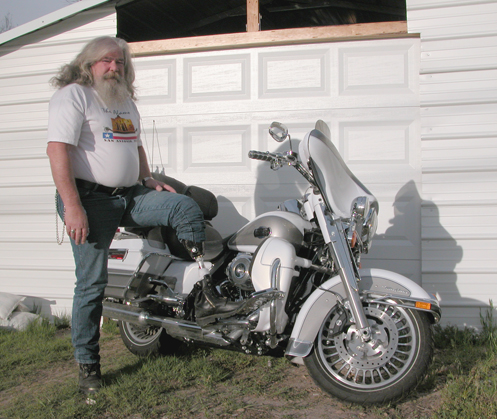
motorcyclist who lost a leg

Randy Savely displays his new Harley-Davidson Ultra Classic and his new leg.

Broken Wings: When A Biker Goes Down Hard – Part 1

When everything finally came to a stop, Randy Savely sat up, thinking, “Well, I’m alive.”

A couple moments later he noticed his boot laying in the middle of the intersection.

“That boot don’t come off,” he thought. Then he turned to the driver who had hit him and asked for his belt to use as a tourniquet on his leg.

At that early morning hour on March 8, 2007, life changed forever for Randy and Joan Savely. Randy lost his left foot and lower leg, and he and Joan gained an understanding of what is truly important in life: friends and family and people who care about you.

The accident and the hospital

Randy needed to be at work early that March day, so, with only one car, he decided to let Joan sleep and take the Harley. They worked close to each other so normally they went together.

Riding east approaching an intersection, Randy saw the car coming the other way, looked to the left at the car stopped there, and looked back to see the oncoming car was turning into his path.

Awakened by the phone, Joan hurried to the hospital. Randy and Joan are ABATE members, and word flew out through the ABATE grapevine so that by 7 a.m. Joan was joined by 15 friends who sat with her the entire time until Randy came out of surgery at 3 p.m.

Before going into surgery, Randy informed the surgeon that “I will walk and I will ride again.”

The doctor replied, “You do understand that we’re going in the operating room and I’m going to amputate your leg?”

Randy replied, “Doc, you do what you’ve gotta do, I’m going to ride again.”

Under other circumstances, they learned later, the surgeon probably would have removed the leg to above the knee. Considering Randy’s determination, the doc worked extra hard to save the knee, and he was successful.

“The doc was awesome,” says Randy. With the knee still attached, he is able to bend his leg, which makes a world of difference sitting on a motorcycle.

Joan was with him through it all. “She put up with more than I did,” Randy says, and when Joan came in his room one time looking obviously exhausted he told her to climb in bed next to him and sleep.

“I hadn’t slept in three days,” Joan says. Randy kept the nurses away and Joan slept there the entire afternoon.

During his hospital stay, Randy has a constant stream of visitors. Most were friends and acquaintances, but one day he noticed someone he did not recognize in the hall in leathers, just standing there.

“Do I know you?” Randy asked.

“No,” the stranger replied, “I just heard a brother had gone down and I wanted to see how you are.”

The two talked awhile and Randy has never seen him since.

“It choked me up, holy for crying out loud. You feel so insignificant, but then you feel so important to some people.”

“It’s changed what’s important in our lives,” says Joan. “There are so many things that are just not important any more.”

Randy had four surgeries in the week following the accident, and whereas most patients would have stayed in the hospital for three weeks, he recovered so well and so quickly that he was released after one week. Far from being the end, however, this was just the beginning.

Part 2 — The Road to Recovery
Part 3 — Back in the Saddle

Biker Quote for Today

I’m a biker’s wife. Just like a regular wife but way more badass.
Examiner Resurrection: One More Sweet Motorcycle Road In Southern Utah

November 18th, 2016

OK, this is the last of these Examiner Resurrections to focus on great roads in Utah; I’ll move on to other things next time.

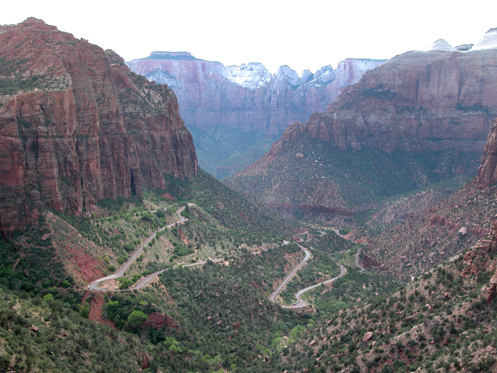
The view down into Zion Canyon

The view down into Zion Canyon.

I told you about Kolob Road, the best motorcycle road in Utah that nobody knows exists. Here’s one more that everyone knows, with a twist.

Utah 9 crosses through Zion National Park from just east of Springdale. As soon as you enter the park you reach Zion Canyon Road, which goes up Zion Canyon. This is the main part of the park that all the tourists go to. And you should, too. It’s worth it. This is the Zion that most people know.

During peak season you can’t drive this road any more. It’s a deadend and there used to be hordes of traffic and it was not pretty. Now they put you on free shuttle buses that run frequently, making the the canyon a lot more enjoyable. I’ve got some pictures in the slide show below (sorry, no slide show carried over from Examiner) that gives you an idea of some of what you’ll see.

But that’s not the road I have in mind. What you’re really interested in is Utah 9. If you look at the map you’ll see a bunch of switchbacks followed by broken lines for a bit. This doesn’t mean the road is gravel, it shows that you’re going through a tunnel. A long tunnel. With windows cut out of the rock.

It’s at the east end of the tunnel when things really get interesting, not that the switchbacks weren’t. You come out of the tunnel and there’s a ranger shack and a parking area. Park here.

Then cross to the north side of the road and take the trail you’ll see there. It’s a steep climb right at first, but you don’t climb more than 100 feet or so and then it levels out the rest of the way. This trail takes you back over the saddle of the hill you just came through in the tunnel and the view back into the canyon is spectacular. Again, check the photos in the slide show. It’s awesome. And I mean that in the original sense of that overused word.

Once you’re back to the road, the run on out of the park is still pretty darn scenic. There’s a reason there are so many parks in such a small area. Southern Utah is fabulous. So many roads, so little time.

Biker Quote for Today

Freedom: Getting lost on your motorcycle and enjoying every minute of it.

Watch Out–No Telling What’s Ahead

November 14th, 2016
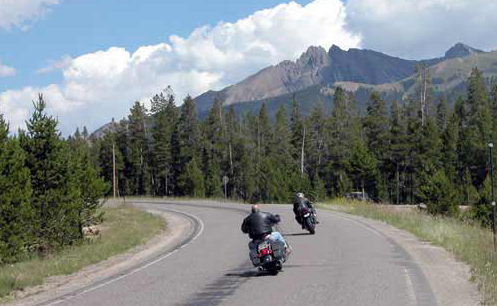
motorcycles on mountain road

What’s up ahead? You never know.

OK, more crazy things people have encountered when riding. It’s kind of a zoo out there, actually. (These are from Adventure Rider.)

  • I was headed north on I-5 when the top of an RV peeled off like a tuna can lid. A wall about twelve feet tall of aluminum and interior stood erect in the middle lane and the piece was sliding at about eighty miles an hour. Sparks were spitting out from under it. I was lucky that I was riding the inside lane because a diesel was in the outside lane and he was jack-knifing his trailer in order to avoid it. I only had enough time to see it coming in the center lane.
  • Heading South on US 83 in West Texas, a pickup was pulling a grain cart heading North and the hitch pin bounced out, cart came across my lane. Full brake lock and came way too close.
  • (Same guy) Heading West on I-70 in Kansas at night and saw headlights/taillights/headlights about a half mile down the road. I knew a car had crashed so was fully aware and getting ready to stop and help, but this fire ball was still coming towards me and not slowing down at all. I was trying to figure out what the hell when I realized it was a pickup missing the front driver wheel. Some lunatic was driving the wrong way on an interstate highway at night with no lights. He had hit a suv head on which was the crash I had seen, the highway patrol chased him another 10 miles before they got him stopped.
  • Man, I wish I had a picture of this one. Making my last left turn on my 86 mile commute home, 5 mile zone of death and am paying extra attention. I have a green, catch movement from the right, it’s 11 o’clock at night, bicycle riding against traffic runs the light, process and wait for him to go by, then fireworks thrown into intersection by bicyclist, ok I’m too tired for this, start to go, wait what? Bicycle is towing a 12 foot canoe and I almost rode right through it. This.Is.California.
  • If any of you have ever been near the Mississippi River (northern part) in the spring, you know all about May flies. Those things FILL the air to the point that after just a few miles, you are literally covered in dead bug juice….the Iowa DOT goes as far as to put signs up showing a mayfly on the road, with the word “Slippery”…and it CAN be….absolutely disgusting cleaning cooked bug guts off your pipes and radiator.
  • How about a 3 foot alligator, in Idaho! Was playing on the ST1100 at work, call it playing because I just patrol to be visible, going through an area along the river with a bunch of hot springs. Came around a curve and saw what looked like a log in the road, but one end moved and had two reflective dots. Got stopped and saw what was and tried to back pedal. It turned and scooted back into brush. Turned out to be an attempted theft from a private farm by high school kids.
  • A month ago, riding in the N. California coastal hills with a buddy, I pulled over and my buddy came alongside saying he had to clean off his jacket. What? Turns out about a mile back a buzzard had lifted off ahead of him carrying a huge load of purified road kill. It flew low over my pal and suddenly dropped his load like a precision bomb, a direct hit. It was about the consistency of jelly and so putrid I almost puked while helping wipe it off his jacket. We rode on a couple miles further to a small lake where we were able to wash off the worst of it while flies buzzed around us.
  • It was down in New Mexico on I-25 heading north around sunrise, I saw three golden eagles in the median eating breakfast. I passed some small car just as I got to them, they saw me and took flight. Two went almost vertical, but Larry the lazy eagle headed right in front of me! I watched him as he looked over his right wing and realized he better alter his flight plan.

    First order of business, lighten the load and then go vertical. He took a s–t and I watched it hit my left hand, continue up my left arm, and cross my face as his butthole and lower legs grazed the top of my helmet. I pulled over onto the shoulder and my girlfriend-who was following on her own bike-looked at me and I could see she was in pain from trying not to laugh out loud.

    I had worn an open faced helmet that trip-it was f—ing hot-and without even thinking about it, I licked my lips. Did you know that eagle s–t has a slightly butterscotch flavor to it? Who knew? My girlfriend was no longer in pain. She was laughing out loud.

    I no longer wear open faced helmets and she and I are no longer together.

  • Riding along a dirt lane to a campground in Steelevile MO, what I thought was a mass of about 40 to 50 dragonflies hovering and darting around over the middle of the road turned out to actually be a mass of humming birds. I never slowed down since bug guts never really bothered me. But I recognized what they were as I rode through the cloud of birds. Never touched a one of them as they simply just parted enough to let me through. It didn’t even faze them and they returned to their buzzing over the middle of the road as if nothing ever happened.

Biker Quote for Today

The most dangerous place on earth is between a biker and his bike.

Drawing Conclusions From The Naturalistic Study Results

November 10th, 2016
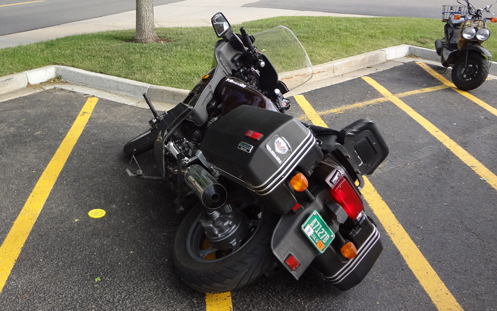
motorcycle laying on its side

The rider (me) definitely lost control of the bike when this happened.

“All of the crashes and near-crashes included in the risk analyses involve some type of control loss for the rider, whereas the baseline reference events include no loss of control.”

It may seem a little obvious and that may be a bit frustrating, but that is the primary conclusion drawn in the Motorcycle Safety Foundation (MSF) naturalistic study of motorcycle crashes and near-crashes. Isn’t loss of control a given in a crash?

I guess I’m not sure how to read that. Are they saying that the rider’s loss of control caused the crash or near-crash? Or that the crash/near-crash resulted in the rider’s loss of control? It’s that latter reading in which I would say, “Well . . . Yeah!”

But consider that dropping the bike is included in these incidents and that suggests the former is the one they mean. Dropping the bike didn’t cause the rider to lose control; dropping the bike indicates a loss of control by the rider.

(I’m reasoning this all through as I sit here writing. You’re seeing my thought process in action.)

So if I’ve got that right, then that may well be a significant conclusion. In every instance, the rider could have done something to avoid getting into the situation in the first place.

That actually jibes with what my friend Jungle says. He essentially believes that ALL crashes are avoidable and if you did crash, it was your fault. You could have avoided it if you had been paying more attention, looking further down the road, keeping your speed in check, whatever. And sure, people do turn left in front of you; they’ve done it to me but I haven’t crashed because I’ve either been paying attention and anticipating them, or slowed down nearing the intersection, or whatever. I’m sure this is true of you, too.

Of course then I have to consider what happened to Alan. He and Dan were out riding and seemingly out of nowhere a deer dashed out and hit him from behind. He never saw it, though Dan, riding behind, saw it all. Challenging Jungle a little, I don’t really know how Alan could have done anything at all to prevent that one.

But in all but the very tiniest number of instances, it seems you can do something. That’s why you’ve got to be sober and that’s why you’ve got to be paying attention, ALL THE TIME.

Of course, none of us is perfect and so none of us is really paying attention all the time, every single second. And most of the time we get away with it, but sometimes we don’t. Todd, a guy who came with the OFMC just one year, was on his bike sometime after our trip and he looked down to fiddle with something–I can’t remember what now–and when he looked up a couple seconds later the car in front of him had come to a sudden stop. He rear-ended the guy and went flying. Todd totally gave up motorcycles after that.

So fine, we’re not perfect. But we have to try to be perfect, because the penalty is too great. Back to that conclusion up top, you could paraphrase: If you have full control of your motorcycle, you will not crash. Because no one chooses to crash. If you do crash, you were not in full control. Stay in control.

Biker Quote for Today

A motorcycle coming down from 30 feet at 70 mph gives you a terrible jolt. — Evel Knievel

Digging Into Results Of Naturalistic Study

November 7th, 2016
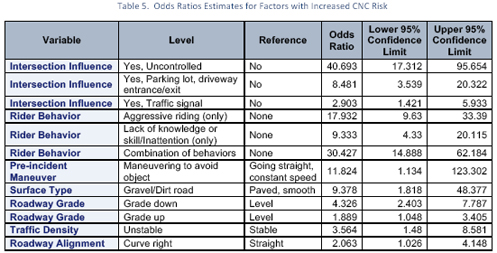
chart showing how risk increases

This chart from the report shows how much certain conditions or actions increase risk. (Source: Motorcycle Safety Foundation)

As noted previously, the Motorcycle Safety Foundation (MSF) has released the results of its naturalistic motorcycle crash study. Here are some interesting items from that report.

I would guess that the findings the MSF considers important to work into their rider training curriculum could be considered the most relevant. Toward the end of the report there is a section, “Application of Findings,” where they briefly state the issue and then list the finding that suggest more emphasis might be needed in training. I’m going to abbreviate this considerably. If you want to read it all you’ll find the report here.

  • Changing direction requires special attention / Riding in a right curve doubles the risk of a crash or near-crash compared to riding on a straight roadway.
  • Emphasis on the importance of appropriate speed in curve maneuvers / Study results indicate that excessive speed is a factor in 45% of the events.
  • Crashes, if they ever happen, occur mostly in curves and at intersections / The risk of crashes
    and near-crashes are increased at various types of intersections: traffic signaled intersections (nearly 3 times), parking lot/driveway intersections (8 times), and intersections uncontrolled in the rider’s direction (40 times).
  • There is rarely a single cause of any crash / Factors that increase risk include locality, intersections, the type of road surface, traffic flow, roadway grade, and roadway alignment; practicing under these conditions, riding with extra vigilance, or just avoiding the risky situations will decrease one’s chance of being involved in a crash.
  • Use your eyes and mind to determine how and when to adjust position as situations unfold / having to maneuver to avoid an object increases the crash/near-crash risk by nearly 12 times.
  • Running off the road accounts for many crashes / 67% of all single-vehicle crashes and near-crashes involved curve negotiation, and 63% of those were run-off-road or lane line crossing cases.
  • Special consideration for starting on a hill / riding on an uphill grade doubles the risk of crash/near-crash, and riding on a downhill grade increases this risk four-fold.
  • Types of road surfaces to be aware of, and how to react to them / Riding on a gravel or dirt road is related to 9 times the risk of crash/near-crash involvement than riding on paved, smooth roads.

Of course, we already know these different situations involve greater risk but this study puts some numbers to them as to just how much riskier they are than just going straight on a smooth road under good conditions. All good information to factor into your riding strategy.

Biker Quote for Today

A bad day just makes an evening ride feel that much better.

Report Out On ‘Naturalistic’ Study Of Motorcycle Crashes

November 3rd, 2016
naturalistic study

The opening slide of the naturalistic study slide deck.

About six years ago I wrote quite a lot about a new motorcycle crash study that was being conducted by the University of Oklahoma. It was to be an update to the old Hurt Report of 1981. The Motorcycle Safety Foundation (MSF) was to chip in to cover the cost.

Then things got a little crazy. The MSF announced it would not help fund the study, but instead would fund its own “naturalistic” study of factors contributing to motorcycle crashes. Later on, Dr. Samir Ahmed, the researcher heading up the Oklahoma study, left the group and had some harsh words for it all. Honestly, I lost track and don’t even know if a report was ever issued.

But now the MSF has completed its study and it recently issued its findings. I’ll do a quick recap here and then follow up in more detail in follow-up posts.

The difference between the two types of studies are that the one looks at police reports and interviews those involved after a crash occurs. The “naturalistic” study equipped 100 motorcycles with a considerable array of cameras and other sensors and tracked riders at all times. The thinking, of course, was that at least some of these riders would experience “incidents” along the way. Then the data collected by the sensors could be studied to develop a deep understanding of what happened, which in turn would make it possible to devise methods for avoidance of such events in the future. And as a purveyor of a motorcycle rider training curriculum, the MSF would presumably revise its curriculum and work these new findings into its training.

A number of the tracked riders did indeed crash, although most of the crashes appear to be been cases of dropping the bike in a parking lot. I say that with some caution, however, because the wording used is not totally clear and that is my interpretation.

The 100 riders covered more than 366,000 miles during the course of the study. There were 78 male and 22 female riders, ages 21 to 79. Bikes included 41 cruisers, 38 touring bikes, and 21 sport bikes. Participants live in California, Virginia, Arizona, and Florida. The study ran over the course of one year.

Altogether, there were 30 crashes and 122 near-crashes, summed up under the term of “crashes and near-crashes” and abbreviated as CNC.

Beyond the 17 incidents of “ground impact – low speed,” which I presume to be dropping the bike, there were 3 incidents where the rider ran off the road, 3 where another vehicle turned in front of them, 2 where the rider rear-ended someone, 1 crash at speed, 1 poor curve negotiation, 1 rider who was rear-ended, and two I’m not sure I understand, but 1 “other vehicle straight crossing path” and 1 “subject vehicle turn into path (same direction).”

Enough for now. I’ll get into the details next time.

Biker Quote for Today

A motorcycle is really a miniature automobile with full sized noise, smell and dirt output.