Posts Tagged ‘motorcycle salvage’

The Steele’s Cycle Story: Motorcycle Salvage

Monday, March 9th, 2026

Need a motorcycle part? You’ll probably find it here.

At first it was just figuring it out. Beginning in 2006, Steele’s Cycle embraced the new opportunities presented by the internet, and specifically eBay, and began the transition from junkyard to salvage operation.

“In the beginning, people would put it on the floor, on your desk, just take pictures and list it on eBay. Over time, we, like everybody, were like, we need a listing station,” Rick explained. “We need a place to put somebody to list the stuff. We tried lights. We made PVC white sheets to try to reflect. We tried to have a photo studio next door. But in the end, we just ended up with these listing stations. But that was all just over time and experimentation.”

They also used a tool called MotoLister.

“These two guys showed up in a car out front here. In the back of their car, it was called MotoLister. And they had a staged deal. It was basically, you take a picture, it’s hooked to your computer. It was software, basically. But they were the first ones. And they said, we’re looking for people to try it for free.
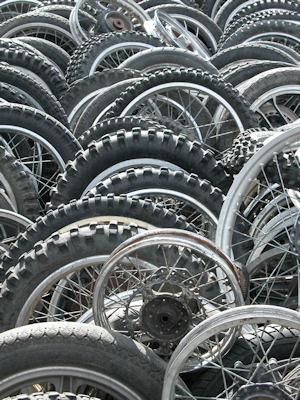
 Wheels? Yeah, we’ve got wheels.

“And he showed it to me and I said, yeah. Price is right. I do remember though, telling them okay, I’ll do it. But what’s going to happen in a year or two, you’re going to start charging me. And I said, I’ll do it. But you’ve got to give me free for life. And he agreed to it. I think five years ago or something, he started charging me. But they improved it immensely.”

“We also decided we needed more space, which is when we added on the 5,000 square foot addition in the south end of the building.”
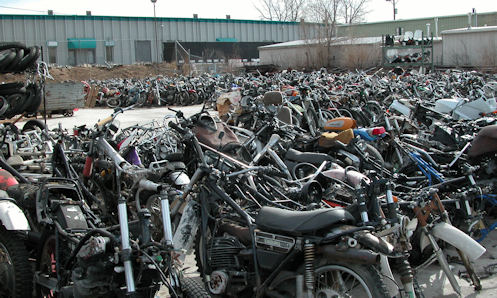
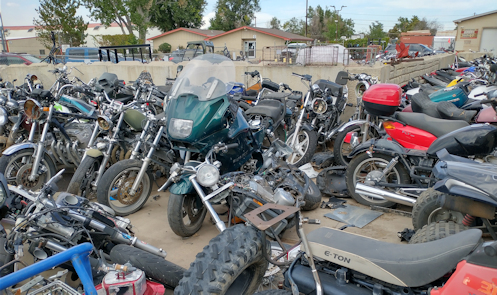
By the time that addition was built the yard was overflowing with bikes. To make space, Matthew said, “I threw away 800 motorcycles. We had to clear the yard and they were just all sitting there.”

Those 800 bikes filled a lot of recycling dumpsters.

“We were filling it up, taking them away, and it was just a round robin for a number of weeks. Probably got a whole $300, $400 for each skip.”

But did they single out at least a few better bikes to salvage?

“For the most part, we didn’t really have a choice. But if there was something there that we thought was a better piece, I’m sure there were some we set aside. There was a lot of burnt bikes. We bought Fay Myers’ burnt stuff, so there was quite a bit of burnt stuff out there.” (Fay Myers Motorcycle World suffered a devastating fire at their old location on West Alameda, which resulted in their moving to their current location on East Arapahoe.)

These days Steele’s Cycle doesn’t go looking for salvage bikes, the bikes come to them.

“I get more coming in than space to put it in,” Rick continued. “It’s a big place here, but space is always an issue. So usually about once or sometimes twice a year we go through the yard and just have to make room. It’s kind of sad because parts have value. But probably the decider is the labor that it takes to take it apart. If it takes the same labor to take apart that bike that you can make $3,000, $4,000 on, or that bike that you might make $500 or $1,000 on, which one are you going to choose?”
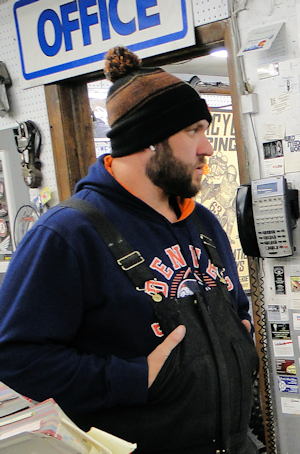
 Brandon Steele runs the eBay operation.

Nowadays, Rick’s son Brandon, that new baby who arrived just after the business was purchased, runs the eBay side of the operation. While the guys doing the stripping of the bikes generally decide what purchase price to put on the parts Brandon does double check it from time to time.

Brandon told me that “Some of my favorite part of it is I’ll have a guy buy a motor from, oh man, Australia. Last year was a guy that bought some old BSA parts and he was in Australia and you chat a little and you learn, you know, it’s just fun to meet people from around the world that have, you know, one thing in common, which is motorcycles. Then just also to hear, what’s it like over there? What do you do?

“Chasing the deal is probably what I enjoy the most, buying and then stripping and then seeing what, everything sells for a price but it’s, you really never know what’s going to sell next. That’s the fun part about eBay. I always tell my dad it’s like gambling the opposite way.”
Today Steele’s lists about 24,000 parts on eBay, a more manageable number. Half of their total business is through eBay. On the whole, parts off newer bikes sell fastest but old parts just keep on selling, too. A sizeable portion of new bike parts go quickly and what remains might go for years before they sell.

Does there ever come a point where they throw away parts that have been data-entered and stored? Rick says no.

“No. Not really. I mean, we haven’t reached that point yet. Look at a manufacturer. He has to have every part of the bike. The difference with them is after it’s 10 years old, they just stop. So they’re going to blow everything out, cheap sell it to somebody, which we could do, but I’m not a big sale guy. Because if somebody needs a part that we have, they need a part, right?”

Biker Quote for Today

There’s only one color for a motorcycle, that’s black. Unless you want to sell it, then paint it red. – Melvin “Swede” Dunlap
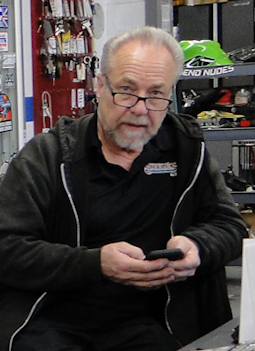
The Steele’s Cycle Story: Junkyard

Monday, March 2nd, 2026

Steele’s Cycle will have been in business for 40 years come this summer.

On July 20, 1986, Rick Steele was 26, about to have a second child, and was now the owner of a business on which he owed $90,000. What business? He now owned a junkyard. A motorcycle junkyard.

Almost 40 years later this former junkyard is a multi-million dollar business servicing bikes, selling used motorcycles, and breaking bikes down to sell for parts. The internet has helped transform this local business into a global operation, and customers needing that one hard-to-get part for their 40-, 50-, 60-year-old bikes are thrilled to find it at Steele’s Cycle. As are the owners of much newer bikes.

Today the main showroom is packed with a large variety of bikes for sale and the walls are covered with gear and memorabilia. The place is clean, well-lighted, well-heated, and a staff of 10, including Rick and his partner Matthew Morrison, keep the place humming. According to Matthew, storage rooms hold more than 100,000 parts from every model bike imaginable, all neatly stocked and quickly accessible, based around computerized inventory.

 Rick Steele

The conditions on that July day in 1986 could hardly have been more different. Bikes for parts were lined up outside for customers to find and remove their own parts and then bring them in to make payment. Grime coated everything. Lighting was poor. There was no running water. And Rick was scared to death.

He knew motorcycles. He had worked at several shops around town: BK Motorsports, Western Honda, Senti Yamaha. But he had never owned a business. He had seen the possibilities. No stranger to Denver Used Motorcycle Parts (the D.U.M.P.) just east of downtown Denver along Park Avenue, Rick had seen the profit to be had from used parts. Pick up a crashed bike for pennies and sell the undamaged parts for dollars. There was money to be made here. But first he had to survive as a business. The $10,000 he had put down, half loaned to him by his then-mother-in-law, was, to him, all the money in the world. What had he gotten himself into?

“The scary part was just starting that late in the season because I opened July 20th. Back then, winters were, you know, it snowed on Halloween and it stayed. You didn’t get any customers. So, I was here all by myself, just a new dad. It was what I think anybody starting a business goes through. It was like, why did I do this kind of thing? And then it was challenging. It’s always challenging in the beginning. But, there was a demand, it’s supply and demand. And there was a demand for the stuff. And people kind of knew about stuff that was here. So that first fall, I think there were a few bikes in here that I sold right away. And that kind of carried me through. But, it was touch and go that first one, for sure.”

A Utility Heart Attack
Occupying at that time only a small portion of the space that now comprises Steele’s Cycle, the space had only one electric heater. Rick ran that until he got the first electric bill. For $1,500.

“I about had a heart attack. I didn’t know. So I quit heating this. Right inside the door, there was an office. Where that window is, that was a closed-off office. And I had a space heater outside of that office. I was working in that little room in there. And then I had a kerosene heater. And that was my heat.”

The building itself was sheet metal and cinder block. And the lot was rocks. There was no pavement. It was rocks everywhere with tree shoots growing through the rocks.

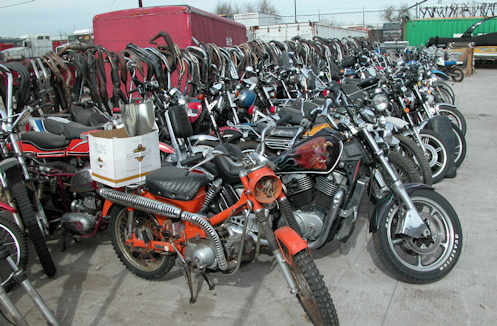
Just a small portion of the old bikes are visible in this photo from 2019.

While initially the site was in pretty poor physical condition, because he was only renting the space Rick did not do a lot of clean-up and fix-up.

“When I rented it, I never really asked to fix things because I didn’t want to get my rent raised. So, I would just fix them. I fixed all the plumbing. The winter before I bought it, all pipes froze. They shut the water off. So, when I came, there was no water or anything. I didn’t fix it the first winter. I think I ended up fixing it the next summer.”

In addition to being cold, that first winter was lonely. “It was me for about the first, I think, eight months to a year. And then, my first employee was a guy named Bobby Berkler. And he worked for me for probably 20 years. It was just him and me for the first four or five years.”

Then, four or five years in, Rick got his dealer’s license so he could sell motorcycles. They had already been doing service on bikes and this opened up additional opportunities. In this manner the company existed for about two decades.

Next: From Renting To Owning

Biker Quote for Today

I may be lost, but on my bike, I’m always found.

The CB750 Makes It To Steele’s

Monday, February 23rd, 2026

I spotted my old CB750 at Steele’s.

As I had pretty much expected it would, my old 1980 Honda CB750 Custom has made it to Steele’s Cycle.

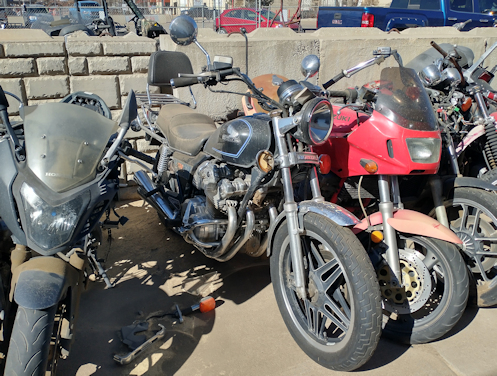
I was at Steele’s awhile ago following Tyler as he broke a Ninja down into parts and we were out in the yard at one point. Walking along a row of bikes I saw a bit of blue, a shade of blue that I’m extremely familiar with, and I looked closer. It was my Honda.

The funny thing was that I did not immediately recognize it as being my bike; I only thought it was another bike of the same vintage. I pointed it out to Tyler and he asked if this was in fact my bike and I told him no, it was just another like the one I had.

It wasn’t until that evening over dinner when I was telling Judy about it that it dawned on me that no, of course it was my bike. I had noticed that, hmmm, this CB750 has the same kind of sissybar my bike had. But somehow that had not jarred me awareness. But telling her I realized it was my bike. And I went back to look at it the next time I was at Steele’s and it was so obvious I can hardly believe I didn’t realize that the first time.

There was the same case guard, the same highway pegs, the same side panel on one side from a different year’s model. Of course this was my bike. But when I first saw it it did not have so much that I had come to associate with the bike, stuff I had stripped off the bike at the tow yard when I went to look at it after the crash. Without all that stuff it just didn’t seem like mine.

I pointed it out to Rick Steele and he said that considering I got hit head-on the bike didn’t suffer as much damage as it might have. But when I mentioned the cost of bailing it out of the tow lot he got it instantly–way more to bail it out than it would be worth. He said he gets a lot of bikes from that particular tow lot.

As I said, I was not at all surprised. I expected it would end up there and in fact it has probably been sitting there ever since last summer. Now two of my old bikes are at Steele’s. They’ve had my old Concours for a couple years now and at least it’s sitting inside and may eventually be fixed up and sold. It looks like the Honda is just destined for parts.

If anybody needs some parts for a 1980 Honda CB750 Custom I know where you can find them.

Biker Quote for Today

New Year, New Dreams, New Roads

Breaking Down A Motorcycle Into Parts

Monday, February 9th, 2026

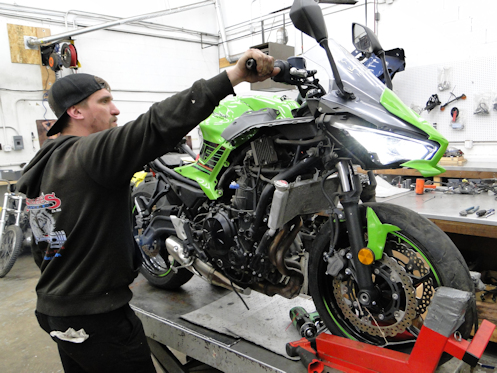
Today Tyler was taking apart a 2023 Ninja EX650R.

I wanted to see the actual process of breaking a motorcycle down into parts so over two days I watched Tyler, at Steele’s Cycles, disassemble a 2023 Kawasaki Ninja EX650R that had clearly hit something very hard. The story behind the bike? Totally unknown.

The bike was up on a lift when I arrived and Tyler, with the assistance of Kade, had it running and were testing the motor and all the electrics to determine the running condition of these items. Kade shot photos of the instruments to document their functionality.

This bike clearly hit something with great force.

Meanwhile, the front end was clearly headed for the trash or the scrap metal bin. While the right fork tube was bent, the left one was busted wide open, with the spring inside now completely exposed.

Naturally enough, Tyler started on the outside, stripping off the plastic body panels. The bigger ones were trash but many of the smaller pieces further back were in good shape and clearly worth resale. These were stacked on an adjacent bench, which got fuller and fuller as Tyler worked.

The gas tank was in excellent condition so that came off and had to drained. Tyler removed the gas cap mechanism from the tank and set that aside with the keys. Later when the ignition switch came off the frame it was bagged with the tank cap and the keys. On other bikes, with keyed elements such as helmet locks, those, too, are included.

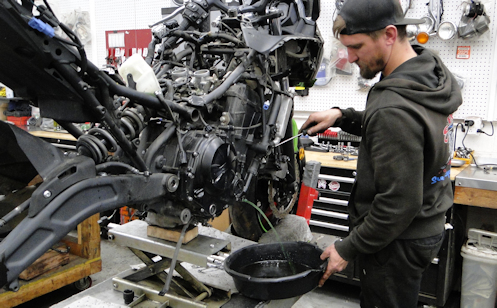
All the fluids had to be drained: coolant, oil, gas, brake fluid.

The muffler came off and would have presumably worked fine but it was dented so it became scrap metal. Is this axle good or is it bent? It looked straight and it rolled smoothly on the floor. Salvage, not scrap.

Piece by piece the bike came apart with everything salvageable set aside with all nuts, bolts, and washers carefully collected. Tyler might start on removing one item but then find that to get it off he first had to remove something else. The construction of the bike dictated the sequence of its deconstruction.

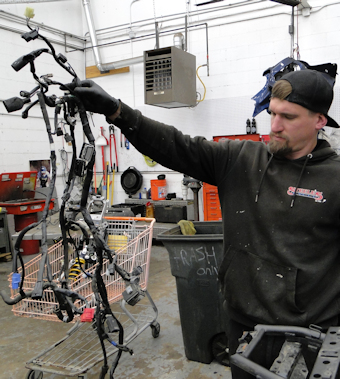
Finally the wiring harness came free.

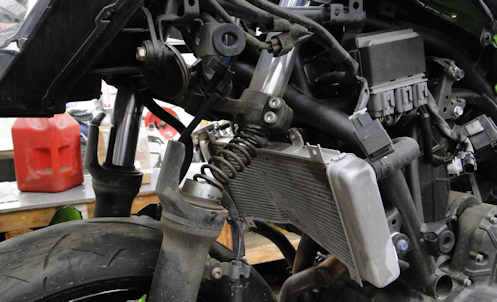
The oil pan came off and the oil had to be drained. The cooling system came off and the coolant had to be drained. Sometimes it was not a clean job; shops rags are close at hand when needed.

Finally it was time to remove the swing arm. Tyler put a jack and a block under the engine and raised it to take the weight off the rear wheel. First the wheel came off and then the swing arm.

Out at the back end, the taillight assembly was in excellent condition—salvage.

One of the very last things to come off was the wiring harness. Pretty nearly everything else had to be removed because that octopus of copper and rubber winds its way through everything.

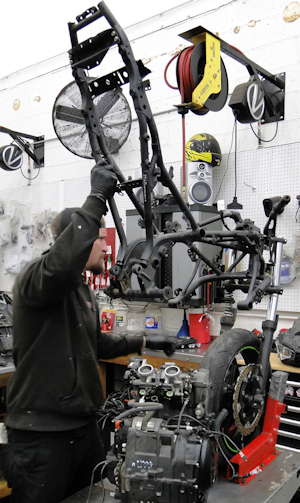
Now it was time to release the motor, leaving only the frame attached to the front fork and wheel. The triple clamps seemed not to be bent but they would be examined more closely before the decision was made as to scrap or salvage.

Nothing left now but the frame and part of the fork.

Nothing else was good. The wheel itself was shattered on one side and the brake disks were bent.

Amazingly, the front lights and mirrors were undamaged. This bike hit something really hard but that object must have been no more than two feet high and the upper portion was unscathed.

The very last thing to come off the frame was the ignition. And this, Tyler said, was “The most painful frame ever.” Up to this point Tyler knew the words and had been singing along to practically every country/western song that came on his Pandora feed. For the next 20 minutes Tyler did not sing.

The box with the ignition switch was bolted to the frame with bolts designed not to be removed. The only way to get them out was to drill into them and then tap them with reverse bits and back them out that way. But Tyler drilled and tried the bits, drilled more and tried again—over and over and over. They just would not come. Until they finally did.

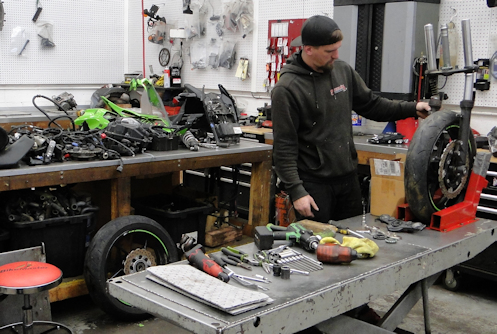
What had been a motorcycle was now a collection of larger parts—engine, rear wheel, frame—and two benches of smaller parts. The job was half done.

Most of the bike now lay in pieces on the bench behind Tyler.

Biker Quote for Today

You might be a Yuppie biker if you think a wrench is a bitchy woman.

How A Motorcycle Dies

Monday, March 25th, 2024

A Concours at Steele’s. This is the vision I hate to imagine for my Concours.

We all know how many motorcycles die: they get crashed and that’s that. But what about those that don’t get crashed? If they don’t keep going, why not?

I know the answer to that now. It’s all about the Benjamins.

I bought my Kawasaki Concours new in 1999. I have ridden it something over 80,000 miles. In July of last year it overheated going up to the Eisenhower Tunnel and I had to have it hauled home. Then I took it to a shop to have that all put right. But when I got it back it was not all right. Now the throttle refused to back off properly, so I took it back to the shop. It has sat there for three months now not getting worked on.

In the meantime, the last time I went by, planning to take it for a short ride, it had developed an oil leak. After three months of not getting worked on I decided to take the bike to a different shop, so I started calling around. It appears that getting the work done that the bike needs would run me at least $1,000. Meanwhile, I had decided that the time has come to let go of this bike. It has always been a very heavy bike and I am getting older. I can still handle it OK but for how much longer? But it seems doubtful that I could find a buyer willing to pay even $1,000 for it.

The big no-brainer question: why would I pay more than $1,000 for repairs and turn around and sell it for less than $1,000?

One of the places I called about repairs was Steele’s Cycle. Yeah, they could definitely fix it; working on older bikes is their specialty. On the other hand, I could sell it to them either as salvage or, more likely in my opinion, in my hopes, so they could do the repair work and then put it on their used bike floor and sell it. Other than the throttle and the oil leak there’s not a thing wrong with it and it can easily run many, many more miles. And they will give me about $300 to $400 for it, according to Rick, the owner.

So let’s see. Pay more than $1,000 to have it running good again and then sell it for less than that, or sell it as-is with no additional costs and get a few hundred bucks. It’s really sad to say it but I’m planning to have the bike hauled over there–probably on Tuesday–and take whatever they’ll give me for it.

I have loved this bike. This bike has taken me so many places, and I have done so much on this bike. I really hate the idea of abandoning it. Walking away from it after all the good times it brought me. But what am I going to do? Keep pouring money into it? Especially when I’ve already made the decision to move on from it. This will be the first time I have let go of a motorcycle I owned.

And about that. My first ever bike was/is my 1980 Honda CB750 Custom. I still own and ride that bike. And as my first bike I am deeply in love with it. It is in bad need of some work of its own and at some point this year I will pay whatever it costs to get this work done. This is how one bike dies, while another continues to live and continues to run. Sometimes it’s not about the Benjamins.

Biker Quote for Today

100 reasons not to date a biker: 17. We spend more on tires than we spend on you.