First Ride For 2015

January 12th, 2015
Motorcycle on dirt road in snow

You can ride when it's snowing--I've done it--but I don't think anyone makes a habit of it.

It was surprising that I only saw seven other motorcyclists out on Saturday. It was a great day to ride, in the 50s. I saw joggers in shorts and t-shirts and besides, Sunday was to be cooler with possible snow on Monday. You better believe I got out. Maybe everyone else was watching football.

The weather was fortuitous. Up until the day before there was still ice covering our street. Saturday morning I took a walk down our street to make sure I had a clear path and to figure out what that path was. I also busted up a few bits of ice just to be sure. Then I waited till around noon for the sun to help out a bit more.

This whole bit of icy streets has me wondering. Before Hickenlooper was mayor the city never plowed residential streets. Hickenlooper instituted a policy where they hired contractors with a wide variety of vehicles to make sure all streets got plowed at least once, and it made a huge difference. Has our current mayor Hancock countermanded that directive, feeling that the city can spend that money better elsewhere? I’m not sure I agree with that, but if that decision was made I think it should have at least been announced. Anybody know the answer?

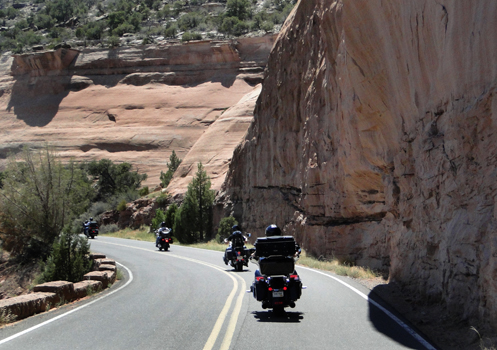
So any time I’m just out riding for the sake of riding I like to try to come up with a theme for the day. Heading out on the Concours I didn’t have one so I headed east on Belleview and turned south on University, figuring to loop back via C-470 and I-25. I thought about staying on University as it arcs on south and east, becoming Lincoln Avenue, and then turning north on I-25 but then I got my theme.

I did take C-470 and I-25 and then I got on the Honda and went right back down I-25 and west on C-470 and got off at University. Then I headed south. When I reached I-25 down there I headed north again to home, got on the V-Strom, right back down I-25 and got off at Lincoln Avenue and took that over to Parker. Then I turned north on CO 83 all the way up to I-225 and then home. Just a bunch of consecutive loops. Sure I’d have rather taken one long ride somewhere further but when you want to squeeze in at least a quick ride on three different bikes you do what works. If the weather cooperates later in the month I can do more. For now at least, January is in the books and all three bikes have been out.

Biker Quote for Today

If you love your motorcycle and let it go… and it comes back… you’re in the middle of a crash.

Getting Ready For Motorcycle Camping

January 9th, 2015
Gear for two-up motorcycle camping

Compact is the word when it comes to two-up motorcycle camping.

Judy and I tried out two-up motorcycle camping once last year. It was OK for a first time and we learned a few things. Now we’re acting on what we’ve learned and planning to really do this thing this year.

Compact is key when it comes to two-up camping on a bike. I’ve been camping by myself on my motorcycles plenty of times and it’s easy. The bike has plenty of room to pack one sleeping bag, a tent, a foam pad, food, and whatever else you need. It’s totally different when you’re two-up.

When you go two-up you now need two sleeping bags, two foam pads, clothes etc. for two, food for two, and a significant part of your packing space–the seat behind you–is taken up with non-gear, i.e., your wife/spouse/friend, whatever. That’s why a lot of people who are serious about this pull a trailer, but that’s not something I have any interest in.

So compact is the word.

We had already bought two down sleeping bags because they squeeze down smaller than our fiber-fill bags. Now we bought two Thermarest self-inflating mattresses. The two of them take up less space than one of the pads I used to use. That’s a step in the right direction.

On our test run last year we learned one thing profoundly: Having no provision for breakfast or even coffee in the morning sucks. Figuring we were going close by and just overnight we had figured we could do without that kind of thing. “Cold camping” I believe it’s called. So we woke up at about 9,000 feet elevation and it was cold and we had no way to even have a hot cup of joe. Rather than enjoy our camping experience we quickly broke camp and rode over Guanella Pass to Georgetown and had breakfast there. We’re not going to do that again.

Asking around I found that the consensus is that the compact JetBoil cookstove is the way to go. It’s designed for backpackers, so it’s small and light-weight. We don’t care about weight on the bike but we do care about small. The JetBoil and its gas canister are probably smaller than a two-liter bottle of pop. So we got one of those and also some dehydrated camping meals. Now we’ll heat water in the evening and pour it in on the dehydrated food and that will be dinner, and at the least we’ll heat water in the morning for coffee. Of course this all eats up most of the space savings we made with the smaller pads.

Which brings us to the choice of bikes. We took the V-Strom last year because it’s the dual-sport bike and seemed the natural. Plus, it has two very large Givi side bags that hold a lot, and I have a top bag on the rear as well. It might still be the bike of choice, especially if we’re going somewhere where we’ll have to be on a lot of gravel.

We do want to try the Concours, too, however. There’s no top bag, but unlike the V-Strom it is easy to strap a bunch of stuff on the rear, behind Judy. Plus, when you’re strapping stuff on the back, larger or awkward sizes are not much issue, whereas they are if you’re trying to get something inside something else. The two side bags are quite large, too, so I’m thinking it should certainly hold as much as the V-Strom. We’ll try the Concours on a trip where we know we won’t need to do gravel. The Concours hates gravel. Hates it!

I’m not sure if we’ll be getting more stuff or not. A tent that packs down smaller would be good on the V-Strom, but on the Concours it’s no issue. Less bulky clothing specifically designed for this sort of thing could save space. We’ll see.

Right now, though, we’re just waiting for warmer weather. I had hoped to get out for my first ride of the year today but freezing rain overnight and cold temps early in the day persuaded me otherwise. Camping weather–June–is still a ways off. Patience.

Biker Quote for Today

Companion wanted. Male motocrosser seeks caring and generous lady with her own dirt bike. Please send photo of dirt bike.

A Potentially Hazardous Ride

January 5th, 2015
motorcycle rider training

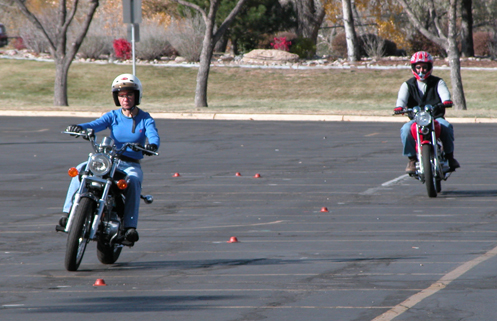
You learn a lot in rider training classes; what you need to do then is put that knowledge to use.

I like to think I’m a pretty good rider. Not only have I been riding plenty for 25 years, I have also taken the Beginning Rider Course, the Experienced Rider Course, and the Rider Coach training to teach others to ride. So I’ve learned a few things along the way. Presumably I put at least some of what I’ve learned to use.

I was coming south on I-25 recently and traffic was middling thick. Apparently I wasn’t paying enough attention because all of a sudden I saw brake lights coming on in a hurry on the cars ahead and I was way too close to the guy right in front of me.

I went for the brakes hard and felt my rear tire lock up and start to slide sideways. I wasn’t overly concerned because I’ve experienced this before and reacted by pulling my foot off the brake. We had even practiced exactly this in a track day lesson I took one time.

This time was unlike any in the past. Whether it was because I was going faster, or I wasn’t as quick at getting off the brake, or whatever, when I did pull my foot off, the bike certainly straightened out and stood up right away but the front end also shook violently. I realized that that was exactly the sort of physics that would, under more extreme conditions, result in my getting through over the front end in a high-side crash. Fortunately, this time I rode it out.

That got me thinking about what we discussed in class. The general rule of thumb is that if your front end starts to slide you release the brake immediately. When the rear starts to slide the teaching is to ride it out, because if you don’t, you’re looking for a high-side.

But there seem to be discrepancies here. As I said, at a track day class we practiced braking till the slide started and then releasing. And that makes sense. If you don’t slide too much the counter action when you release presumably won’t be that great. Apparently, though, at higher speeds, and the further you’ve gone into the slide, the greater the counter action.

So what do you do in a case like the one I was in? In the split-second I had to think there was no thought in my mind of riding it out because I was pretty sure if I didn’t get off the brake right now that my back end was going to sweep around and I’d go down in a low-side crash. And I didn’t want to do that. So I raised my foot.

I don’t have the textbook answer as to what I should have done in this situation. I do know that what I did worked, so I have to think that wasn’t a totally bad response. But I’m thinking I need to discuss this with some of the very experienced rider coaches I know and get their thoughts. If I learn anything valuable I’ll let you know.

Biker Quote for Today

If you get it out of shape, gas it hard. It may not help but it’ll make it spectacular for anyone watching!

Riding Numbers Looking Better In 2014

January 1st, 2015
My three motorcycles

Having three bikes reduces the number of miles you put on any one bike.

My mileage numbers were up on all three bikes in 2014, so that’s the good news (at least as far as I’m concerned). And down on the car. I would have liked the numbers to go further in each direction but at least they moved in the right directions.

The Honda was up the most percentagewise, although it had the lowest base to start from. I rode it 712 miles last year, compared to a paltry 327 miles in 2013. That’s the thing with having three motorcycles: time spent on one is often time not spent on another.

The Concours numbers were still a tiny fraction of what they had been the four years I spent freelancing full-time, but at least I put in more than 1,000 miles on it, which I had not in 2013. Total miles for 2014 were 1,037, compared to a piddling 666 in 2013. Compare that to the 9,437 I put on the Connie in 2012. I’ll point out though that I took the Suzuki on the OFMC trips in 2013 and in 2014, so that reduced the Kawi numbers substantially. The Connie is the bike I normally like to take on that trip.

And how did the Suzuki do? It rang up 2,596 miles compared to 2,294 the previous year. So that was respectable.

Meanwhile, I only put 7,558 miles on my car, compared to 10,109 in 2013. Match that with the total of 4,345 for the three bikes versus 3,287 the year before and you get more than 1,000 more miles on the bikes and about 2,500 fewer car miles. I’ll take that.

The difference this year had an awful lot to do with the fact that I just simply rode to work more often in 2014 than I did in 2013. I also went to work less, having cut back from five days a week to four days a week in about June. And I still ride the light rail to work a couple days most weeks.

I’m looking for things to change seriously in 2015. My job at the National Park Service will be drawing to a close around the first of May and I just don’t see any way in the world that I’m not going to ride a heck of a lot more and drive my car a whole lot less. Plus, the OFMC is looking at taking several trips this summer instead of the usual one.

I have a strong expectation that 2015 is going to be one heck of a good motorcycling year. Bring it on!

Biker Quote for Today

I’d rather be a rider for a minute, than a spectator for a lifetime.

New Colorado Helmet Law Threatening

December 29th, 2014
Motorcycle helmets

A bill to bring back a universal Colorado helmet law appears to be in the offing.

The legislative update at our ABATE of Colorado D-10 meeting on Sunday brought news of a bill possibly in the offing that would reinstitute a helmet law here.

According to State Coordinator Bruce Downs, Rep. Paul Rosenthal had first stated that he would definitely such a bill in the upcoming session. Rosenthal then apparently backed off from that, indicating that he might work on developing a base with an eye toward introducing such a bill in the 2016 session.

ABATE has been cooperating with two other major motorcycle groups in the state, the Colorado Confederation of Clubs and the US Defenders, preparing to fight any such bill.

The groups have put together a letter that will be made available at numerous motorcycle events, such as ABATE’s Last Brass Monkey Run this week and the Colorado Motorcycle Expo (formerly Colorado Motorcycle Show and Swap). Riders will be asked to sign the letter and provide their address, and then the letters will be sorted by the signer’s representative. Should a bill be introduced at any point the letters will be hand delivered to the appropriate representative.

The idea is to be ready, and hopefully to have thousands of signed letters in hand to be delivered.

“There’s no way this is going away,” said Bruce of the attempt to reinstate the helmet law.

According to Bruce, the organizations sought a meeting with Rosenthal to discuss the issue but the representative made it clear he would not be swayed by their arguments.

Recent from National Motorcycle Examiner
Only a biker knows . . .: Motorcycle wit and wisdom, 35

Biker Quote for Today

Full Throttle – solves the problem or ends the suspense.

More Questions Than Answers With ABATE

December 26th, 2014
ABATE Road Racing

Sponsoring racers is not likely to be an ABATE priority due to the group's current financial crisis.

I had a discussion recently with Bruce Downs, the new state coordinator for ABATE of Colorado, in regard to the financial issues the organization is facing. It was not a particularly satisfying conversation.

That’s not, in large part, Bruce’s fault. A lot of the questions I asked had to do with events that took place before Bruce stepped in as the new state coordinator. He has no desire to comment on matters that he had no knowledge of, and no one can blame him for that. In many cases he said that he was asking the same questions himself and so far had not been able to come up with solid answers.

I have to admit, too, that I had an erroneous understanding going into this discussion. With all the stories and rumors going around, Bruce had issued a statement to the membership denying/refuting specific claims and offering . . .

This is where I didn’t read carefully enough. I had the idea in my head that he was offering to speak to anyone who had questions about the matter. If I had really focused on his words I would have had a different take. Here’s what he said:

I would like to state right now that I am interested in getting to the truth about the rumors circulating about ABATE and its operation. I am willing to meet with anyone who can provide me with justifiable documentation as to the rumors.

And then this:

Again, I ask that anyone with justifiable documentation please come forward and show me the proof. I and others have dug deep and can find no evidence to support any of the rumors. I am willing to be corrected and will say so. If no justification can be provided any statements made are based on hearsay and innuendo and will be treated as an effort to defame ABATE and will be dealt with as such.

Not at all what I was thinking, is it? Bruce was not offering to answer questions, he was asking anyone with information to help answer his questions. So I soon got frustrated asking questions to which Bruce would respond that he didn’t know the answer. That was my own fault. But it had been my intention to speak with him even before he sent that note out, so my questions were the same as they would have been.

With that said, what did we discuss, and what did I learn? A little; not much.

My first question was broad: Considering how flush the organization was a few years ago, how did we get to the point where someone decided borrowing money at a high rate of interest was a good idea?

Because most of the money flowing through ABATE comes from rider training, this is inevitably where this question leads. Bruce walked me through the introduction of new competition and changes in the Colorado Motorcycle Operator Safety Training (MOST) program that reduced revenue per student. While a relatively stable number of trainees signed up for classes, trainers proliferated and ABATE, which at one time was training more than 5,000 per year, last year trained around 2,700. Meanwhile, the amount paid to training organizations by the MOST program in order to reduce the cost to the students, thereby encouraging more students to get trained, fell from $100-$125 apiece to about $35 now.

OK, I knew the generalities of all that, if not the particulars. So what did the board do, and when, to address this declining revenue?

“I cannot answer that question for you.”

Bruce was on the board in the early 2000s as Northeast Regional Coordinator but left the board before the downturn. So he was not there to be privy to the discussions that may have gone on.

Let’s move on to the stories about a $45,000 ad campaign that reportedly went nowhere.

I have no idea where that figure came from and to hear Bruce discuss it, he doesn’t either. In his message to the members he had said as much:

As to the rumor that ABATE spent $45,000.00 on advertising I can find no documentation or evidence that that claim is true. We did spend a lot (in my opinion) of money on advertising but nowhere close to the amount claimed. Please prove the claim or quit using false information.

He told me, “I have dug into the 2014 financials and there was nowhere close to $45,000 being spent on advertising, much less $45,000 over budget. It has come to my attention that this did not even occur this year. If that is the case, I’m still going to look into it, but if this is something in the past, it’s something in the past.”

Let’s move on to the loans that are crushing ABATE now. Who made the decisions to take out those loans?

Bruce doesn’t know. He wasn’t there when the decision was made and apparently conversations that seem crucial now were not seen to be significant at the time, so memories are vague.

Why were the loans taken?

“As I understand, it was because we were short money and needed to pay bills.”

That about sums things up. That’s about all Bruce was able to provide.

I want to make the point here that Bruce’s focus since he took over as state coordinator is primarily on the future, not the past. His primary focus is on accomplishing whatever is necessary for the organization to survive, and not so much on how we came to be in this spot in the first place. After survival is assured perhaps you can go back and look into how the problems came to be in the first place.

“I’m trying to give you as much information as I can. I don’t know that we’re ever going to . . . I think there’s way too many things that went on that we’re never going to be able to say, ‘This is the cause.’ I think it was a multitude of factors and hopefully we will learn from that. Hopefully the members will say, ‘Yes, I have a responsibility for this organization, and I am going to hold those more accountable in the future’ and go from there.”

I don’t argue with that priority. But as a member I’d still like to know how we came to take on these scandalous loans. I think it was Larry Montgomery who said at the first D-10 meeting where this was all announced, that “doing absolutely nothing would have been better than taking out these loans.” How the hell did that decision get made? I think we have a right to know.

Recent from National Motorcycle Examiner
Former ABATE of Colorado officer faces theft charge

Biker Quote for Today

The more complete your on-board tool-kit, the more likely it is that all your trail riding buddies will expect you to fix everything that breaks on their bikes.