Playing in the Dirt

October 9th, 2017
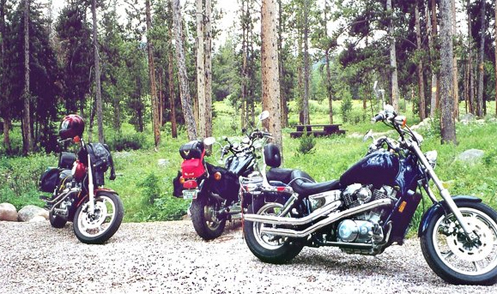
motorcycle along Kebler Pass.

Get off the pavement and have fun!

I hadn’t done any dirt-biking when my friend John offered me an opportunity. You can think of him as the pusher. “Try this, you’ll really like it,” he seems to say. Then you’re hooked. To maintain your habit, you can kiss your bank balance good-bye.

I didn’t get hooked but I got the craving. My V-Strom is a result of this.

John had a couple dirt bikes he and his son, Johnathon, would take up to the Rampart Range, an area in the hills outside of Denver given over to motorized fun on trails through the forest. They invited me along one day.

They were meeting up with other members of their extended family and this was the first time I ever saw how dirt-biking is such a family affair. It wasn’t just their own family. The campground area was packed with families and dirt bikes of all sizes, from pappa’s big bike, to momma’s mid-size bike, right down to baby’s little two-wheeler carrying young’uns who must have only learned to walk last year. And every one of them in full riding gear. Who even knew they made helmets and jackets and boots that small, not to mention motorcycles?

I have to tell you, I really envied these kids. I would have given anything I had to have had parents who took me dirt-biking as a kid. Instead, I had parents who wouldn’t even let me buy a bike with my own money.

So we went riding, and what a blast that was! First of all, being out in the woods and going up and down hills on these narrow trails is a kick. You never get going all that fast, but speed isn’t the point. That said, a bit of speed is the point when you’re going up and there’s a hump in the trail. “Whoops” as they’re called. You come up on that whoop and gun it and you’ll catch some air and that, I’m here to tell you, is fun. Catch several whoops in a row and you’re having serious fun. Did I mention that this can be addicting?

One big difference between riding in the dirt and riding on the street is that on the dirt you’re pretty much guaranteed to dump the bike from time to time. On the street that’s one of the biggest things you seek to avoid ever doing, but on the dirt it’s just part of the game. You don’t usually get hurt and neither does the bike.

Of course I dumped it more than once but I was right back up and on it and off down the trail. Talking about it at the end of the day I felt I had earned my wings when Johnathon told his dad, “Ken did pretty good. He even caught some air a few times.”

Not long afterward John sold the bikes and his trailer so I’ve never been back to the Rampart Range, and that was my only time to ride with them. But I got in some more dirt riding here and there and finally about four years ago got the V-Strom, which I consider a dual-sport bike, though some folks do not. But it has the suspension and it has the tires.

That day in the Rampart Range whetted my appetite as I started realizing how many, many unpaved roads there are through the Colorado mountains that I’ve never been on. I did finally pick the lock on my checkbook.

Biker Quote for Today

You know you’re a biker if your wife has ever asked you to move the bike so she could see the TV better.

Running Out Of Gas

October 5th, 2017
motorcycle by highway

Stopping beside the road is not always your desire.

I read an article some while ago that said, “Nobody runs out of gas any more, not with dash lights and other geegaws reminding you to stop and fill up.” Obviously, they weren’t talking about motorcycles.

Most motorcycles don’t even have gas gauges. What they do have is a petcock that you turn to Reserve when the bike starts to sputter. Then you know you had better find a gas station fairly soon. Presumably you know how much fuel your reserve holds, you know how many miles you get to a gallon, and that tells you approximately how far you can get on what you’ve got left.

My Kawasaki Concours does have a gas gauge, but it’s in a minority. And even that is only a half-way measure because it still has reserve and once you flip that petcock the gauge just registers Empty and you’re judging your range as you would on any other bike.

I have run out of gas. More than once, on both the Honda and the Kawi. And you’ll rarely meet a rider who hasn’t also run out, at least on occasion.

Now, riding with the OFMC I have never run out, for the simple reason that all my bikes have bigger gas tanks than any of the other guys’ bikes. They need to gas up long before I do so as long as I do the same I’m golden. And I carry a long plastic surgical tube so that if need be we can siphon gas from my tank to one of theirs, though that has never been necessary.

That fact is largely due to John’s experience on one of our early trips. He and Bill and I were blasting north through Wyoming on I-25, heading for Deadwood, SD, and I was in the lead. I noticed they had dropped back so I slowed down and after awhile I pulled over. The customary thing in this situation is to wait, with the assumption that they’ll be along soon. If they don’t come along soon you head back to see what the hold-up is.

So I sat there a while, too long, and turned back. I hadn’t gone far and there they were, going the direction I was now coming from, so I turned around again. We all pulled off and they filled me in.

John had run out of gas and hadn’t thought to flip to reserve, so he coasted to a stop. Bill pulled over to offer aid. They quickly deduced the problem, but even after John switched to reserve the bike wouldn’t start because the fuel line had been drained dry and he couldn’t get any gas to the carburetor. Most motorcycles don’t have fuel pumps, it’s simply a gravity flow system.

So they tried jump starting. We were on flat land and Bill pushed and pushed and pushed while John tried to get the thing going. Finally, about the time Bill was ready to die from his work-out the bike did start, and after he trudged his way back to his own bike they were finally on their way again.

Ever since then John is a total fanatic about getting gas long before he even reaches reserve. He also instructed his son, Johnathon, in this approach so a few years later, on another trip, when the bike Johnathon was on started sputtering he had no idea what was happening because he had never gone to reserve before.

Me, I hit reserve regularly. The only problem is when you forget to switch the petcock back to the regular tank when you gas up. Then, if you’re not paying attention to how many miles you’ve ridden, when the bike starts to sputter, guess what? You’re out of gas. Trust me on this, I know.

Biker Quote for Today

You’re a biker wannabe if you spend more time shining your bike than riding it.

Getting Off The Pavement

October 2nd, 2017
motorcycles on gravel

John’s driveway.

Some motorcycles are built to go off the paved road, even off any road at all. Generally, these have knobby tires for getting a good grip and serious suspension that can take big bumps without complaining.

Then there are street bikes. As the name implies, these bikes work best when you keep them on the pavement. And the fact is, many street riders are loathe to take their bikes anywhere near gravel. You can slip and slide and bounce like crazy on that stuff. In addition, you kick up dust and the guy behind you gets to eat it. It’s not like being in a car where you can roll up the windows.

But consider this: According to the U.S. Department of Transportation, there are 1.4 million miles of unpaved roads in the U.S. It stands to reason that there are a lot of really nice places you might like to go on your motorcycle that aren’t paved.

So, if you’re like us in the OFMC, sometimes you go anyway. Our experiences have been mixed in this regard. I’m the only one with anything close to an adventure bike, a 650 V-Strom, and everyone else just has street bikes. I have mentioned in the past (not any time recently) how some of our guys took a dirt road outside of Taos down to a hot spring. There wasn’t much to the spring and the road was very rough, with the result that Jason’s bike snapped an electrical connection and he had to make a quick stop at a dealership to get it fixed.

Another time, in the early days of the OFMC, John proposed that we take the road from Phippsburg, CO, over Ripple Creek Pass to Meeker. He had looked at the map and figured there were about 10 miles of it that were unpaved. We could handle that, couldn’t we?

Well, of course we said we could, only it turned out that there were about 40 miles of gravel, not 10. And it wasn’t smooth gravel, either, as is sometimes the case. No, there was a lot of washboard and we bounced and banged our way over this road for what seemed like a long, long time. John even managed to drop his at-that-time brand new Honda Shadow in some deep sand along the way. My luggage rack was shaken so badly that it broke in two places and I had to stop at a welding shop in Salt Lake City to get it fixed.

Later that same day, Bill turned off on a dirt road by a lake we were passing, which quickly turned deeply rutted, and John dropped the Shadow again.

With that day clear in our memories, it was something of a surprise a few years later when John suggested that he show us the Trough Road, another gravel road that runs from Kremmling, CO, over to State Bridge. He had been on it recently, he assured us, and it was smooth and hard packed. It was in fact every bit as nice as he said it was and a beautiful ride to boot that Bill and I had never been on. We’ve all ridden it at least a couple times since then, and I’ve been on it more than that.

So as much as John, especially, dislikes gravel roads, here’s the supreme irony. The worst stretch of gravel I’ve ever been on is John’s driveway. His driveway is a tenth of a mile of loose, unpacked, large stone. On top of that, it’s about 5 miles of better gravel from the main road to his driveway. More than one OFMC rider has biffed it going to or from his house.

We’ll all agree to ride gravel sometimes, but let’s just say we don’t make John’s house a frequent gathering spot.

Biker Quote for Today

Why bikes are better than women: Your motorcycle doesn’t get mad when you ignore it for a month or so.

Examiner Resurrection: Playing Monkey On A Racing Sidecar

September 28th, 2017

This experience was a real highlight, so I’m happy to run this as an Examiner Resurrection.

motorcycle sidecar rig and two riders

Rick Murray at the controls and me in the passenger spot.

“Grab this grip with your left hand and never let go.”

I figured that first bit of instruction was the most important of all. Especially when ignoring it could result in my hitting the pavement at speeds in excess of 100 miles per hour.

I was going for a ride on a racing sidecar.

If you watch sidecar racers scream around the curves, often with the passenger hanging much of their body out of the car and inches from the ground, your first impulse is to say “Those guys are crazy.” Well, crazy or not, I wanted a piece of it and I was going to get it.

I went to the Bonneville Vintage GP and Concours last week with antique motorcycles on my mind but was quickly caught up in the excitement surrounding the sidecars that were also there racing, both vintage and Formula 1 and Formula 2. And as luck would have it, the sidecar guys love to take other folks on what they call “taxi rides” for a couple laps of the track. Where do I sign up?

So Rick Murray, with Team RGM, who would be taking me for a ride in his rig, was explaining to me what I should, and most importantly, should not do. As you move around from left to right to center, the right hand moves from grip to grip. But the left hand never moves from its grip. A lot of the rest I was told was forgotten as soon as we got out on the track but I did remember this.

Then Christine Blunck, with Subculture Racing, walked me through the entire track, showing me how to roll on my legs from left to center, where to brace my feet as I moved right, and what move to make on each turn in the track. She noted that sidecar passengers at times wish they were monkeys so they would have that tail, that fifth hand, to grab on with.

Wearing my own helmet and gloves and a borrowed leather suit, I was mounted and we were ready to roll out on the track. There would be one other taxi rider on the sidecar ahead of us. Let’s go.

Around the track we looped, through turns with evocative names such as “Gotcha,” “Mabey Y’ll Makit,” “Agony,” and “Ecstasy.” If I remembered anything Christine had told me about each turn it became moot as I quickly lost track of where we even were on the course. Initial thoughts of shifting left to right and back to left were dashed at the realization that, oh yeah, sometimes you have two lefts in a row, or two rights in a row. Guess I’d better pay attention to the track.

But even then it got confusing. I’d be figuring that I needed to be going right and I’d look ahead and the guy in the car in front of us was going left. Who was correct and who was confused? I know I was confused even if I was correct.

Of course, in all honesty, it didn’t matter if I screwed up. We were not going at full race speeds and Rick told me he could run the whole course at that speed with no problem regardless of what I did. And afterward I asked him if I screwed up and he just said, sort of noncommitally, that “You did fine.”

So we did the first lap and were well into the second when I heard the engine rev and felt us picking up speed. I knew Rick was opening it up to give me a taste of real race speeds and I hung on tight to enjoy the sensation. I have no doubt that my own personal land speed record was set at that moment.

Then we swept again through the clubhouse turn and into the pit lane and off the track to a stop. I stood up and realized I was breathing hard, not to mention feeling like I’d just had a work out. And I’m sure I was smiling. Here’s your leathers back, and thank you for the pin that reads, “I rode a racing sidecar.” Thank you, thank you, thank you. When can I do this again?

Biker Quote for Today

I have no interest in living a balanced life. I want a life of adventure.

Big Pantha Helmet Lock Makes Security Simple

September 25th, 2017
Big Pantha helmet lock

Here’s the lock with the cable looped through my helmet and the handlebars. The locking carabiner dangles in between.

Having some way to secure your helmet to your bike when you park somewhere is essential. Sure, I know a lot of people leave their helmets with the bike, unsecured, and even I do that at times, but there are other times when I just don’t feel that trusting.

Years ago it seemed most bikes came with helmet locks as part of the bike. I know my 1980 Honda CB750 Custom has one. But then there’s my 1999 Kawasaki Concours: it has one but it is located such that it is essentially useless. Whose idea was that? No matter, I have long had a third-party helmet lock that has worked great.

I have not had a helmet lock for my 2006 Suzuki V-Strom 650. So when I was contacted by Big Pantha asking if I would be interested in testing and reviewing their helmet lock I jumped at the opportunity.

This device is really simplicity itself. It is rubber-coated cable with a loop at one end and attached to a locking carabiner at the other end. You run the cable through your helmet and around something on the bike and then connect the two ends with the carabiner. There is a combination lock element and once you have closed the carabiner you move the dials to secure it. When you’re ready to go you set the dials back to your combination and disconnect. As compact as it is, Big Pantha says the cable can be unwound to stretch as much as six feet.

As a former technical writer creating user guides I am a strong believer in the concept of reading the instructions. Nevertheless, this seemed so simple that I started fooling with it without doing so. I was immediately confounded by the difficulty I had trying to reset the combination. That is, to change the default combination to something of my own choosing. Doh! Read the instructions.

The lever to open the carabiner is obvious. What is not so obvious is a second lever on the inside that you need to depress in order to reset the combination. Press that and voila!

The biggest difference between the Big Pantha lock and the one I have on the Kawi is that the one on the Kawi is seriously connected to the bike and moving it to another bike would be quite a pain. The Big Pantha lock is not connected to the bike at all, and it is quite small, so it is very easy to just slip it in your pocket and use it on any bike you want at any time. Or you could use it to lock anything else you might need to secure.

Now, as with the lock on the Kawi, the weak link in the system would appear to be the cable. Make no mistake, someone with a pair of bolt cutters could chop through either of these cables in an instant. But how many people do you see walking around carrying bolt cutters? I’ve used the lock on the Kawi for close to 10 years and have never had the slightest problem. Let’s face it, a dedicated thief can defeat just about any protective device. These devices are more about preventing someone who just happens to walk by and take a fancy to your helmet from taking it home with him.

And unless you have one of those really expensive helmets, it’s likely that no one is going to want your helmet anyway. Who wants to wear someone else’s sweaty helmet? But it’s still comforting at times to have it secured to your bike rather than just sitting there.

So OK, here’s the deal. Big Pantha sent me this lock as part of a partnership arrangement whereby I get a small payment for each lock sold to people coming to purchase via my site here. That’s not a big deal for me because I would have been happy to do a review just for receiving the lock. But it does matter to you if you’re interested because if you do click through on this link you will get the lock for 15% off the regular price. What you will need to do is, when making your purchase, enter the code “KENP797U” in the appropriate field. (That’s a clarification from what I previously told you–now that Big Pantha clarified it to me.)

If this is something you would find useful, by all means, click away!

Biker Quote for Today

I’m a free spirit. Either admire me or ride with me, but never try to cage me.

Target Fixation: ‘Don’t Look At That!’

September 21st, 2017
road kill and motorcycles

You go where you look.

Whatever you do, don’t think about pink elephants. Ha! Right, now there’s no way that you can’t think about pink elephants even though they were the furthest thing from your mind a moment ago. OK, try this. You’re putting down the road on your favorite two-wheeled iron steed and there’s a big pot hole up ahead. You really, really don’t want to hit that pot hole, so you keep your eye on it very carefully, but inexorably you head right for it, and Whump!, you bounce right through it. Dang, what just happened?

Welcome to target fixation.

The very simple fact about target fixation is that, whether you’re on a motorcycle, in a car, or whatever, you will go where you look. I know. I’ve seen the truth of this up close and personal more than once.

The first time was years ago when I was learning to fly a hang glider. I launched off the low hill we were using for training, with the simple intent of flying forward as far as I could. I got lucky and hit an updraft that popped me up nicely, so I was in for a good little ride. As I approached the landing area I saw the 10-foot aluminum pole stuck in the ground with a flag on top to indicate wind direction.

“Definitely don’t want to fly into that,” I thought.

So with my eyes locked on it, to my horror, I kept heading directly toward the pole. Just before I would have hit it I pushed out on the bar to flare the glider up and over it. That was successful. But at the slow speed I now had I had initiated a stall, and as soon as I got over the pole the nose dipped sharply down and I dove into the ground. I was a little banged up but the glider got it much worse than I did.

The next time was on my Honda CB750. After another, much more serious crash on my hang glider I sold the glider and used the money to buy the bike. I was out with the OFMC on one of our first summer trips and we were coming down some canyon road. There was a rock I’d judge to be about 5 inches square lying in the middle of my lane.

“Definitely don’t want to hit that,” I told myself. And then I proceeded to run right over it, bouncing the front wheel high in the air for the only wheelie I’ve ever done on that bike.

It was after that that I finally learned about target fixation. You will go where you are looking. If you want to avoid a hazard you MUST look away from it, not at it. Look to your escape route, not at the hazard.

The trouble is, it’s not that easy to do. Your natural instinct is to look at the object–let’s face it, you’re extremely interested in it because it is a definite threat. You’ve got to have the presence of mind to overcome that instinct.

Fortunately, with discipline and practice you can train yourself. Now, periodically when I’m riding, I’ll look ahead and pick a spot on the road that I designate as a hazard and then select another spot that I designate as safe. I keep my focus on the “safe” spot, steer through it, and avoid the “hazard.” Then when I come upon a real pot hole or rock or object lying in the road, my instinct to look at it is not as strong, and my brain can take charge.

Be careful out there!

Biker Quote for Today

Horsepower is how fast you hit the wall. Torque is how far you take the wall with you.