All of us have encountered flying objects or objects in the road ahead of us. It comes with the territory. Awhile back I found a thread on a motorcycle forum where people were asked to tell about their encounters. I did two posts back then, sharing some of the postings with the readers of this blog: Motorcycles and Flying Objects, and More Flying Object Tales.
Well, it’s time for another batch. The thread is alive and continues to receive posts.
**********
Back in my youth, in the mid 70’s – I was coming back into town from some cowtrailing on my Yamaha 175. Just got to where the road opened up to 4 lane, saw that I was closing in on some oil field trash (top level Merc with dried mud halfway up the windows). They were shedding little bits of mud as they went, so I decided to move to the other lane to miss that – when they hit a bump and let loose quite a mud-clod storm, and this long tubular object the width of the car….that turned out to be a rattlesnake! That bad boy had apparently been all cozy inside their back bumper, all stretched out.
He was doing some interesting spirals as he rolled down the road, and I passed him. Not much other traffic, so he had time to get clear – just glad I didn’t leave near there!
**********
On the bike I hit a bat that was flying through the woods, hit me in the shoulder, actually hurt a Lot, but didn’t dislodge me, and didn’t kill the bat – which after a moment departed my shoulder.
In the car I drove through a plate glass window which came off the back of a truck.. had it not fallen the way it did – I drove through it like it was a wall before it hit the ground – had it not – had it stayed parallel to the road I’d have been dead.
**********
I was riding some very curvey roads in east TN and was following a buddy of mine. He scared a hawk that had just made a kill on the side of the road. Who knows, maybe a mouse or something. When my buddy startled it, it took to the sky and came across the road right at me. It swooped up, I ducked down. All I heard were its talons clicking when they hit my helmet. No injuries to either of us.. Just a good story (of course better told in person).
**********
3 lane highway…noticed a truck about 2 cars ahead in the slow lane…full of old furniture…that “gut” voice said move over to the fast lane…fast…
About 2 min later a coffee table came out and shattered in the middle lane…I missed it completely…
WHEW!!
**********
Tuesday after work I took my usual dirt detour on the way home over Hog Creek. Right off the bat, had a couple deer run across the road, no biggie, usually see at least a half dozen on this trip.
I get over the first good hill and start down the other side. It’s a pretty good slope with sharp twisty corners and lots of loose gravel. I’m running about 40 mph when all of the sudden a fairly large black bear comes out of nowhere up the bank and almost T-bones me!
I locked the rear and started fish tailing and I yelled out WHOOOOAAAA! The bear turned and ran a few yards in front of me before heading down a near vertical cat slide.
I got off the brakes and gave her some throttle and saved myself from going down. I was feeling a little edgy though and the ol’ ticker was getting a good workout
So I stopped up on the next hill and drank an Obsidian Stout to calm the nerves.
**********
* Sheet of plywood, skimming along in front of me at about 50mph – when I swerved, it drifted my way, etc – Wonder what would have happened if I’d tried to ride straight over it?
* Burning truck tire in the middle lane of a near-deserted M4 at 1:00am in the pouring rain – Wafting smoke obscured it until I was almost right on top of it – Smelled it before I could see it. – Caused a bit of a pucker
* Found a box of high-explosive shaped charges laying by the side of I-10 on my way to work one day – Didn’t nearly hit them and wasn’t on bike but it was certainly unusual – Picked them all up, put them back in the box and in back of my truck then called State Police. Had an interesting conversation with trooper when he finally got there.
* Empty plastic garbage can blew right in front of me on a city street at about 45 mph – Big GS and I blasted right through it with a bang – Saw lots of bits in mirror – No damage to me or bike.
Biker Quote for Today
Everyone is trying to kill you. Really TRYING.
 If you want a better discussion of the concept than I can give,
 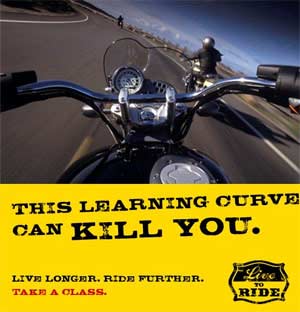 It seems appropriate then that when the State of Colorado set up a motorcycle rider training program they named it the
 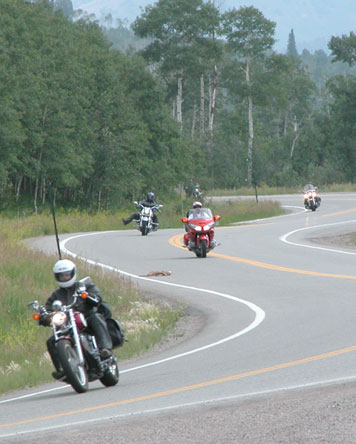 The OFMC is probably pretty typical in this regard. Early on, John and Bill and I recognized that there were a couple things we needed to be able to communicate to each other. We didn’t knock ourselves dead trying to think of every eventuality. We just came up with about three that we considered extremely necessary.