Archive for the ‘Motorcycle Safety’ Category

Hearing Set For Tuesday On MOST Repeal

Thursday, February 16th, 2012

motorcycle rider training

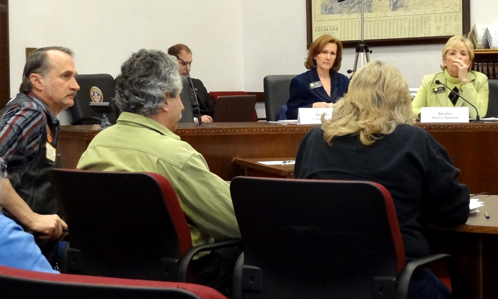
As mentioned previously, a bill has been introduced that would eliminate the state’s Motorcycle Operator Safety Training (MOST). There will be a hearing on that bill at 2 p.m. on Tuesday, Feb. 21, in Room SCR 352 at the state capitol. ABATE of Colorado is urging all who can to attend and lend support for the continuation of the MOST program.

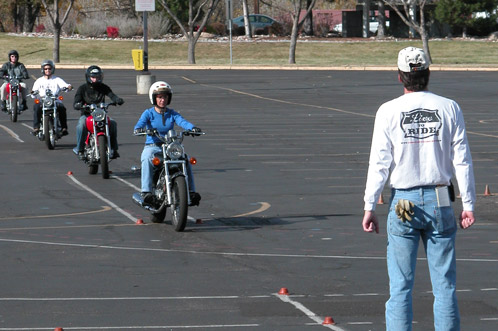
MOST is a program that was created at the request of motorcyclists to help defray training costs so that more riders will have better riding skills. The program is funded through a $4 per year additional fee on motorcycle license renewals and an additional $2 every time someone with a motorcycle accreditation on their driver’s license renews that license.

Aside from eliminating the program, SB12-089 makes no provision for what is to be done with the money already paid into the program should MOST be eliminated, which would presumably mean that money would simply stay in the state’s general fund.

The bill to eliminate MOST is sponsored by Sens. Renfroe, Cadman, Grantham, Harvey, Lambert, Lundberg, Mitchell, Neville, Roberts, Scheffel, and Spence, and in the House, by Reps. Holbert and Sonnenberg.

Anyone planning to attend the hearing should check first to ensure that it has not been rescheduled. The bill was originally scheduled for hearing on Feb. 14, but was postponed. If it is postponed there should be a notice to that effect on the ABATE site.

Recent from National Motorcycle Examiner
Struggle in Congress to continue Recreational Trails Program

Biker Quote for Today

The world is a book, those who don’t travel, read but a single page.

Motorcycle Safety: A Good Answer to ‘Why Not?’

Thursday, December 15th, 2011

We all know those signs over the highways that alert you to problems, scheduled closures, and such. And during May, which is designated Motorcycle Safety Awareness Month, those signs typically carry the message for drivers to be aware and watch out for motorcycles on the road with them.

The CDOT logoThis past May, my wife Judy asked the question, “Why do they only have that message during May? Why don’t they put that up there all year?”
I can now answer that question, and it’s actually a good answer.

Last week I attended a meeting at the Colorado Department of Transportation and one of the people there was Heather Halpape, who works in public relations with CDOT. At one point in the meeting she spoke about messages on those signs so afterward I asked her Judy’s question. Here’s what she said.

First, they do put up that message more often than just in May. They also put it up in August during the time around the Sturgis rally because there are a lot of bikes moving through the state to or from Sturgis. She said there is one other time when they use it as well, though she couldn’t remember off hand when that is.

Second, although the message is an attempt to promote safe driving, it can actually create less-safe conditions. Those signs don’t always have messages on them, but when they do, people make a point to read them. This can lead slowdowns and congestion. We saw that just this past weekend as we were coming down I-25 past the Yale exit. The sign there was alerting people to a closure at Belleview, and we hit congestion approaching that sign. After the sign, traffic sped up and the congestion cleared.

Third, people have been trained that messages are only put on the signs if the matter is important. So they make a point to read them. If there was always a message of some kind, that would just become routine and people would start to ignore the signs. And of course, that would defeat the purpose.

So there you go. Judy had a good question but Heather had a good answer that shows the people working for the state have given real thought to the matter. Kudos to CDOT.

Recent from National Motorcycle Examiner
NHTSA measure advances without helmet mandate

Biker Quote for Today

Don’t let my motorcycle ride interfere with the safety of your phone call.

Rider Training Program Threatened

Thursday, December 8th, 2011

Are you aware that when you renew your plates on your motorcycle(s) each year in Colorado you pay $4 that goes into a fund to help defray the cost of rider training courses? Also, anyone renewing their driver’s license with motorcycle accreditation pays an extra $2 that goes to the same fund.

MOST logoThis is all set in place because some years ago the motorcycling community asked for it. The general idea is that it is a good thing for everybody to have the folks riding motorcycles actually get some training so they can do it competently. The accompanying concept was that such a program could help to forestall proposals that Colorado institute a mandatory helmet law. That is to say, education and better riding skills do more to prevent traffic fatalities than wearing helmets. Or, to put it differently, crash prevention is better than having safer crashes.
Regardless of how you might feel about helmet laws, I don’t see how anyone can argue that it is not better to avoid crashing than to crash and not get hurt so badly.

The vehicle for this funneling of fees to rider training is Colorado’s Motorcycle Operator Safety Training program or MOST. MOST is now under attack, in some cases from organizations that originally supported its creation.

I could go on at great length with the history and background of what is currently going on, as ABATE of Colorado’s State Coordinator Terry Howard did with me, but I’ll give you the short version.

ABATE, Riders for Justice, some of the motorcycle clubs, dealerships, and others pushed for the training approach. Over the years the program was not given sufficient oversight and some problems developed. The Colorado Legislature this past year conducted an audit of the program and identified a number of issues. Several of those issues were immediately addressed and rectified and the rest will soon have been fixed.

In the meantime, however, new people have replaced the old, and in organizations such as the Colorado Confederation of Clubs (COC) which came into existence later, there is no understanding of the history of and reasons for the fees. Some of the previous supporters are now saying, “Why should we have to pay to reduce the cost for other people to learn to ride?”

In a twist that gives fits to Terry Howard, a Republican, the legislative audit committee was divided on party lines–with the Republicans being the ones she finds herself in opposition to. In the current anti-tax atmosphere, the Republicans on the committee are in favor of eliminating MOST and letting us keep our $4 and $2 fees. It is the Democrats who are saying, “The motorcyclists asked for this program, and for these fees to be levied on them, so let’s keep the fees and keep the program they fund.”

One other thing to keep in mind: If MOST is killed there is no certainty that the fees will be eliminated. We could end up paying the fees without getting the benefit.

The committee deadlocked in this past session, but it seems likely that Republican Rep. Marsha Looper, of Colorado Springs, will introduce legislation in the next session to kill MOST. This would be a good topic for all Colorado motorcyclists to learn more about, and then do what you can to educate your legislators, whether you support MOST or oppose it. Most of them don’t know anything at all about it.

Recent from National Motorcycle Examiner
NHTSA proposes additional naturalistic motorcycle safety study

Biker Quote for Today

Statistics show that most solo motorcycle accidents are caused by a defective nut holding the handlebars.

Time for More Weird Road Encounters

Thursday, October 27th, 2011

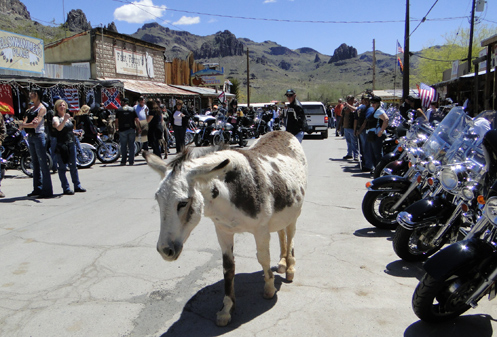
Burro on the street in Oatman with motorcycles

What’s the strangest thing you’ve ever run into on the road on your bike? By now several thousand Adventure Riders members have weighed in with their stories. It’s time to pass along a few more.
***************
I was on my normal commute on one of the coldest days of the year last winter.(17degrees on my home thermometer) The air was dry and my KLR seemed to be running extra good that morning. As I was rounding one of my favorite peg dragging corners the front pussed out then I totally lost the rear.I managed to save it after doing some weeding on the shoulder. I turned around to see what upset me and to my suprise (discust) I discovered that someone had puked in the middle of the road and it had frozen solid. Leaving a 3-4 foot round sheet of ice.
***************
An airborne 12′ aluminium dinghy with roof racks attached. I almost hit it! I was following the offending vehicle, just about to turn of the Kwinana Fwy heading north onto Canning Hwy. Just crossed the Mt Henry bridge and I thought….that dinghy is loose, that dinghy is flying, that dinghy is going to hit me in the face……..it did a loop the loop and landed in the lane next to me, upside down sliding along on the roof racks…..cars going everywhere…it was peak hour!! Moral of this story…..never follow closely behind boats when on bikes. If I had been two car lengths closer or a little faster….bammm.
***************
I broadsided a police car at about 40 mph that turned left in front of me while I was splitting lanes.
***************
A car raced past me and I thought ‘That bozo put the skis on the rack backwards!’ Tips forward and up!! There were 3 or 4 pairs and the whole set up was shaking like crazy… moments later the skis achieved enough lift to tear the racks off the car and everything went airborne. Fortunately for me, I managed to avoid everything, but it was quite a light show when they hit the highway at 120 km/h or so.
***************
When I was in college, late ’80s, I rode a ’78 RD400. I was heading home on the interstate. I liked to draft behind semis or big trucks. I was tucked in behind a loaded horse trailer at about 75 mph. All of a sudden up goes the horse tail and he proceeded to crap right in front of me.
***************
One second, I’m cruising down the road, not a care in the world, and the next, I’m laying flat of my back looking up and wondering what the hell just happened. According to the guy behind me, this big-assed buzzard came swooping down out of the sky headed toward some chunk of road-kill and buzzard and I intersected.
***************
While backroading up in Oregon, I came around a particularly fast, tight corner and narrowly missed a REFRIGERATOR sitting in the middle of the road. About 4-5 turns later, I passed a guy standing next to an empty flatbed pickup truck. He was inspecting his broken load straps with a very confused look on his face.
***************
Fellow I know and was rooming with – riding a long distance motorcycle rally: Riding down the super slab at night, he was dangling his feet from his ST1100, to relieve leg cramps. Suddenly, WHAM, his foot is hit by something on the pavement. Stopping to evaluate, he notices porcupine quills spiked in to his riding boots. I only heard the story from him, but I saw the quills permanently installed in to his boots. Imagine a squid doing that with flip flops!
***************
A boulder rolling down a hill on highway 20 going towards Truckee. It was traveling in a straight line right in the middle of the lane, going about 20mph. It was huge, I was afraid to pass it in case it took a weird wobble and crushed me. I followed it for at least a quarter mile before it went off the side.
***************
Almost hit = large Hog that jumped out of the back of the truck in front of me.

All right. Just a reminder to be careful out there.

Recent from National Motorcycle Examiner
Polaris shows it’s more than serious about motorcycles

Biker Quote for Today

ATGATT: “Because the only crumple zones on a motorcycle are YOU.”

Guest Post: Motorcycle Safety Tips To Ensure A Good Ride

Sunday, October 9th, 2011

Motorcycles riding through Central City

This guest post has been provided by Sarah Henderson. Sarah is into road safety and making our roads much more safe for cyclists and also motorists. Click here for more information. I hope you’ll find it useful and perhaps thought-provoking.

Motorcycle Safety Tips

There’s nothing like the feel of riding your bike on a beautiful, sunny day. Staying safe on the bike is really up to you. Here are some tips to help you stay safe when you’re out on the bike.

Bike Maintenance

Give your bike a quick check once in a while to ensure that everything is working. Check the lights, brake lights, turn signals and oil on a regular basis. Look at cables to be sure they aren’t frayed or worn and lube the train.

Gear

Quality gear can make the difference in an accident. The helmet should fit well and snugly. It should have the DOT label to show that it meets federal standards. Quality leather pants and a jacket not only look sharp, they also help protect you from road debris. Black is the natural choice, but a brighter color will make you more visible to other drivers. Gloves should be non-slip and the shoes you put on should cover the ankles.

Respect

Motorcycles are naturally harder to see. Engaging in risky behavior like riding on the shoulder or weaving through traffic will increase your chances of being in an accident. It’s also important to obey the speed limit when riding and, of course, never drink alcohol or take drugs before hitting the open road.

Assumptions

Normally, you want to avoid making any assumptions. But when you’re on a bike, there are some that make sense. Assume that there is a car in the lane you want to merge into and check on its location. Further, assume that the driver in that car has not noticed you and proceed with caution.

Take a Rider Safety Class

There are classes available to help make you a safer rider. Consider signing up for one of these affordable classes so you can spend more time enjoying the road and less time dealing with accidents. Plus, several insurance companies offer a discount on insurance premiums if you take a safety course. Allstate Insurance, for example, will reward you with a five percent discount on insurance premiums if you take a motorcycle safety class. Nationwide is another insurance company that will insure your bike and give you a five percent discount for taking a safety course.

Remember that Drivers are Blind

It’s not a conscious choice, but it is a fact that far too many drivers just don’t notice motorcycles. Motorcycle awareness, or the lack thereof, is often cited by the National Highway Traffic Safety Association a leading factor in motorcycle accidents. Make yourself more visible by using your turn signals when possible. Take the time to check your mirror before braking so you can not only watch the object in front of you, but also the car behind you to be sure it is slowing down.

Smooth Riding

Easy accelerations, gentle braking using both brakes, proper gear choice and smooth steering will help you stay safe. Your bike will hold traction on the road better and you will be less likely to land in a ditch.

Slow Down when Necessary

If visibility is poor or the car ahead of you is slowing down, you need to slow down, also. Keep the speed in line with what you can see and leave a distance between you and the car ahead of you.

Recent from National Motorcycle Examiner
Royal Enfield making inroads in US

Biker Quote for Today

Gear: Because walking away in disgust beats riding away in an ambulance.

Motorcycling Fact or Fiction?

Thursday, September 15th, 2011

Motorcycle on Squaw Pass Road

I just want to pass along this information I saw in this month’s issue of ABATE of Colorado‘s Spokesman publication. It’s something they got from the Motorcycle Riders Foundation, and has to do with the statistics that so often are used to justify “fixes” for problems. Here’s what the MRF put out.

Possible Errors? When errors, omissions or inaccuracies are discovered in reports or statistics, it calls into question the integrity of results. Additionally, small numbers can be easily skewed by slight or seemingly insignificant variations. Furthermore, numbers may be exploited if uncharacteristic highs or lows are used as a baseline. None of these discoveries are intended to argue against helmet use, but rather to demonstrate that suggesting a helmet law is not the solution to motorcycle safety. Individual states need to maintain the ability to determine what measures best address the needs and desires of their residents as suggested in the National Agenda for Motorcycle Safety (NAMS).

FACT Comparison of studies is complicated due to varying criteria, wherein one report references riders, it is unclear if that includes passengers or specifically operators. Other papers may refer to the numbers of persons, crashes or vehicles intermittently. This can be quite confusing as the numbers are usually very close and are frequently compared in error.

FACT A Minnesota motorcyclist survived a crash only to be struck by a car while standing on the road attempting to flag down a motorist for assistance. This was subsequently counted as a motorcycle fatality.

FACT A Pennsylvania taxi driver, with multiple suspensions,was responsible for about two percent of the state’s total motorcycle fatalities when he caused a crash with three motorcycles and killed five helmeted riders in a single incident.

FACT Motorcycle fatalities dropped by 10% in 2009 and preliminary reports indicate that 2010 numbers will be further reduced by at least 2%. The Motorcycle Industry Council advises that sales of replacement tires were up by 6.1% in 2010, suggesting an increase in motorcycle usage. A decrease in fatalities despite an increase in exposure would suggest that motorcycle safety and awareness programs, specifically rider education courses, have been successful.

FACT The National Transportation Safety Board has investigated over 120,000 airplane incidents, over 60,000 surface transportation incidents, and just 6 individual motorcycle incidents in their entire 44 year history — Apparently enough investigation to warrant adding mandatory helmet laws for motorcyclists on their “top ten most wanted list.”

FACT According to preliminary data from the Governors Highway Safety Association, states that have a mandatory adult helmet law had 6 fewer fatalities in 2010 than in 2009, while free choice states saw a reduction of 74. The state with the single largest decline in fatalities (Texas -60) is a choice state and a state which requires helmets on all riders tied for the greatest increase (New York +24).

FACT FARS (Fatality Analysis Reporting System) continues to include “mopeds” in motorcycle crash statistics despite the fact that most states do not require registration of these vehicles. This practice skews the most respected method of measuring the effectiveness of motorcycle safety programs, which is the ratio of accidents, injuries and fatalities per 10,000 registrations.

For more information, contact Jeff Hennie, Motorcycle Riders Foundation, 202-546-0983, jeff@mrf.org

Recent from National Motorcycle Examiner
Creating a comfortable, high-mileage motorcycle that carries groceries

Biker Quote for Today

She pulled out into his path. Classical modus deathus for a biker.