Archive for the ‘Motorcycle Safety’ Category

A Tale Of The Tundra

Thursday, May 5th, 2022

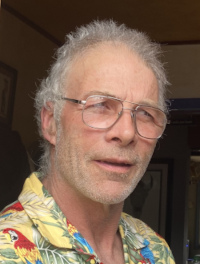
We were up in Eagle at Willie and Jungle’s earlier this week and to our pleasure and surprise, Mario was there, too. You’ll understand what a surprise this was as I tell you Mario lives in the Yukon. He’s a long way from home.

Mario

We met Mario four years ago on a ride Judy and I did with Willie and Jungle and some others up to British Columbia, to Banff and Jasper, along the Ice Fields Parkway. Mario flew in from the Yukon to Calgary, rented a car, met us in Radium Hot Springs, then cruised with us for about five days. Super nice guy.

So among the many things we talked about, Mario told us of a road north of where he lives that had been built across the tundra. I don’t recall if he said anything about the purpose of the road or where it went to and from, but the road itself was the item of interest. First off, it’s hard to build a road across the tundra. As the soil freezes and thaws the road gets lifted, sinks, and you end up with mile after mile of some terrific whoops. Whoops are great fun for a short distance but not something you want to drive on for a couple hundred miles.

To build this road they laid down some kind of fabric as wide as the road was to be and then covered it with sand. We’re talking some honking big rolls of fabric. Let’s see: 18 feet by 150 miles . . .

You can see how this type of road could better handle the freeze and thaw and the shifting. But there was some kink that nobody had expected. In the first couple months it was open, Mario said, the EMTs had to go out something like 50 times because motorcycles had had bad crashes. And primarily these were all heavy cruisers, Harleys mainly. What the heck was going on?

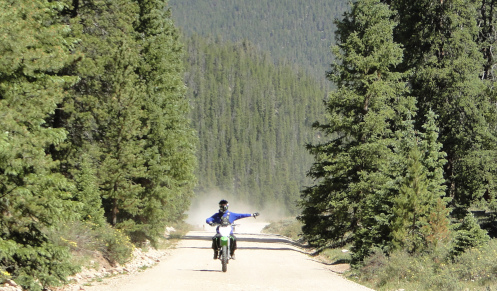
Mario went out to ride the road himself on his Kawasaki KLR 650. Everything was fine at first but then it got to where he felt like he was floating. He came close to crashing but managed to ride it out. What the heck?

Riding on, more cautiously now, the same thing kept happening. He had a hunch, and he pulled over to see if he was right. This is not a busy road so he had to wait awhile but eventually another vehicle came along and he saw just what he expected to see. It was like this.

The fabric material was waterproof, and beneath it, with the sun beating down on the sand, heat permeated and melted the permafrost. This released water, which had nowhere to go so it sat there. When a vehicle would come along some of the water would get pushed along under the fabric, gradually building up to something of a wave, which would start lifting the front end of a motorcycle up–the floating feeling–until such time as the front wheel would go on over the crest of the wave and suddenly the biker was running steeply downhill ahead of the wave. Then you hit level ground at a steep downhill angle and things do not go well.

Once he had this figured out Mario pushed on, cautiously, and eventually found what seemed to be the best way to ride it. He would stand up on the pegs and lean back, like you would on sand going down a hill. Hard to do on a big Harley, but OK on a KLR. So he rode to the end of the road and then turned around and rode back. Fun in the Yukon, huh?

Biker Quote for Today

More people die in their sleep than on motorcycles, so sleep less, ride more.

Distracted Driving Bill Needs Your Support

Monday, April 25th, 2022

At least out here you don’t have much concern about distracted drivers.

Stump, the legislative liaison for ABATE of Colorado, continues sending updates on legislation at the capitol and he has sent out an alert about the pending distracted driving bill. This bill would make it illegal to use a cellphone while driving except in hands-off mode. It has been brought up repeatedly over the past few years and each year it gets further in the process.

Here’s the latest:

SB22-175 is scheduled to be presented to the House Transportation & Local Gov’t Committee next Tues or Wed (April 26/27). Committee member info is below. Please reach out to these legislators to request their support. Thank you for your continuing support on trying to make Colorado roads safer for everyone.

Tony Exum, Committee Chair
tony.exum.house@state.co.us
303-866-3069

Meg Froelich, Committee Vice Chair
meg.froelich.house@state.co.us
303-866-2921

Andrew Boesenecker
andrew.boesenecker.house@state.co.us
303-866-2917

Marc Catlin
marc.catlin.house@state.co.us
303-866-2955

Matt Gray
matt@matthewgray.us
303-866-4667

Edie Hooton
edie.hooton.house@state.co.us
303-866-2915

Mandy Lindsay
mandy.lindsay.house@state.co.us
303-866-3911

Andres Pico
andres.pico.house@state.co.us
303-866-2937

Janice Rich
janice.rich.house@state.co.us
303-866-3068

Tom Sullivan
tom.sullivan.house@state.co.us
303-866-5510

Donald Valdez
donald.valdez.house@state.co.us
303-866-2916

Tonya Van Beber
Tonya.Van.Beber.house@state.co.us
303-866-2943

Kevin Van Winkle
kevin.vanwinkle.house@state.co.us
303-866-2936

In an earlier update Stump also noted that “Senate Minority Leader, Sen. Holbert, gave a very ‘persuasive’ argument in support of the bill at 2nd reading, citing how his personal distracted driving experiences have changed his view to supporting a bill which he had opposed in the past.”

That is why this bill keeps gaining support. Maybe this year we can get it passed.

Biker Quote for Today

What do you get when you mix a motorcycle with a joke? A Yamahaha.

Filtering, Not Lane-Splitting, OK In AZ

Thursday, March 31st, 2022

The Arizona state flag

Arizona has joined the ranks of the few states where lane-splitting is legal–sort of.

The state legislature has passed, and the governor has signed, a bill legalizing lane-splitting under very specific conditions. The new law will go into effect in three months.

What the law allows is actually more along the lines of what is referred to as filtering. In full-on lane-splitting, such as in California, motorcycles can pass between cars while traffic is moving. Filtering generally refers to bikes moving to the front of the pack when traffic is stopped at a traffic light.

That’s actually what Arizona will allow. Traffic has to be at a dead stop at a red light. And bikes can only move between them to get to the front at a speed of less than 15 mph.

The key here is that statistics have shown that one of the most dangerous places a bike can be is between cars at a stop. If someone slams into the bike from behind, or into a car further back, setting in motion a chain reaction, the biker can be caught between the cars in front and in back of him/her, to catastrophic effect.

Filtering ahead gets you out of the trap. Someone could still run into the car two vehicles back but there would not be a car in front of you to get crushed against. (Though you could get shoved out into the intersection, into the cross traffic. I’d be willing to take that chance.)

I had the chance to do some filtering in California a few years ago and it worked really well. Out there the drivers are used to it so many of them deliberately leave space ahead of them at a light. A couple other riders and I were behind the first car at the light and there was room in front so after a couple hand signals to suggest we do it we nodded in agreement and pulled around. Others followed us. The light turned green and we sped off, with acceleration much greater than the typical car. We didn’t slow them down and we were quickly out in front with no traffic to be any kind of threat.

This seems like the sensible, safe sort of practice that even bikers who consider lane-splitting to be crazy can get behind. Kudos to Arizona for being sensible.

Biker Quote for Today

Accident Scene Management: Treating The Injured

Thursday, March 17th, 2022

The previous posts in this series are here: First on the Scene. Safety First. What Next?

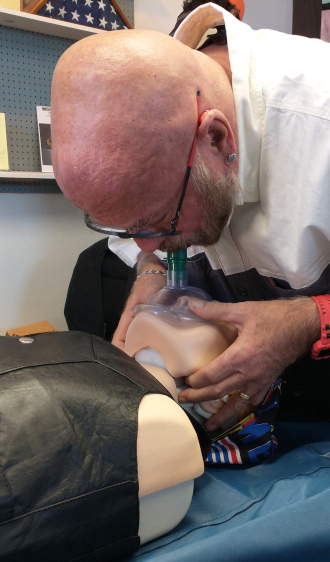
If you have one of these fancy gadgets, use it, but probably you’ll need to do regular mouth-to-mouth resuscitation. Note the finger behind the jaw executing the jaw thrust.

OK, help has been sent for and no one is likely to be injured by passing motorists. Now you need to do something to help these people or this person while waiting for the EMTs.

The first question you need to ask is, is the person breathing? If they’re not breathing nothing else matters. You can lose some blood, you can lose an arm, but if you are not getting oxygen you’re going to die. Or worse, your body may survive but your brain will not. Irreparable brain damage starts to occur at the five-minute point.

Often it is easy to detect breathing. If it’s not then things get trickier. You will want to look at the chest to see if it is rising and falling. Put an ear near the mouth and listen for breathing. Feel the chest for movement and feel at the nose and mouth for the movement of air.

Realistically, if the person is not breathing they may already be dead. But we don’t know that. So you’ve got to give them oxygen non-stop until the rescue team arrives. Also realistically, they may have injuries that may kill them even if you do give them oxygen. You might find yourself needing to apply a tourniquet at the same time you’re giving them oxygen. Nobody said this was going to be easy.

If you need to give oxygen, and the person is wearing a helmet, you will need to remove it. There is a danger here of causing additional spinal injury but that’s the chance you’re going to have take. Presumably it’s better to be alive and paralyzed than to be dead. If there are two of you then one should stabilize the head and neck while the other removes the helmet. Then stuff anything handy under the head and neck to keep it in the position it was already in. If it’s just you you’re going to have to try your best. But try.

In the training session they talked a lot about barriers and other devices to protect yourself from potential disease. Unless you’re one of those well-prepared types who carry first aid kits you’re not going to have any of those and you’re just going to have to go with regular old mouth-to-mouth resuscitation. But first you’ll need to ensure that the tongue is not blocking the air way.

There’s a move called the jaw thrust where you place your fingers behind the jaw, kind of below the ears, and shove it forward. This separates the tongue from the throat enough for air to pass. Then start breathing into them. You should see the chest rise and fall if you’re doing it right. Keep that up every six seconds (three seconds for a child) until help arrives. This is going to be work and you’re going to get tired. But you need to keep it up unless you reach the point where you absolutely can’t do it any longer. Obviously, if there are others at hand you can trade off.

Bleeding is next. Pressure is always the best way to stop bleeding. With a more serious injury, such as a limb ripped off or an artery torn open, you will need to use a tourniquet. Otherwise this person will bleed to death. Do not apply a tourniquet unless it is absolutely necessary because it may result in the loss of the limb. But it’s better to lose your arm than die.

Often the visible injuries are nowhere near that severe, but that does not mean there are no serious injuries. Internal injuries are harder to detect but can be just as deadly. All the more reason to keep the person right where they are.

And internal injuries are not obvious even to the injured person. One helpful hint from one of the experienced members of the class was that he who screams the loudest is usually the least hurt. But do everything you can to keep someone who says “Hey, I’m fine. Let’s go” from going anywhere for at least 15 minutes, because it could take that long for shock to set in, after the adrenaline fades.

And shock will kill you. You need to keep the person flat, with legs elevated to get blood to the head. Don’t give them anything to drink because that will be a problem if they need surgery. Look for restlessness or irritability; confusion; pale, cool, and moist skin; rapid breathing and/or pulse; nausea; and excessive thirst. Cover them to keep them warm.

Then wait for the rescue guys.

Clearly there’s a lot more, but I can’t begin to cover it all in a few blog posts. That’s why it’s a good idea to take one of these courses yourself.

And clearly it’s not all a simple one, two, three. Everything will vary based on how many people are injured and how badly, how many people are there with you assisting them, and so many other factors. All you do is the best you can do, and that could mean, in a worst case scenario, doing triage and ignoring others who are badly injured while working to save just one or two. You can only do so much.

But at least if you have some idea as to what to do you’re likely to provide more help than if you’re totally clueless. Take the class. And encourage your friends to take it, too. Someone’s life may depend on it some day. Maybe yours.

Biker Quote for Today

It is one of the illusions, that the present hour is not the critical, decisive hour. — Carlyle

Accident Scene Management: What Next?

Monday, March 14th, 2022

Demonstrating how to remove a helmet. Only do this if necessary as injury could result.

I recently took an Accident Scene Management class. Here are the first two posts. First on the Scene. Safety First.

OK, presumably no one is now in danger of getting killed trying to help this injured person so what comes next? You need to assess the situation and figure out what needs to be done to help. Then you need to contact emergency services.

These days it is nearly always possible to call 911 for help to be sent. If you don’t have cell service you can try texting 911 and that sometimes will be successful. If calling is not possible and you are not the only one there, send someone for help. This may even just be another passerby. It is important, however, to instruct that person to return to the scene after they have put out the distress call so that you will know for certain that help really is on the way.

If you are the only one there and you must go for help, this is when you would position the person in the “puke and drool” position described previously before you leave.

Before the person you’re sending for help departs, ask them if they know for sure where you are. “Back up Highway 20 somewhere” is not good enough. Find a mile marker or a physical landmark or something so the rescue crew will know as precisely as possible where they need to go. And if you have choices it is better to send a bland-looking person rather than a big hairy tattooed biker type who some timid people might refuse to open the door to.

Starting out, you need to presume the injuries are bad until you can determine otherwise. Assume the worst. Determine, to the best you can, the extent of injuries. If the person is conscious and can talk you also need to ask their permission to assist them. Yes, it’s a CYA but if they say no and you try anyway and end up injuring them further the Good Samaritan law will not protect you. If they are unconscious consent is implied.

Sometimes at least some of the injuries are obvious. If there is a lot of blood and visible open wounds, those need to be addressed. But don’t forget that there may well be internal injuries that are not immediately obvious, either to you or the injured party.

Oftentimes a person may be conscious and initially unaware of how badly they have been hurt. Try very hard not to let them just get back on their bike and ride away. After the adrenaline subsides they may find themselves going into shock or worse. Better to keep them on the ground for at least 15 minutes and see what happens.

One approach here, as offered by one of the EMTs in the class, was to say, “You just sit here for a couple minutes and meanwhile I’ll go take a look at your bike and see if it’s badly damaged and whether it’s rideable.” Then take your time doing that.

Also, use this time to gather information for the emergency response team. While the person may initially be conscious, that could change. Ask their name, where they hurt, whether they have allergies and what medications they take, when they last ate or drank and what, any pertinent medical history, and if they know what happened to cause their crash. Write it all down, or record it with your phone.

If they are unconscious, look for medical alert bracelets on their neck or wrist.

The experienced people in our group stressed that it is important that you stay cool and act competent, even if you don’t feel that way inside. The injured person is much more likely to panic if you are acting in a frantic manner. Be calm and project that you are in control of the situation.

Biker Quote for Today

Two priests were riding very fast on a motorcycle.
They were promptly stopped by a policeman who says, “What do you think you’re doing? What if you have an accident?”
The priests say, “Don’t worry, my son. God is with us.”
The policeman says, “In that case, I have to book you. Three people are not allowed to ride on a motorcycle.”

Safety Is First At A Crash Scene

Thursday, March 10th, 2022

Rolling the victim to slip something under them to slide them to safety. Note the attention to stabilizing the head and neck.

If your buddy goes down or you just happen upon a crash scene, and you’re the first one there, the number one thing you need to do is make sure no one–including yourself–suffers further injury.

I recently attended an “Accident Scene Management” class and all this information comes from that.

The first person you’ve got to take care of is yourself. You’re not going to help matters at all if you get hit by a passing vehicle and end up needing assistance yourself. So park safely, with your flashers on, and then go to assist. When you park be sure to leave room for emergency vehicles when they arrive. If there are other people in your group, designate the one with the most training or experience to be in charge. If you have flares or lights or anything to catch attention, deploy those things.

If there’s more than just you you’re going to want to control traffic. Station someone at least 100 feet up the road in each direction, and if you’re at a curve make sure that person is around the curve enough to alert other drivers before they come screaming along. Same with a hill. In town, have them go to the two intersections ahead and behind.

The next part of the training talks about protecting yourself from disease transmission. They say to put on gloves and a face mask. If you’re on your bike you’ll probably already have gloves and helmet on so it would make sense to leave those on. Frankly though, if I see someone bleeding profusely I doubt I’m going to take the time to struggle to slip on some latex gloves.

We’re proceeding now in terms of a motorcycle crash. If the bike is laying on the person you first want to get it off. Besides the weight of the bike and the injury that can cause, they might have their leg pinned against the blazing hot exhaust pipe. Get that thing off them. I won’t waste space here telling you how to lift a bike; you should already know how to do that.

Do you move the person? That depends on potential danger. If you move them there is the possibility you will cause further injury. But if they’re in the middle of the road and you’re the only one there and there is traffic on the road you’ve got to get them off the road. Be aware that every state has “Good Samaritan” laws so don’t worry about being sued for trying to be helpful. But if you don’t absolutely have to move them, don’t. Emphatically, don’t.

If you do have to move them, your method will depend on how many others are there to assist. If you’re alone, reach under from next to the head, grab them by the armpits, cradle their head and neck with your forearms, and pull. If you have assistance you can support their head and neck and roll them over enough to slip a blanket or something under them and them pull on the blanket. The blanket makes it slipperier. The key is to support the head and neck and try not to move the spine. That’s the really big thing, the spine. And that’s why it’s best not to move them at all unless you have to.

Especially if you’re the only one there and you have to leave to get help you will want to–if it’s safe–put them into a position so if they puke–a definite possibility–they don’t suffocate themselves doing so. You’ll want to roll them onto their side with an arm under the head and one leg extended as a “kick stand.” With the person facing downward, any puke will pour out their mouth rather than filling their throat and suffocating them.

Obviously, all these movements are based on your assessments of the situation. If the person is conscious and can talk and they’re moving themselves you have a lot more assurance that the neck and spine are not at issue so you can be freer in what you do. If they’re unconscious you just have to do what seems to make the most sense.

There’s a lot more and I’ll get into that in my next post.

Biker Quote for Today

I got a motorcycle for my wife last week. Best. Trade. Ever!