First Time, Repeat Visit To Great New Mexico Motorcycle Roads

April 3rd, 2017

Judy and I were recently in New Mexico and though we were in the car, not on a bike, we made it a point to hit some great motorcycle roads. The simple fact is, a road that’s great for a bike is generally pretty darn good for a car, too.

motorcyclist on Emory Pass

A rider heading down on the east side of Emory Pass.

We spent a couple days in Ruidoso and boy if there is one thing you learn right away it is that Texans love Ruidoso. In Colorado it is common knowledge that Texans by the horde come to Lake City. Well, for Ruidoso, think Lake City on steroids. A waitress we spoke with said it’s commonly accepted that at any time of year, not just particular seasons, there are more Texans in Ruidoso than New Mexicans.

So we’re not into crowds and we headed south to Cloudcroft and the road from there to Timberon. This was a route I learned about on MotorcycleRoads.com. It was a good trip, and would be a really sweet ride. You’re up high, in fact, so high that along the way you encounter several observatories. Not the look-at-the-stars kind, however, but solar observatories. For looking at the sun.

Then from the main observatory it’s down and down and down through one of the longest series of S-curves I’ve ever seen, to Timberon. There is food here but no gas. Have lunch and turn around.

From Ruidoso we headed over toward Truth or Consequences, turning off the highway for Hillsboro to take NM 152 over Emory Pass to Silver City. This is a terrific road I wrote about some years ago on Examiner.com. At that time I called it New Mexico’s tail of the dragon. Yes, there are curves.

Things change, though, including your memory. I’ll need to dig that old article out to see what I wrote then but I would have sworn that on the western side of the pass the road went for 20 miles or more twisting, twisting, twisting along the creek. In fact, it does a phenomenal amount of twisting on the east side of the pass, and going up the pass, but on the west there are probably fewer than 5 miles along the creek.

Doesn’t matter. It’s still one of the twistiest roads you’ll ever see. Then there is one thing that has changed since I was last there: forest fire. Back in 2013 the area got hit hard by a fire, so it’s just not as green as when I saw it last. But it’s still a good ride. As that guy in my photo above would attest, I’m sure.

Biker Quote for Today

Some paths can’t be discovered without getting lost.

Scaring Myself

March 27th, 2017
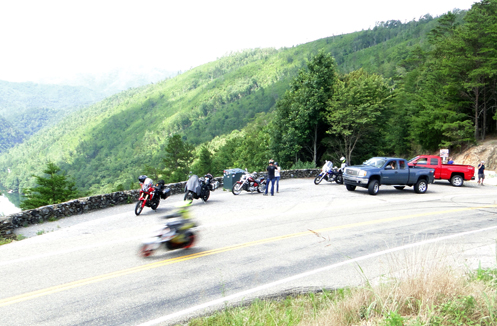
Motorcycle on a curve

Turns can be fun–or they can scare you silly.

I’ll knock on wood and say that I’ve never gone down on my motorcycle except in the mildest circumstances possible. That includes a 2 mph tip-over in mud and wiping out on gravel at about 5 mph when a dog walked out in front of me from between two cars. But that doesn’t mean I haven’t come close a few times. And there were plenty of other times when in truth I probably wasn’t all that close to disaster but managed to scare myself pretty badly just the same.

I’m happy to be able to say that most of these incidents were a good many years ago, when I was nowhere near as experienced or as good a rider as I am now. That fact testifies to the folly of someone thinking they can get on a motorcycle and ride it just fine without any sort of formal training. Like me. Managing to not go down and being a good rider are not at all the same thing. I’m a good rider today because I have by now had a great deal of experience AND I have taken the Motorcycle Safety Foundation’s Beginning Rider Course (twice) and their Experienced Rider Course. Plus a couple other classes.

Almost without exception, the situations where I’ve been scared have been when I’ve been in a turn and either found myself going too fast or seen loose gravel on the road. You know as well as I do that there is nothing that will get your adrenaline pumping more than being leaned over in a turn and feeling that rear tire let go when it hits gravel or a patch of water. At that point there’s nothing you can do but ride through it and count on your tire to hook up again once you’ve cleared the hazard. Fortunately, that’s usually what happens.

Get a Grip

Going too fast is different. Most importantly, you can learn better riding skills that will help you avoid the situation in the first place or how to cope with it if you failed to avoid it.

The crucial factor in a sharp curve is traction. Leaning and braking both consume traction. If you’re going straight down the road at 90 degrees vertical you have maximum braking traction. Leaning into a curve it can be very dangerous to use the brakes because the farther you’re leaning the less traction you have left to brake with. Thus, the best way to enter a curve is to do your braking coming into the curve, before you initiate your lean.

Rider coaches will tell you not to touch your brake while in a curve, except very, very gently as a last resort. I have actually violated this rule from the very beginning because I didn’t understand the physics of it. Suffice it to say that I’ve gotten away with it because I’ve always been very gentle on the brake, but I’ve known instinctively that it was a risk and there were a lot of times when I was very scared. Now that I’ve learned more I do this a lot less, but I’m actually fairly confident in my ability to do it because I’ve been doing it successfully for so long.

The other factor in finding yourself too fast in a curve is taking a huge leap of faith and trusting in the bike, and that’s a mighty scary thing to do, too. The fact is, motorcycles and motorcycle tires are very good these days, and they have abilities that exceed those of most riders. That is, you can safely lean most bikes over farther than the rider has the courage to lean.

When it’s a do or die situation, though, you’re going to be a whole lot better off scaring yourself silly by leaning even further, than if you don’t try it and just accept that you’re going to crash. It’s hard to find that courage but seriously, what’s the worst that can happen if the only other alternative is crashing for sure? I make a point sometimes of leaning way off the bike, keeping it as upright as possible, even on easy turns. I figure I want it to be muscle memory coming into play if I ever desperately need to make that move.

In the end, I think what has saved me all these times was fear. I have been more afraid of crashing than I have been of pushing beyond my comfort zone. But fear is no fun, so I’ve worked to become a better rider and these days I just don’t find myself in these situations much anymore. It makes for a much more pleasant ride.

Biker Quote for Today

200mph, no hands. Damn that’d be cool… right up to the part where you die.

Starting Big

March 23rd, 2017
Ken and CB750

I still have that bike, and I still have that jacket. I don’t still have all that hair.

Big, 800-pound bagger motorcycles are very popular, at least in the U.S., but there’s one place you’ll never see them: at the Department of Motor Vehicles on the license testing range.

When you’re getting your motorcycle accreditation you have to pass the written test and also pass a driving test, just like with a car. The driving portion for a bike takes place out in the parking lot, where they set up cones and have you ride through the course demonstrating your competence. On a scooter, or a small bike, such as a 250cc Honda Rebel, it’s easy. For a beginning rider to maneuver their full-size bike around the course, the likelihood of success is minute.

I didn’t know this when I bought my first bike. But I learned.

I had ridden motorcycles whenever I had the opportunity for many years, but it was only once I bought my first bike, a 1980 Honda CB750 Custom, that I got licensed. My friends told me then that it would be good to get a small bike to take the test but I didn’t have any idea where to get that small bike so off I went on my 750.

Now, a 750cc bike is only considered a mid-size bike anymore, though it was a big bike in 1980, and it still weighs about 500 pounds. I suspect the licensing examiner was surprised to see what I rode in on but no matter, let’s go do the test.

The first part of the course demonstrates handling control. You have to weave around cones in a slalom pattern at slow speed. Then there was a right turn, and another right turn, which set you up to come into a much tighter box where you have to do a 180-degree turn.

I did not make it through all the cones and when I came around for the 180 I had not understood the directions properly. I thought the examiner told me to stay outside the lines, when in fact I was supposed to stay inside them. I was successful in staying outside. You then start out from a spot where you accelerate forward and then brake and swerve sharply as if you were avoiding an obstacle. That part was easy.

Of course I failed the test. And I was very surprised when she told me I utterly failed to make the U-turn within the lines. Ooooh. Within! I get it now.

Second Try

Now that I knew what the test consisted of I practiced. I showed up again a few days later, not at all confident I would succeed, but willing to take a shot at it. With no training I instinctively figured out that to weave through the cones I had to use a technique called trail-braking, where you keep the engine revved for stability while working the rear brake to move forward at about walking speed. To my relief, I got through the cones just fine.

Heading into the U-turn I now knew I needed to stay inside the lines and, using trail-braking again, I successfully executed the turn. Coming out of it, however, the lean was too great and the bike laid over on its side. It didn’t actually go all the way down; it ended up resting half-way up on the foot peg. I looked at the examiner and she said she couldn’t help me but if I got the bike back up I could keep going with the test.

I raised the bike and continued and everything else went fine. She passed me. Yahoo!

I have since learned that one of the major benefits of taking a Motorcycle Safety Foundation riding course is that you learn on small bikes and at the end of the course you do the riding portion of the test. If you pass, all you have to do to get your license is go to Motor Vehicle, pass the written portion, and pay your fee. Of course you also get some training in the process, which is a very good thing.

Had I known all this that’s probably what I would have done. I didn’t, though, so now I take pride in being able to say I passed the test on my real, full-sized highway bike. And I love the looks of amazement I get when I say that.

Biker Quote for Today

Myth: You only live once. Fact: You die only once, you live every day.

Examiner Resurrection: Rain On The Motorcycle Trip — Great!

March 20th, 2017
Bikers take a break.

OFMC takes a break.

Sometimes the best thing that can happen to a motorcycle trip is a rain storm.

The OFMC is off on its annual summer trip and today we rode out of Meeker, CO, on our way to Kamas, UT. Yesterday was blazing hot and today it was mercifully overcast. We cruised west on US 40 and the sky was threatening but mostly it was an “Oh my god!” day.

West on US 40 is the standard route through these parts but a little west of Duchesne we headed north on a road we’d never seen before, Utah 208. A 10-mile jog hooked us up to Utah 35, which took us up over Wolf Creek Pass and down, ultimately, to Kamas. This is not the famous Wolf Creek Pass that runs from South Fork to Pagosa Springs in Colorado, but it’s an amazingly beautiful pass just the same. And the secret is that it has not been paved for all that long, so it’s almost unknown. I wish I had pictures to show you but when you’re traveling with eight other guys they don’t take to stopping every half mile or so so you can shoot a picture.

But I’m not here to talk about the pass anyway. It’s Utah 208 that I have in mind.

map of road in Utah

We turned north off US 40 after dodging rain for hours. Every time it looked like we were headed straight for some big storm cloud it just slipped on by us. But we turned north on Utah 208 and there was the biggest, stormiest cloud in the sky directly in front of us. Shall we stop now and put on rain gear?

The guys in the lead didn’t stop so on we cruised. And the sky got blacker, and the blackness drew nearer. A pull-off came into view and the turn signals came on. Time for rain suits.

The funny thing is, this is Utah, where, as in Colorado, single clouds move across the sky dumping buckets of rain on everything below and leaving the rest of the world completely dry. By the time two-thirds of us had our rain pants on, one of the guys who didn’t announced that “I don’t think we’re going to need rain gear.” We looked and this black cloud had already moved substantially to the east and the area we were heading for was not looking all that bad.

“Let’s just sit here a while and we won’t need to suit up at all.”

We looked around. We were in a beautiful spot on a road where there were almost zero cars going either direction. And just then a cloud came over so were weren’t even roasting in the sun as we had been when we stopped. We broke out some cold beer and kicked back.

This turned out to be one of the best stops of the day. We stayed there for probably 45 minutes just relaxing, stretching, and enjoying the solitude and beauty. And we don’t make any apologies for the beer, either. We each had one 12-oz can and, as I said, we were there for 45 minutes. It was just one of those spontaneous moments that make trips such as this a joy. Friends out in some gorgeous country, on our bikes, taking it easy . . . it doesn’t get any better than this.

And we never would have stopped if it hadn’t been for the rain. As it was, when we pulled out we missed the cloud entirely and we continued up over Wolf Creek Pass and were just awed by the beauty. I love my motorcycle. It makes moments like this possible.

Biker Quote for Today

“Damn, buying that motorcycle was a bad investment.” Said no one ever.

Examiner Resurrection: Motorcycle Rides Retracing Vanished Highways

March 16th, 2017

Riding your motorcycle on old Route 66 from coast to coast. Retracing the route of the old Victory Highway. Nostalgia has never been more in vogue than it is right now for bikers exploring this country’s vanishing old highways.

Indian motorcycle

An Indian motorcycle at the Rocky Mountain Motorcycle Museum.

The problem with many of these higher profile rides, such as Route 66, is that to do them end to end you need a lot more time than most people have. But hey, everyone’s doing Route 66 these days, in whole or in part. Why follow the crowds?

The fact of the matter is, before everything got all depersonalized with route numbers, highways had names. And there were a lot of highways, some that you may be familiar with and many that you’ve probably never heard of.

For instance, growing up in Lincoln, NE, I was well acquainted with Cornhusker Highway. Not because it was a clearly defined highway that started somewhere and ended somewhere else, but just because it was the name of a particular road.

Likewise, living in and around St. Louis I was familiar with Kingshighway. Was there a story behind that name? You bet. Did I know a thing about it? No way.

But now we have the Internet. And one of the greatest things about the Internet is that many, many people put a lot of time and effort into putting up a wealth of information about whatever is of interest to them.

It’s not surprising, then, that someone has put up a site with details about old highways all over the country. Dave Schul has built a North American Auto Trails site where you can learn about more highways than you probably knew existed. Interested in the Black and Yellow Trail? This road runs between Chicago and Yellowstone National Park. The site doesn’t have a lot of information about it but it shows the towns that it passed through and gives links to sites where you can learn more. It’s a starting point for your own exploration.

How about the Detroit Lincoln Denver Highway? Just as the name suggests, this old road ran from Detroit to Denver, passing through Lincoln.

And then there’s my old acquaintance, the Cornhusker Highway. Turns out this road ran from Sioux City to Oklahoma City. I never knew that. It was always just that road up on the north side of town.

Then there were the smaller highways, confined to just one or two states. For example, the Mayo Trail was a route that just ran between Ashland and Jenkins, KY. Is it still there? What does it look like today? Are there any surviving road signs or monuments along the route? This stuff can be very cool to investigate and explore, and it can add an interesting element to your rides.

There are a lot of other, related sites out there. I ran across one focusing solely on the old highways in Colorado, which I definitely plan to explore. In fact, I spent three days last week out doing exactly that. Now I’ve ridden parts of old US 6 that probably don’t see 10 vehicles a week.

Try it. You just might get addicted.

(Note: Dave Schul’s site does not appear to be there anymore. Fortunately, all these pages are preserved–for now–by “The Wayback Machine,” which is an internet archive.)

Biker Quote for Today

I ride so I don’t choke people.

Ride To Eat, Eat To Ride

March 13th, 2017
motorcycles and fast food

The OFMC at a lunch stop.

Because, on a motorcycle, the journey is the destination, it’s common practice to look for whatever excuse you can find to ride. Happily, food can be that excuse. There aren’t many things better than an eatery with terrific food that also happens to entail a terrific ride getting to it. For many bikers, eating fast food on the bike is a blasphemy; excellent food is as important an element of the ride as the bike.

Admittedly, the OFMC is not hard core on this the way a lot of riders are. When we’re out on our summer trips we can generally expect to eat at McDonald’s at least once, despite the protests of a minority. On the other hand, we’ve had some extraordinary meals as well.

In the early days of the OFMC we rolled into Laughlin, NV, for a two-day stay. Not wishing to pay the price for the casino hotels, we crossed the river to the Arizona side and found an inexpensive motel. But of course the action was on the Nevada side, so we rode back and forth on the river taxis that shuttle people up and down the shoreline and across the Colorado River.

Come time for dinner that first night and we hit the restaurant in whatever casino we were in, and being a casino, the prices were outrageously cheap. We ordered the $3 prime rib and were absolutely blown away by the best prime rib any of us has ever eaten. That was such a high point it has officially become an OFMC legend.

The Local Specialty

On another trip we were in Utah cruising up past Bear Lake, which straddles the border between Utah and Idaho. The primary town in the area is Garden City, where a couple highways come together. It turns out that this place is renowned for its blackberry milkshakes. When in Rome . . .

It seemed pretty low-key that first time, no huge crowds or anything, but we’ve been back several times. What a change the next time. Garden City was packed with tourists of all kinds but especially the two-wheeled variety. Whole groups of bikers had run up from Salt Lake City or Logan or Ogden, with the objective being to have a great ride with a special treat at the end. Standing in line at one of the numerous spots selling the shakes we watched a constant parade of motorcycles rumbling up and down the strip, like a mini-Daytona.

Then there’s Jerome, AZ, which we discovered on one trip and came back to for a visit years later. This old mining town, built perilously clinging to the steep side of a mountain, was practically a ghost town when we first passed through but has since become an artist’s colony and gone very upscale. And it was here that we found a stunningly good French restaurant.

We had broken into groups to find dinner, but found there wasn’t much open, so we all ended up in the one place that was. I can’t remember details but I do recall raviolis with cheese sauces, pizzas like you’ve never seen before, and all of it out of this world. Some of the guys swore they had never had a better meal in their lives. A couple of the guys have since taken their wives back there; it was that good.

Sometimes it’s the Setting

Fancy food aside, under the right conditions, and prepared in the right way, even the most mundane meal can be a stand-out. This was the case one year at Lake Powell.

We had headed out of Blanding, UT, for the south shore of the lake, where we would take the ferry over to Bullfrog. The plan was to camp for the night and cross in the morning so we wisely decided to buy food in Blanding. Nothing special, just hot dogs and buns and maybe a can of beans.

What we hadn’t counted on was the total lack of fuel for a fire. This is desert country and it’s not like you can gather fallen limbs to burn. And we don’t exactly carry Coleman stoves on the bikes. We could eat the beans cold but we really wanted to cook the dogs. Scrounging around, we gathered some dried grasses and bits of sagebrush and managed to build the world’s smallest campfire. One by one, holding the hotdogs in our fingers and passing them patiently back and forth across the tiny flame we did cook them.

Now, any food tastes better when you’re hungry, but I’m guessing that in this case the bits of sage we burned played a role, too. One way or another, they were without question the best-tasting hot dogs we had ever eaten. And another OFMC legend was born.

“It’s all about the stories” is a common phrase among motorcyclists. Sometimes the stories are about the food, not the bikes.

Biker Quote for Today

Biker born, biker bred, when I die I’ll be biker dead.