Fear Of Flying (And Falling)

January 14th, 2019
motorcycle on gravel road

Riding on gravel took me a while to get used to.

Motorcycles are inherently more unstable than cars. When a car comes to a stop it stops. Period. When a motorcycle comes to a stop you’d better put your foot down or you’re going to fall over. Something about two wheels versus four, you know?

Now magnify the instability by adding a curve in the rider’s trajectory. Motorcycles lean in order to go around curves, so you’re already cocked to one side. And then add gravel in the curve. There’s nothing quite as thrilling as feeling your rear tire break loose in gravel on a curve, and this is not the good kind of thrill such as what you get on a roller coaster.

Give credit to the people who design motorcycles and motorcycle tires that losing traction on gravel, or ice, or wet leaves doesn’t automatically mean you go down. All it takes is to hit a wee patch of pavement again and you’re back in control. You’ll probably want to take it easy for a while, though, and let your adrenaline subside.

Motorcyclists generally fall into two categories, those who learned to ride on dirt and those who didn’t. It’s a huge difference. Dirt riding is all about breaking traction, riding the slide, and keeping the bike up. Those who never rode in dirt are at a significant disadvantage.

I never rode in dirt. While I had the opportunity to ride several bikes from time to time over a lot of years, I never got good at it until I bought my first bike, my 1980 Honda CB750 Custom. I learned to ride on the road and gravel was a particular nemesis. I hated gravel roads and gravel in a curve scared the bejeezus out of me.

The very first trip Bill and John and I took, before we even named our group the OFMC, we camped one night at Rifle Gap State Park, outside of Rifle, CO. It was probably 8 to 10 miles from the campground to town and we needed to ride in to have dinner. I had noticed when we first rode out to the park that there was a lot of gravel in some of the curves so I was already in high-caution mode. Heading into town the other guys left me way behind and I picked my way carefully along. Heading back to camp after dinner it was now dark, and thus even harder to pick out the hazards. They were back at camp long before I got there.

The difference, of course, was that they had had scooters and dirt bikes as kids.

“Didn’t you slide on some of that gravel in the curves?”

“Oh sure, but when you ride dirt bikes you learn how to stay in control.”

It took me a long time to get comfortable riding my street bikes on gravel roads, but I do it pretty well now. (Except for the Concours, which HATES gravel.) I still hate gravel in a curve. But I’ve been on the dirt more since I got my V-Strom. Maybe someday I’ll feel that rear wheel slide out and smile. But I’m not holding my breath.

Biker Quote for Today

I’m not the biggest motorcycle fan – they’re cool and a lot of fun, but they’re scary as well! — Taylor Lautner

Motorcycle Mileage For 2018

January 10th, 2019
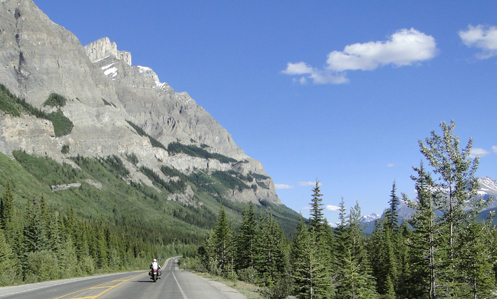
motorcycle near Banff

Getting to here requires racking up some miles on the bike.

Once again last year my motorcycle mileage totally kicked the butt of my car mileage. I only drove my car 2,928 miles, while I put 7,230 miles on my three bikes. Heck, I put more miles on the Concours in one trip than I did on the car the whole year. In comparison, I put 5,043 miles on the bikes in 2017 and 3,004 on the car.

The lowest mileage–as usual–was on the Honda. That was just 469 miles, compared to 713 the year before. Every year I promise myself I will ride the Honda more and every year I prove myself a liar. Maybe this time at least I can claim that, “Oh, I would have ridden the Honda more if I weren’t off the bikes for two months due to heart surgery.” And that’s certainly true because minus the surgery I would have ridden the Honda in both those months at least a few miles. But that’s still not much of an excuse.

The V-Strom got quite a bit more riding. We went 2,425 miles together and that compares very favorably to the year before when we only went 1,588 miles.

The big boy, also as usual, was the Connie. I put 4,336 miles on that bike; the 2017 total was only 2,742. So once again, that one trip to British Columbia put more miles on this bike than it got all of the previous year.

In other words, if you really want to put some miles on your bike it pays big time to go somewhere–somewhere far away.

So what’s on the agenda for 2019? Of course the OFMC ride will happen, and that looks to be about 2,300 miles. And once again we’re hoping to join members of the Rocky Mountain Motorcycle Riders Club on one of their long trips, but that will all be determined by timing and conflicts.

And I’m not planning to be off the bikes for two months due to surgery. Of course I wasn’t planning that last year either but it happened. On the other hand, if I hadn’t had that surgery I might easily not be alive this year to do any riding at all.

Beyond all this we’ll just have to see. I do have an idea, however, that I might get out on at least a couple longer solo rides. You see, Judy is very preoccupied at this point and for the forseeable future playing grandma to her new–and first!–grandchild. There may just be times when I tell her I’m figuring to head out for a few days. I don’t want to leave her behind if she’s interested in going but if it’s a choice between Jack and a ride, I’m figuring she’ll choose Jack. Or I could be wrong; we’ll see.

Biker Quote for Today

Time on a motorcycle is unlike time spent anywhere else. There are moments lost in the landscape, seconds devoted solely to balance, and long stretches spent spiraling inward. — Barbara Schoichet

First Ride Of 2019

January 7th, 2019
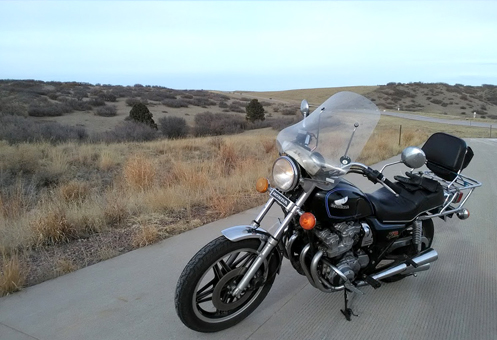
parked motorcycle

The Honda alongside Hess Road.

It wasn’t the first warm day in January but it was the first day when all the ice and snow were melted off our street so I could get out of the neighborhood on a motorcycle. I didn’t need a written invitation. I chose the Honda.

As is so often the case, I had no idea where I was going. I headed south and east but when I got to the road over Cherry Creek Dam my instincts rebelled. No! I go over the dam much too often! So I turned south on Dayton, alongside Cherry Creek High School.

At Belleview I turned east toward the park, and then south on Peoria down to Arapahoe. This is common ground, though usually in the other direction. So I continued south until Peoria became Broncos Parkway, then south on Potomac along the east side of Arapahoe County Airport, west on a disconnected section of County Line Road, then south again on Peoria to Lincoln Avenue.

Peoria then continues south across Lincoln Avenue, winds through a neighborhood, and comes out finally at Ridge Gate Parkway. Ridge Gate is quickly becoming a major road but it can’t be much more than two years ago that it was dirt. It runs from I-25 over to Parker. I headed east, in the direction of that once little town.

I was in explorer mode so when I came to a new housing development, called Stepping Stone, I turned south on Stepping Stone Circle and sure enough, it wound through the development but came back up to Ridge Gate. That’s fine, I was curious. Plus from that street I spied some other major road just a bit further east.

Ridge Gate, which was now Parker’s Main Street, took me quickly to what turned out to be Chambers, so again I turned south. At this point I could see the enormous earthen ridge of Rueter-Hess Reservoir so when I came to another new development, Heirloom, I figured it was likely that Heirloom Parkway would hook me up with Hess Road. It did, and I turned west on Hess.

Hess goes south and west until it hits I-25 at Castle Pines Parkway. I crossed the highway and continued west on the parkway but I knew it would take me to Daniels Park and I didn’t want to go there. I knew there was some road going north before the park if I could find it.

That turned out to be Monarch Boulevard and I headed north. Getting into the McArthur Ranch area the road becomes Quebec and I followed it all the way across C-470 and on up to Belleview, east on Belleview, and back home.

It was only about 38 miles and one hour’s riding but oh what a nice day to be out on a bike! The morning had been clear and warmer but I was busy, so once I was ready to ride it was clouding over and getting cooler. Nevertheless, my electric vest was all the extra warmth I needed and it was just delightful to be out.

Now I have two more bikes to ride in January but the weather is looking good all of the next week. I think I’ll get it done.

Biker Quote for Today

They say life is a highway and we all travel our own roads, some good, some bad, yet each is a blessing of its own. — Jess “Chief” Brynjulson

Examiner Resurrection: Fly And Be Groped, Or Ride And Have Fun: Your Choice

January 3rd, 2019
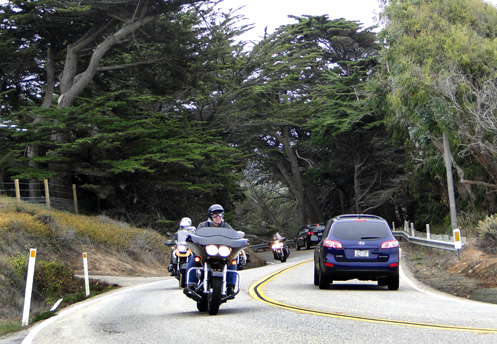
motorcycles on highway 1

A day on that California trip.

I knew things had gone too far when my 86-year-old mother told me she won’t be flying any more if it means they’re going to pat her down all over, as in everywhere. Which, of course, is exactly what they did to me when I flew home from California a few weeks ago. Using profiling to decide who to search may not be the best idea, but can’t we at least agree that there are some people who we can reverse-profile out of being searched?

So what does this have to do with motorcycles? It’s all about transportation choices. I want to say right up front that I owe the idea for this piece in part to Bruce Arnold, who runs http://www.ldrlongdistancerider.com/, and his recent post, Motorcycle Touring Mathematics 102: X-Raying Your Junk vs. X-Treme Riding Pleasure. In this post, Bruce compares the example of flying from Miami to Atlanta to riding there on a motorcycle. He looks at time, cost, and dignity. By his calculations, riding would take about 3 hours longer but cost a little less. He goes on:

The trade-offs to consider, however, go beyond time and money. Given the choice, for instance, how would you rather spend an entire day: Subjecting yourself to the pains of being processed, inspected, stamped and transported like so much meat? Or enjoying the pleasures of the wind in your face, a thundering engine beneath you, and the open road ahead of you? And what about privacy and practicality? Would you rather pack what you really wanted and needed to take with you, or worry about whether your shaving cream, pocket knife or party favors will make it through security? And last but not least, just how much individual freedom and personal dignity are you willing to sacrifice in return for a questionable promise of protection from some ethereal “terrorist threat” that may or may not exist?

On that recent trip to California that I mentioned my first intention was to ride out there. Time was not an issue. This is what I do for a living. I don’t have to take time off to ride my motorcycle, it’s my job. And riding to Southern California would be a great road trip. Why would I not ride?

Well, the answer, as it turned out, was money. I was able to get tickets from Denver to LA and from Oakland to Denver for such incredibly low fares that it was the only logical thing to do. I would have spent more on gas than I did for plane fare, and that doesn’t even include motels for three nights out and three nights back. So I flew and I got groped. And make no mistake about it, the security folks will deny it, but if you fly one-way rather than round-trip you will always get pulled aside for extra screening.

I couldn’t agree more on the idea of riding as your first choice, though I’m also well aware, as is Bruce, of the factors that time, distance, and weather often play in determining whether this option is really an option. Those caveats acknowledged, Bruce’s math does makes sense when riding is a possibility, and more and more people are figuring this out. Even some people opting for cars instead of motorcycles. As security increases and the time you waste in airports increases, the numbers will only favor ground transportation even more.

Hey, here’s a thought: Let’s build some high-speed passenger railroads. Then while most other folks are blasting across the country at near-warp speed, I’ll be putting down the highway on my motorcycle. Maybe you’d like to join me from time to time.

Biker Quote for Today

And I to my motorcycle Parked like the soul of the junkyard Restored, a bicycle fleshed With power, and tore off Up Highway 106 continually Drunk on the wind in my mouth Wringing the handlebar for speed Wild to be wreckage forever. — James Dickey

Examiner Resurrection: Decoding the Harley mystique

December 31st, 2018

OK, I admit, I’m just like you, I’m really busy this holiday season and I’m not averse to taking the easy way out: I’m putting up some Examiner Resurrection pieces. We’re going back here to 2010, but this is still relevant.
Harley-Davidson motorcycle

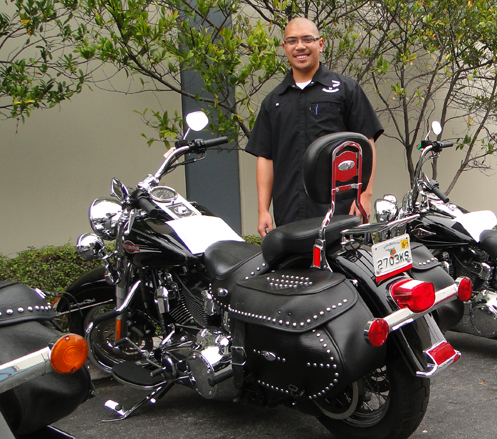
The Harley I rode.

I spent four days on a Harley-Davidson Heritage Softail recently, hoping to understand at last the reasons why so many people are so fanatically devoted to the brand. I recapped my thoughts the first couple days out but now I’m ready to speak about my total experience and the conclusions I’ve reached.

Hint: I’m not converted, but I think I understand more now.

Ease of riding
The No. 1 understanding I came to on the Harley is that this bike is just incredibly easy to ride. Let’s compare it to my primary bike, my 1999 Kawasaki Concours.

The Concours is a tall bike to begin with, and with my 30-inch inseam it took some getting used to. The Softail has a much lower seat height, making it very easy for me to plant my feet widely and firmly on the ground at a stop. The Connie also has a 7.5-gallon gas tank that sits way up high, making for a very high center of gravity. Center of gravity on the Softail is very low, which makes the handling much more stable at low speeds. I never once came anywhere close to dropping it, whereas I have dropped the Kawi a couple times.

The power delivery on the Softail is very different from what I’m accustomed to so that took some getting used to. My Kawi has a high-revving engine and it has a ton of power. It’s very fast and the gearing is such that you don’t have to shift constantly in situations where you’re frequently speeding up and slowing down. My first impression of the Softail was that I all too frequently needed to downshift from the upper gears. To a certain extent I think that is true, but what I found with experience is that mostly that’s just the low-rev, loping v-twin and it would go along fine at the slower speed but then pick right back up with the twist of the throttle.

The bottom line here is that, while it probably took me two years to become totally comfortable on my Concours, I was right at home on the Softail within an hour or two. Now, having gotten comfortable on the Connie, I’m extremely comfortable on it and like it very much. And with longer legs it wouldn’t have taken that long. But I don’t think most people are willing to be that patient, so I can see the attraction of the Harley.

Riding comfort
Having a broad, well-padded seat was a real joy for me on that Softail. My other bike, my 1980 Honda CB750 Custom, has a reasonably comfortable seat but after doing a ride to California and back on a trip that included numerous long-mileage days, I swore never to do that again. I went out and bought my Concours. The Connie is a much better touring bike but even its seat gets hard after awhile. The seat on the Softail was a huge improvement.

Another thing I liked was the floorboards. With the floorboards I could shift my foot position a little or a lot, and even stretch my legs out completely straight. The key here is the knees. None of my buddies likes trading bikes with me and I think that has a lot to do with their aging knees. I suspect that sitting with your knees always bent as you must when your pegs are below you is just not something that works for them any more.

I, on the other hand, prefer to have my pegs beneath me because I want to stand up when I go over a bump and let my legs absorb the shock. The first big bump I hit on the Softail threw me way up off the seat and back down hard. I did find, though, that with my feet on the back edges of the floorboards, and a good grip on the handgrips, I could raise myself off the seat for bumps and minimize the impact. I still prefer pegs below me, however, and my knees are still limber enough that I can ride that way comfortably. Besides, highway pegs allow you to stretch your legs out, too. That said, I do, again, see the attraction of the Harley for a lot of folks.

While the Softail’s seat was comfortable, and you can get custom seats with better lumbar support, I strongly prefer the riding position on my Connie. Stock, the Connie had an intolerable reach to the grips, so the very first thing I did when I bought it was install risers that brought the grips back and up three inches. That made all the difference in the world. Now I have just a slight forward reach that keeps me in an erect, upright position, which is a good posture for your back. Having the pegs underneath you also helps foster that good posture.

The Softail, on the other hand, encouraged me to slouch. And after four days I could tell. My back was hurting.

Details
One negative aspect of the Softail’s low profile is the potential for contact with hot exhaust pipes. I discovered this one rainy day when I noticed black marks on the pipes. Then I noticed a spot on my black rain pants that was clearly melted a bit. Apparently you have to be careful at a stop to set your right foot down away from the bike so as to avoid this sort of thing. I also apparently let the heel of my boot touch the pipes while riding with my feet back on the floorboards, and that got melted, too.

This has never been an issue with my Honda or my Kawasaki. Sitting up higher as they do, there is room for the pipes to go beneath the pegs, and I’ve never touched those pipes with anything.

Ground clearance is another issue. Riding the bikes I’ve owned, I had never scraped hard parts until just recently when I took a Harley Sportster for a demo ride. Both my bikes are shaped live a V when you view them from in front or behind, and you’d need to lean a long way over to touch anything on the ground. Not so with the Softail. Swooping through curves on the New Priest Grade Road I scraped the floorboards and I wasn’t even leaning all that far. I’m not saying that’s a problem, but it’s definitely a difference.

I liked the very clearly defined shifting on the Softail. It gave a loud thunk dropping into the next gear, so it was always clear whether you had or had not flicked that shift lever far enough. There have been times on my bikes, particularly between first and second, where I didn’t make it all the way into gear and didn’t realize it until I let the clutch out and twisted the throttle.

I wasn’t impressed with the Softail’s brakes. I’m generally heavy on the front brake and only use the rear brake when I need extra stopping power. With the Softail I had to use the rear brake almost as much as the front. The front just didn’t do the job. Surely Harley can do better than that.

It took some adjustment for me to look to the gas tank for the instrument cluster. And I didn’t like having to take my eyes off the road to do so. Both my bikes have the instruments up on top of the fork where I can still watch the road while checking the dials and gauges.

The Softail surprised me with how smooth it was. I’ve seen plenty of Harleys that, at idle, shake like a paint mixer but that was not the case here. I definitely prefer smooth. Also surprisingly, it was a bit rougher at highway speed.

Lastly, I liked the idea that the bike won’t start without the key fob in close proximity, so with our frequent stops I wasn’t constantly inserting and removing the key. I’d use the key in the morning, then all day long I’d just turn the bike off and walk away. Coming back to it I’d just turn the switch and push the Start button. Then use the key for complete shut-down at night.

Harley or cruiser?
While these riding impressions all have to do with the Softail I was on, I suspect most are applicable to any dressed out cruiser. In other words, I’m not certain whether I’ve gained a better understanding of the Harley mystique or simply a better understanding of the cruiser mystique.

Of course one thing many Harley owners point to with pride is the fact that their bikes are “American iron.” That’s as opposed to, say, Star’s Royal Star Venture, which is made in Japan, I presume. I’ll point out, however, that Kawasaki operates a plant in Lincoln, NE, which until recently produced motorcycles. I may be wrong but I believe that’s where my Concours was made, so how much more American-made is a Road King with Kiehin carbs and Brembo brakes than my Connie?

So no, I’m not converted, but at least I don’t find it such a mystery. The Softail is a comfortable bike that is easy to ride and feel at home on. Presumably that’s true for the whole Harley line-up, with the possible exception of the V-Rod. I think especially for aging riders, and there are a lot of those out there, cruisers are absolutely the way to go. Maybe that will even include me one day. But not yet.

Biker Quote for Today

Motorcycle adventures are the perfect antidote to middle age. — Alex Morritt
The Rubber Meets The Road

December 27th, 2018
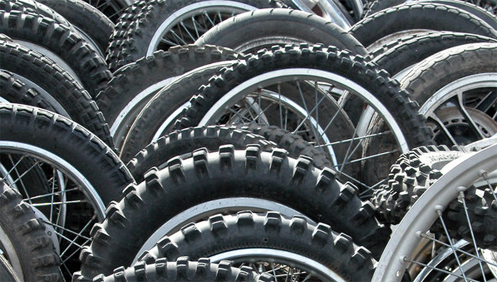
piles of tires and wheels

Tires are pretty important, do ya think?

Have you ever watched the tread melt off your tire? I have. Not literally turning to liquid and dripping off, but being worn off in a matter of hours.

What you need to understand is that motorcycle tires are an entirely different critter than car tires. With car tires you have a broad, almost flat tread that the car rides on top off all the time. Motorcycle tires have a round profile because when you turn, you are leaning the bike. The round profile ensures that you always have tread in solid contact with the ground.

With only two tires, and those having very small contact areas, it is extremely important that you have good grip. Car tires have a hard rubber tread that will last 35,000 miles and more. In order to get a good grip, motorcycle tires use a very soft rubber. And guess what? That soft rubber wears away a whole lot quicker than hard rubber, generally not lasting much more than 10,000 miles.

Then there’s the effect of air pressure in the tires. It’s common knowledge that under-inflated tires wear out quicker, on cars as well as bikes. And while under-inflation can ruin a set of car tires in just a few thousand miles, that’s nothing compared to the soft rubber on motorcycle tires.

Which gets me back to my story.

In the early days of the OFMC, John and Bill and I went one year to the North Rim of the Grand Canyon. While there I noticed that I was getting a bit thin on tread and mentioned it to the guys, who looked and agreed I would be needing new tires pretty soon after we got back home.

We only rode on to Page, AZ, the next day, which is about 100 miles. While unloading the bike I happened to glance at my rear tire and I was shocked. What little tread it had just a few hours ago was almost completely gone! I called Bill and John over and they gasped in amazement. Somebody had a tire gauge and when I checked my air pressure it was very, very low.

Of course I put air in, and it’s no surprise I was nervous the rest of the trip about the possibility of a blow-out. Realistically, I should have had a new tire put on right there in Page, but ever the optimist and a cheapskate to boot, I didn’t. And it did get me home safely.

But I tell you what, these days I have it on my calendar to check tire pressure on both my bikes and my car at the first of every month. And if I’m getting set to go on a trip I check the pressure before I leave.

This is really all just common sense, but it’s so easy sometimes to ignore common sense. It is far, far harder to ignore your own eyes when you see the tread vanish from a tire that quickly. We all learned a good lesson that day.

Biker Quote for Today

If you think it’s too dangerous, go home and cut your lawn, and leave us to it. — Guy Martin