Time For Some Biker Humor

May 7th, 2020
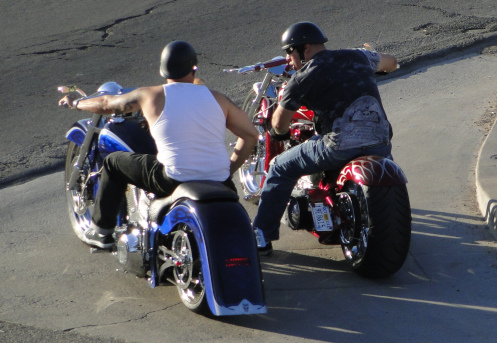
bikers with fat rear tires

Do you suppose these guys are swapping jokes?

Before I get started, here is a humorous note. I decided I would search the web and come up with some biker jokes. I looked at a lot of sites and copied a bunch that I liked. Then I came across a link to my own blog–this blog. It was from 2008 and it was a post with biker jokes. Well, I clicked through and there in that 2008 post were three of the very same jokes I had copied and intended to use today. Doh!

OK, time for some humor.

How can you tell when a Gold Wing rider is having an affair? His helmet doesn’t match the passenger’s.

Q: How is a Harley Davidson like an old dog?
A: They both like to ride in the back of pickup trucks.

Q: What is the difference between a Harley Davidson and an old dog?
A: The dog can get in the back of the pickup by itself.

What do you get when you cross a donkey with a motorcycle? A Yam-Hee-Haw.

A ten year old boy was walking down the street when a big man on a black motorcycle pulls up beside him and asks, “Hey kid, wanna go for a ride?”
“No!” said the boy, and he kept walking.
The motorcyclist pulls up to him again and says “Hey kid, I’ll give you $10 if you hop on the back.”
“No!” said the boy and he proceeded down the street a little quicker.
The motorcyclist pulls up to the boy again and says, “OK kid, I’ll give you $20 and a big bag of candy if you hop on the back for a ride.”
At this point, the boy turns around to him and screams angrily, “Look Dad, YOU bought the Honda, so YOU ride it!”

A biker is riding along a country lane, when a sparrow flies up in front of him. The biker can’t do anything and hits the sparrow. As he looks
in his rear view mirror, he sees the sparrow lying in the road. Being the kind of guy he is, he stops, picks up the sparrow and takes it home and
puts it in a cage, still in a coma. When the sparrow wakes up the following morning, he looks through the bars of the cage and says, “Dang! I must have killed the biker.”

Q: What is a Harley Davidson rider’s favorite type of wood?
A: MaHOGany

This big ugly biker walks into the bar with a parrot on his shoulder, orders a beer and a shot. The bartender sets him up and says, “That’s really cool, where did you get him?”
“Sturgis.” Replied the parrot, “They’re all over the friggin’ place!”

And here, for the last one, is one I especially like.

Badass Biker Bob wakes up at home with a huge hangover. He forces himself to open his eyes, and the first thing he sees is a couple of aspirins and a glass of water on the side table.
He sits up and sees his clothing in front of him, all clean and pressed. Bob looks around the room and sees that it is in perfect order, spotless, clean. So is the rest of the house.
He takes the aspirins and notices a note on the table: “Honey, breakfast is on the stove, I left early to go shopping. Love you.”
So he goes to the kitchen, and sure enough there is a hot breakfast and the morning newspaper. His son is also at the table, eating.
Bob asks, “Son, what happened last night?”
His son says, “Well, you came home after 3 A.M., drunk and delirious, broke some furniture, puked in the hallway, and gave yourself a black eye when you stumbled into the door.”
Confused, Badass Bob asks, “So, why is everything in order and so clean, and breakfast is on the table waiting for me?”
His son replies, “Oh, that! Mom dragged you to the bedroom, and when she tried to take your pants off, you said, “Lady, leave me alone, I’m married!”

Biker Quote for Today

I love my motorcycle — it’s great for getting to the front of queues quicker. It does always terrify the other people in the post office though.
Motorcycle Sign Language

May 4th, 2020
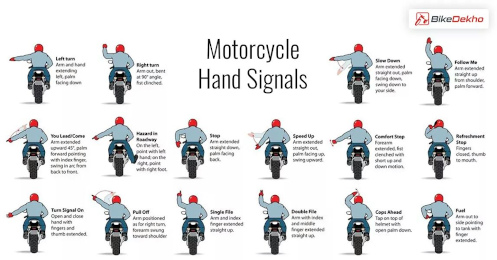
hand signal chart

Just search for “motorcycle hand signals” and you’ll find plenty of them.

I got a comment from Mark in regard to my most recent post, wherein I mentioned a rider going the other way tapping the top of his helmet to warn me of a radar trap up ahead. He asked if there were other signals that are used to communicate while riding. I had written about hand signals in a post back in 2008 and I referred him to that post. But that got me to thinking about how it can be good to cycle back to certain topics from time to time because there are always new people coming into motorcycling, as well as readers who didn’t see what I wrote 12 years ago. Just because you wrote about something 12 years ago doesn’t mean you should never mention it again.

On the other hand, I don’t want to just repeat myself. So I figured I would do a Google search for “motorcycle hand signals” and see what showed up. Turns out there are a lot but also not so many. Which is to say, there seems to be one basic chart that you see with many different organizations’ logos slapped on them. That would be one in the image above. I know you can’t read it that small so here’s a link to it.

Here’s a different one, which I linked to in that 2008 post. It’s a gif so it shows motion, which can be useful in understanding just what it is you do.

For the most part, these signals are for things like “start your engines,” “hazard ahead,” and “police ahead.” That’s all well and good, and certainly we should all know and use them. But in some cases there was a little humor injected. In particular, there was this one. Now, I made a decision when I first started this blog not to use language that could be offensive to some people, and this chart is a bit off color. That’s why I’m linking to it, not just dropping it into this post. So you can choose to view it or not.

And here’s another that is similar.

Good for a laugh. But anyway, thanks Mark for giving me a topic for this post. And I also want to mention, any time someone comments on any of my posts, as Mark did, I post a reply. But I’ve never had the blog set up to notify the person I’m replying to that I have replied. Well, I just added such a plug-in. It also works if someone other than me replies to your comment. So hey, comments are always welcome.

Biker Quote for Today

Why bikes are better than women: Motorcycles don’t get jealous if you come home with grease under your fingernails.

Good Or Bad, Riding Is Back

April 30th, 2020
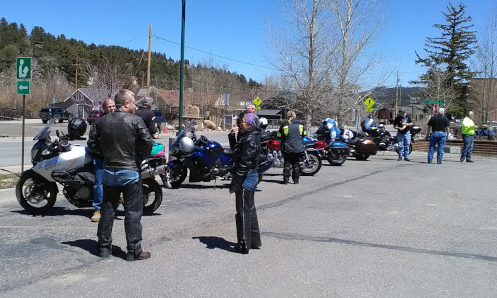
motorcyclists at a stop

Maintaining social distancing at a stop in Nederland.

I’m torn over how to begin this post. I had been figuring on “We saw a lot of motorcycles up on the Peak to Peak Wednesday.” But then it started shifting toward “Holy smokes there were motorcycles everywhere on Wednesday.” Either way, as you can guess, I finally went on another ride with the RMMRC.

I had been persuaded not to ride for a while by the argument that it was selfish and inappropriate to risk injury at a time when emergency resources were overtaxed. But with things opening up a bit now, and no flooding of the emergency rooms, I figured that argument was no longer valid.

Apparently a lot of other people think the same way.

There were 10 of us in Wednesday’s group: five Hondas, two Beemers, a Concours, a V-Strom, and a Spyder. (Surprisingly, we must have seen about 10 other Spyders this day. That’s a lot.)

We headed out US 287 to C-470 to the Golden Gate Park road, up to the Peak to Peak, to CO 7 running down to Lyons. From Lyons the group scattered as each took their preferred way home.

It was a beautiful day to ride. Still a little cool up on the Peak to Peak, especially at higher altitudes, but never cold. The roads were clean with no ice and no sand. All in all: great.

As you can see in the photo above, at a stop in Nederland, we do take the distancing recommendation seriously.

One thing that has emerged as a real issue on these rides is that in so many places the restrooms are closed. We made a stop right where we hit the Peak to Peak and some of us guys used the woods but there were two women on this ride as well and they were kind of SOL. Maybe that will change now. I know the parking lots for the mountain parks we passed were all full of cars so you would think those restrooms ought to be open. Maybe they were; we didn’t try any of those.

So nothing of any note on the ride but on my way home there were two interesting encounters. I came down CO 93 to head east on US 287 and as I headed east I saw a guy on a bike going the other way who tapped the top of his helmet. Oh really, cops up ahead? Sure enough, there was the guy with the radar gun and two squad cars further down, one in wait and the other issuing a ticket. I hadn’t been going all that fast anyway but I was glad to have slowed down a couple mph so as to pass at a legal speed.

Then as I got into the section where 287 is more urban and has traffic signals I was pulling away as the light went green and heard this roar and some guy on a sport bike blasted past me going really fast. I watched him weave in and out of traffic, splitting lanes when he chose to, and he was gone. But then I caught up with him at the next red light. When that light went green he wheelied out and went blasting out of sight and I caught up with him again at the next red light. Maybe he was just having fun but if he thought he was going to get to his destination quicker I’ve got some news for him.

So yeah, riding is back. Maybe I’ll finally use enough gas that I need to fill up, and can take advantage of some of these incredibly low prices. The lowest I saw Wednesday was $1.39.9. Who would have believed that?!

Biker Quote for Today

100 Reasons not to date a motorcyclist: Speeding tickets.

Jury-Rigging

April 27th, 2020
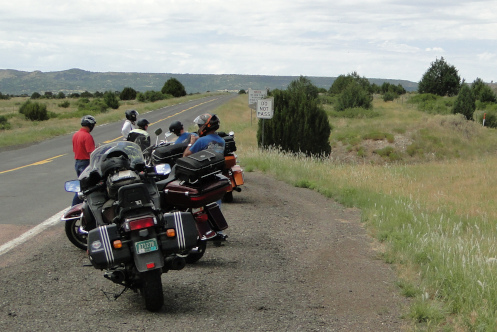
bikers parked by the highway

If you spend time out on the road, something is bound to go wrong sooner or later. Then what?

OK, first let’s address the question, is it jury-rigging or jerry-rigging. We’ve all seen both. A quick search took me to Dictionary.com where I found this bit of clarification:

Jury-rigged means something was assembled quickly with the materials on hand. Jerry-built means it was cheaply or poorly built. Jerry-rigged is a variant of jury-rigged, and it may have been influenced by jerry-built. While some people consider it to be an incorrect version of jury-rigged, it’s widely used, especially in everyday speech.

So I’m going with jury-rigged.

On to topic.

Things go wrong sometimes, don’t they? And when you’re miles from home with no help nearby you just have to figure out how to make things work. Anyone who has done much traveling by motorcycle surely has run into this a time or two.

My first was early on in the life of the OFMC. Bill and John and I were heading for the North Rim of the Grand Canyon and I had taken my bike in for some significant work well in advance of the trip. Long story short, after promising me for weeks that it would be done in time it was not and Bill and John left without me. About three days later I finally had my bike and I took off to meet up with them at the North Rim.

I rode that first day to Durango, where I intended to spend the night with a friend and her husband. I had not gotten far when I discovered that the shop had failed to put one of my highway pegs back on. I really, really like highway pegs and I have them on all three of my bikes. But what could I do?

I mentioned this to the folks in Durango and he went out and got a six-inch length of aluminum tubing and some duct tape and presto, I had a highway peg where before there had been none. Thank you so much Neil. That thing held just fine for the whole trip and believe me, I used it.

A few years after this we were ready to head out and Bill was late. Finally he called (this was before cell phones) to say his bike had died on his way over to John’s house–could we come give him some assistance?

After nearly killing ourselves pushing him up and down this parking lot he finally got the bike started and headed off to his mechanic. He called later to say it was his stator and the bike would not be fixed soon. John and I took off without Bill.

I can’t remember but we must have had some arrangement to stay in touch because in a day or two we got word that Bill would be meeting up with us in Thermopolis. Great. When he showed up he explained to us that he still had no functioning stator but he had a battery charger and a long extension cord and he had removed the fuse powering his lights. The idea was to use as little electricity from the battery as possible all day and then fully charge the battery overnight. That’s what he did and the rest of the trip was uneventful. Needless to say, we didn’t do any night riding.

John was always into jury-rigging something on his bike. Back in the early days, when we all had bare bones bikes, none of us had throttle locks. Nowadays, we all consider throttle locks or cruise control to be essential. And sure, these things were available but they cost money and we were all pretty poor.

So John got a Popsicle stick, drilled a hole in the end through which he tied some string, and tied the other end to his handle bar. While cruising down the road he would shove this stick between the grip and whatever was next to the grip, wedging it in there so when he would release the throttle the thing would not rotate back off the gas.

These were simpler days. In this current day, any one of us would simply pull out the card and pay for whatever it is we want/need. It’s easier but I’m not sure it’s better.

Biker Quote for Today

You know you’re a biker if every time you spend money, you think about what you coulda bought for your bike.

Starting Out Big

April 23rd, 2020
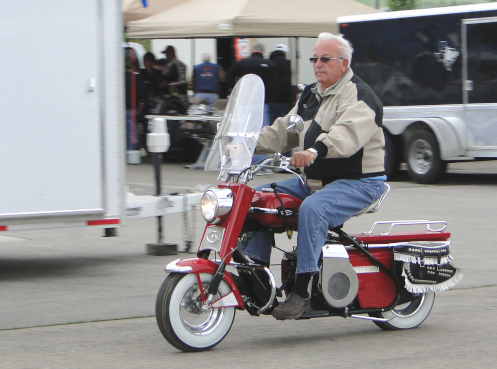
Cushman scooter

Now this would be an easy bike to pass your test on.

Big, 800-pound bagger motorcycles are very popular, at least in the U.S., but there’s one place you’ll never see them: at the Department of Motor Vehicles on the license testing range.

When you’re getting your motorcycle accreditation you have to pass the written test and also pass a driving test, just like with a car. The driving portion for a bike takes place out in the parking lot, where they set up cones and have you ride through the course demonstrating your competence. On a scooter, or a small bike, such as a 250cc Honda Rebel, it’s easy. For a beginning rider to maneuver their full-size bike around the course, the likelihood of success is minute.

I didn’t know this when I bought my first bike. But I learned.

I had ridden motorcycles whenever I had the opportunity for many years, but it was only once I bought my first bike, a 1980 Honda CB750 Custom, that I got licensed. My friends told me then that it would be good to get a small bike to take the test but I didn’t have any idea where to get that small bike so off I went on my 750.

Now, a 750cc bike is only considered a mid-size bike anymore, though it was a big bike in 1980, and it still weighs about 500 pounds. I suspect the licensing examiner was surprised to see what I rode in on but no matter, let’s go do the test.

The first part of the course demonstrates handling control. You have to weave around cones in a slalom pattern at slow speed. Then there was a right turn, and another right turn, which set you up to come into a much tighter box where you have to do a 180-degree turn.

I did not make it through all the cones and when I came around for the 180 I had not understood the directions properly. I thought the examiner told me to stay outside the lines, when in fact I was supposed to stay inside them. I was successful in staying outside. You then start out from a spot where you accelerate forward and then brake and swerve sharply as if you were avoiding an obstacle. That part was easy.

Of course I failed the test. And I was very surprised when she told me I utterly failed to make the U-turn within the lines. Ooooh. Within! I get it now.

Second Try
Now that I knew what the test consisted of I practiced. I showed up again a few days later, not at all confident I would succeed, but willing to take a shot at it. With no training I instinctively figured out that to weave through the cones I had to drag the rear brake, where you keep the engine revved for stability while working the rear brake to move forward at about walking speed. To my relief, I got through the cones just fine.

Heading into the U-turn I now knew I needed to stay inside the lines and, dragging the rear brake again, I successfully executed the turn. Coming out of it, however, the lean was too great and the bike laid over on its side. It didn’t actually go all the way down; it ended up resting half-way up on the foot peg. I looked at the examiner and she said she couldn’t help me but if I got the bike back up I could keep going with the test.

I raised the bike and continued and everything else went fine. She passed me. Yahoo!

I have since learned that one of the major benefits of taking a Motorcycle Safety Foundation riding course is that you learn on small bikes and at the end of the course you do the riding portion of the test. If you pass, all you have to do to get your license is go to Motor Vehicle, pass the written portion, and pay your fee. Of course you also get some training in the process, which is a very good thing.

Had I known all this that’s probably what I would have done. I didn’t, though, so now I take pride in being able to say I passed the test on my real, full-sized highway bike. And I love the looks of amazement I get when I say that.

Biker Quote for Today

We know you’re a poser if you put your pony-tail back in the drawer after you get home.

Getting Around To Maintenance

April 20th, 2020

With so much of the world currently shut down you might wonder what people are doing with all this time on their hands. If you are like me, you’re probably at least trying to clear some long-delayed projects off your to-do list. One of those items would entail motorcycle maintenance.

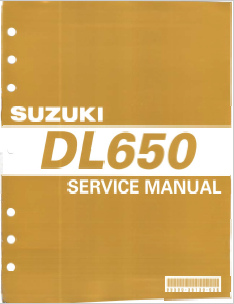
Suzuki DL650 Service Manual

 A manual that was apparently just photocopied and converted to PDF. Works for me.

Now, I’m not a guy to really dig into the mechanics of my bikes. I almost never do any more than change the oil and filter. Plus cleaning. Maybe if the weather stays nice now I’ll get around to cleaning my bikes for the first time in, oh, two or three years. But I have spoken with Joel, my mechanic, and he will be putting a new front tire on the Concours sometime soon.

Others amongst you are more inclined to pull the bike apart. And for that you need a shop manual. I have Clymer manuals for my CB750 Custom and my Concours but when I bought the V-Strom I went looking for one and none of the shops I went to had it. So I looked and found one online.

This all comes to mind because last week I got an email from Mark asking if I would be interested in a guest post about a website that provides shop manuals for most any bike at a modest cost. This site is a UK site called RepairBooks.co.uk. I went there and looked it over and figured this could be useful information for at least some of the folks who read this blog.

But I wasn’t thrilled with the post submitted–it wasn’t bad but it wasn’t good enough for me–so I figured I would do one on my own. This way they will get the link they want–which helps their Google ranking–and I’ll end up with a post I am satisfied with.

So I did an online search and found all sorts of resources. I very quickly found the Clymer site but this is the highest-price option. You can get an online manual from Clymer but it is only a one-year subscription to their service and it costs $19.95, and not all of their manuals are available online. Rather than do that I would just buy the hard-copy manual for $26.95 (most) or $39.95 (some)–whatever the individual price is.

On the other hand, why pay when you can get it for free? Carl Salter offers manuals in PDF at no cost. I already had a V-Strom manual but it is divided into separate sections, which can be convenient or inconvenient depending on your usage. Salter had a single PDF so I downloaded it and now I have both.

And if I don’t tear into my bikes, why do I even need a manual? Well, sometimes things break or don’t work properly. I use the manuals to try to diagnose the issue. Sometimes I still end up paying someone else to fix it but at least now and then it will be something I can handle myself. As I said above, why pay when you can get it for free?

Biker Quote for Today

You know you’re a biker if you have all the tools to work on every Harley ever made, but not any to work on your ol’ lady’s car.