Archive for the ‘Motorcycle Riders Foundation’ Category

Some Progress, Not Enough, On HIPAA Repair Bill

Monday, March 30th, 2009

How is it that bureaucrats can get away with twisting a law to the exact opposite of its intent?

In this instance I’m talking about the Health Insurance Portability and Accountability Act of 1996 (HIPAA), which made it illegal for insurance companies to deny coverage for customers doing things like riding motorcycles or snowmobiling. At least that’s what Congress thought it was doing. By the time the bureaucrats got done with the regulations they had specifically made it legal for insurance companies to do just that. Huh?

I’ve reported previously on efforts to fix this absurdity by passing another law that would be so explicit that no bureaucrat could possibly twist in such a perverse fashion. That legislation, called the HIPAA Recreational Injury Technical Correction Act, was working its way through Congress last year.

Unfortunately, it appears to have been significantly weakened. The Motorcycle Riders Foundation (MRF) reported that the bill currently making it way through Congress does not prohibit non-coverage of motorcycle accident injuries, it only requires that if the company is going to deny these claims it must tell the policy holders well in advance that these injuries are not covered.

To summarize the legalese, your health insurance provider can limit payment for an injury sustained on a motorcycle so long as it is spelled out to you in simple terms well in advance of you joining the plan.

In closing, the MRF release states:

Closing the loophole entirely and mandating that insurance companies must cover all injuries sustained while operating a legal motorcycle is still the ultimate goal of the MRF. HR 1253 puts Congress on record that this issue needs attention and is willing to work on it. The MRF will continue to keep you updated on this important matter.

Clearly we all need to support the MRF and other motorcycle organizations in continuing to fight this fight. But how obscene is it that we won this battle back in ’96, only to have that victory snatched away by some nameless, faceless bureaucrats! Something is seriously wrong here.

Biker Quote for Today

If you don’t pursue your dream, you might as well be a vegetable.
Clarifying Issues from Meeting of the Minds

Monday, November 3rd, 2008

I discussed the recent Meeting of the Minds conference that was held recently here in Denver by the Motorcycle Riders Foundation. At the time there were a couple issues I was unfamiliar with that I wanted to learn more about. I now have more to report.

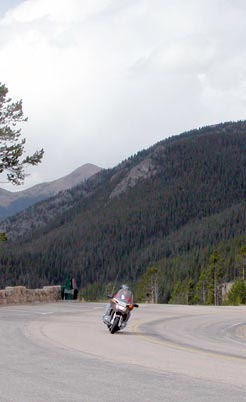
Cruising along Trail Ridge RoadFirst off, I was apparently a little off in my description of the issue of mandatory rider training. I said that MRF members “are concerned about a move to make such training mandatory, because they fear that the capacity does not exist to offer that training to that many people.” That was what I thought I had heard, and maybe to some extent that concern exists.
However, I spoke last week with Terry Howard, State Coordinator for ABATE of Colorado, and she gave me a totally different take on the topic. Speaking strictly for ABATE of Colorado, Terry said the only issue she has with mandatory training is that it apply to motorcyclists AND to motorists. That was really a “Doh!” moment for me. Of course. It would be totally discriminatory to require motorcyclists to have rider training while not requiring drivers to have driver training. We’re both operating motorized vehicles on the same roads and highways. And lord knows we all know that those folks in their cars need better training on avoiding those of us not enclosed in steel cages.

But it occurs to me as well, that as much as we talk about how many motorcycle accidents are caused not by the biker but by the rider, the same is actually true of car on car accidents. Probably in most two-car accidents, only one of the drivers is significantly at fault. The other is probably just as much a victim of the other driver’s carelessness as we are when it’s a car on bike accident. So absolutely, if our legislators want to impose mandatory training on bikers, we have got to ensure that ALL motor vehicle operators have the same requirement. Of course, then we really get into the issue of training capacity, as I mentioned originally.

The other unclear issue from MotM is something Terry was not as able to clear up. That was the idea of tiered licensing. She said she doesn’t really know the issue because Colorado doesn’t have it. The only thing she could tell me is that she thinks it is possible Colorado could move in that direction because of the upswing in popularity of scooters. Anyone on a scooter bigger than 50cc has to have motorcycle validation on their license, but below 50cc there is no requirement. Terry told me that some ABATE members have raised the issue because they see these low-maximum-speed scooters as hazards slowing down traffic on busy arterials. But there is no such proposal currently and ABATE is not pushing for it. So I guess for now tiered licensing will remain an issue for other states, not Colorado.

Biker Quote for Today

Bikes parked out front mean good chicken-fried steak inside.

Rider Training Funds Still Threatened

Friday, October 17th, 2008

What Mary Peters started, others seek to continue. I’ve given considerable coverage to the proposal by U.S. Sec. of Transportation Mary Peters that funds earmarked for motorcycle rider training be diverted to lobby for mandatory helmet laws.

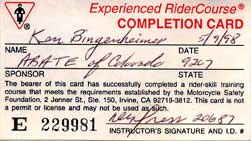
Experienced Rider cardPretty much all major motorcycling organizations have opposed that, and I reported in a report from the Meeting of the Minds that Peters has backed off on that proposal. Motorcycle Riders Foundation (MRF) President Kirk “Hardtail” Willard cautioned me that despite her statements in that regard, he was still waiting to see her send the letters to that effect to the states.

Well, now the American Motorcyclist Association (AMA) reports in the latest issue of American Motorcyclist that a group called the Governors Highway Safety Association has now taken up the issue. American Motorcyclist says:

Christopher Murphy, chairman of the Governors Highway Safety Association, which represents state highway safety agencies, made the request in testimony to the U.S. House Transportation and Infrastructure Committee’s Subcommittee on Highways and Transit this summer.

The opposition to this misuse of funds stems from the conviction that the key to lowering fatality rates is not in having safer crashes, it is in avoiding more of those crashes in the first place. As Doc Ski noted at the Meeting of the Minds, you will die if you get in a bad enough accident, regardless of whether you’re wearing a helmet.

So Mary Peters may have heeded the outcry and reversed her stance, but now that the genie has been let out of the bottle it may not be that easy to put it back in. This is why we need to support organizations like the AMA and the MRF.

Biker Quote for Today

Thin leather looks good in the bar, but it won’t save your butt from road rash if you go down.

Report from MotM: Is Highway Privatization a Threat to Bikers?

Friday, October 3rd, 2008

Hoosier Pass“Welcome to Colorado Interstate W-470, brought to you courtesy of the Northwest Parkway Authority.”

What’s that? Aren’t interstate highways owned and operated by the federal government? Well, that’s the way it used to be, but in this age of trying to reduce spending and cut budgets, more and more of the public infrastructure is being handed over on long-term leases to private, for-profit entities. The Northwest Parkway Authority is not one of these; it is in fact a creation of several local jurisdictions, but this is a variation of the same theme.

The issue is whether these private operators will have to ability to impose different restrictions than those for federally operated highways. This was one of the concerns voiced last weekend at the Motorcycle Riders Foundation‘s Meeting of the Minds here in Denver.

What might happen? Well, in Chicago, for instance, several years ago the city council passed an ordinance banning motorcycles from Lakeshore Drive after a certain hour of the night. The issue was excessive noise from bikes disturbing the folks living nearby. The problem was that that stretch of Lakeshore Drive is a U.S. highway, and federal law prohibits the kind of restriction Chicago wanted to impose. The ordinance was overturned.

But what if Lakeshore Drive were operated by a for-profit “Lakeshore Drive Agency”? Would they have gotten away with it?

There really isn’t a clear answer but that’s what the MRF is concerned about. They want to make sure that there is a clear answer enacted into law, and that that clear answer holds that federal policies DO apply and cannot be ignored. It takes relationship building with legislators and congressmen, lobbying, and a lot of behind-the-scenes hard work.

Just figured you needed to know.

Biker Quote for Today

The battle for bikers’ rights is not about patches, parties, or poker runs. We fight to protect the freedom and promote the interests of American motorcyclists … to defend our right to choose our own modes of transportation, attire, and lifestyle … to deter and defy discrimination against us … and to vanquish those who violate our rights or right-of-way. — Bruce Arnold

Report from MotM: Issues We Will Soon Face

Wednesday, October 1st, 2008

A big part of the Motorcycle Riders Foundation’s Meeting of the Minds, which took place here in Denver last weekend, is looking ahead to the issues we as motorcyclists are likely to face in the near future. Rather than simply react, the MRF wants to be proactive. Rather than scramble in a disorganized fashion for responses when new legislation is proposed, the MRF wants to have its position and its talking points already determined and disseminated to its membership.

So just what are the issues that appear to be on the horizon? Here are the ones I gleaned from my discussion with MRF President Kirk “Hardtail” Willard, from the various speakers, and from the audience during open discussion.

  • Rider and motorist training
    The MRF and the state motorcyclist rights organizations (SMRO) that are its constituent groups strongly advocate for rider and motorist training. However, they are concerned about a move to make such training mandatory, because they fear that the capacity does not exist to offer that training to that many people. This looks like it could be a balancing act.
  • Health insurance
    Not so much on the horizon as current, this issue has to do with efforts to pass the HIPAA Recreational Injury Technical Correction Act, and end the legal ability of insurance companies to refuse to provide benefits when someone is injured while engaged in legal but so-called “risky” activities. I’ve written about this before.
  • Protecting 2010 funds
    The so-called 2010 funds are the dollars earmarked by government for rider training programs. You’ll recall that I’ve written about U.S. Dept. of Transportation Sec. Mary Peters’ efforts to divert some of this money to promote mandatory helmet legislation. There are other threats to this money as well. When states run into budget difficulties these funds are attractive to politicians as a way to balance the budget, regardless of the fact that they are often paid solely by motorcyclists for motorcycle-related purposes.
  • The Transportation Equity Act
    This pending bill will have major influence on highway spending in coming years. The MRF wants to ensure that motorcyclists are included in the planning and not just an afterthought.
  • Graduated licensing
    From what I understand, graduated licensing is very common in Europe. This means that you start out on a small bike, learn to ride, and as you demonstrate competency you earn the right to ride bigger and bigger bikes. Frankly, I’m not clear on the issues here, or the concerns the MRF has about this. I’ll try to find out more and address this issue again.
  • Right to repair
    This issue was raised during a panel discussion on Saturday, with two Harley-Davidson representatives on the panel being addressed. Speakers from the floor expressed their unhappiness with computer chips that shut down the bike when non-H-D mechanics work on them. The reps replied that the computer chips do allow some modification, whereas some governmental agencies are pressing for simply welding carburetors and exhaust pipes on permanently.

There’s more, but this gives you a bit of an idea about what’s going on. It is inevitable that you’ll be hearing more about these issues.

Biker Quote for Today

The biggest problem facing motorcyclists today is that we live in a nanny state, and if people think you can “save just one life” by banning motorcycles, they’d do it. — Jay Leno

Report from MotM: A Failed Safety Paradigm

Monday, September 29th, 2008

Let’s start with two statements that I think we can all agree on:

1. Helmets would not be an issue if motorcycles did not get in crashes.

2. It is crashes, not the failure to wear a helmet, that kills motorcyclists.

Speaking Friday at the Motorcycle Riders Foundation‘s Meeting of the Minds here in Denver, “Doc Ski” Wasileski, Ph.D., addressed the issue of rider safety in a talk titled “A Failed Safety Paradigm.” And the point Doc Ski made can be summed up as such: “If you get in a bad enough crash, you’re gonna die. Crashes kill bikers. Crash prevention saves lives.”

Doc Ski argued that ever since the Hurt Report, “Motorcycle Accident Cause Factors and Identification of Countermeasures,” the government agencies involved in transportation safety have followed the approach of working for crash mitigation. That is, safer crashes. In cars that means seat belts and air bags and other clearly effective means. When it comes to motorcycles, however, the idea of safer crashes does not work as well. As Doc Ski said, you will die if you get in a bad enough accident, regardless of whether you’re wearing a helmet.

Thus the failed paradigm. Doc Ski, who serves as the MRF’s resident statistician, quoted his own studies that show no statistical difference in fatality rates between states with mandatory helmet laws and states with no helmet laws. And he echoed the MRF’s position that rider training, motorist share-the-road training, and impaired riding programs are what lower fatality rates, not stricter protective requirements and vehicle design modifications.

Nevertheless, as many speakers stated repeatedly over the course of the conference, stricter regulation is coming. The form that that regulation takes will be determined at least in part by how effectively the motorcycling community’s voice is heard. One purpose of the Meeting of the Minds is to ensure that that voice is heard, and effectively.

Issues the MRF is expecting to address in the near future include mandatory rider education, graduated licensing, and restricted access for motorcycles on some roadways.

Be grateful that someone is out there fighting for your rights. Consider joining them in the effort. You’ve got nothing to lose but your rights.

Biker Quote for Today

We want to be free to ride our machines without being hassled by the man. — Peter Fonda, The Wild Angels, 1966