Archive for the ‘Motorcycle legislation’ Category

Get Acquainted With ‘Inherent Risk’

Monday, January 19th, 2026

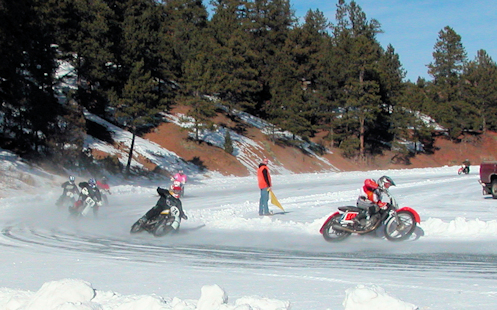
You don’t suppose there might be some inherent risk involved in racing a motorcycle on ice, do you?

If you’re not familiar with the concept of inherent risk you probably will be soon. It’s a movement that appears to be spreading state to state, and it will affect motorcycle riders.

Essentially, inherent risk is a recognition that some things people like to do carry some amount of risk. The current crop of laws being passed regarding inherent risk made a clear statement that if people choose to engage in these activities they do so recognizing the risks and accepting those risks. That is, if you do it and get hurt, it’s on you. Don’t try to sue someone else for your misfortune.

The first thing you might think of in this category could be motorcycle racing, but that’s really not the case. Racers uniformly are required to sign waivers stating they will not sue the track if they screw up and get hurt. Of course this is only true if the track is in good shape and the crash was the rider’s fault, or perhaps the fault of another racer. If there is a big pothole in the middle of a tough turn then the track is at fault. But how often is a track going to allow that hazard to exist?

The legislation is aimed more at places such as an open space area where the governmental entity that owns or controls it allows dirt bike riding. Or a farmer who lets local kids ride in his pasture. If you get hurt, don’t go suing the nice person who let you ride in his pasture. He didn’t cause your crash, you did.

So far Arkansas and Texas have enacted inherent risk legislation. The concept is supported by the American Motorcyclist Association, which put out a report that stated, “The American Motorcyclist Association, alongside Texas motocross track owners, motorcycle dealers, and riding enthusiasts, was closely engaged with efforts to pass HB 5624. The AMA commends the Texas state legislature for its passage, as HB 5624 aims to create a more consistent and predictable liability environment for property owners and off-road riding enthusiasts.”

The AMA also noted, “This form of legislation has picked up steam across the country, and the AMA is focused on additional efforts, primarily in Iowa and Missouri, where similar inherent risk bills are taking shape for re-introduction in each state’s next legislative session.”

Everyone knows the story of the woman who bought coffee at McDonald’s from a drive-up window, put the coffee between her legs, and then spilled it, burning herself. She sued McDonald’s and won. That would seem to fall under this policy. You bought the hot coffee and would have been unhappy if it had been cold. Nobody forced you to put it between your legs as you drove away.

I think we can all expect these laws to come to our own states. Look for them.

Biker Quote for Today

My comments to my neighbor who rides horses but thinks motorcycles are dangerous – “I’m not riding anything that has a mind of its own . . .” — markbxr400

Two Websites You May Want To Check Out

Thursday, August 28th, 2025

A section of the RIDE BYND home page.

I didn’t deliberately decide to post twice in a row about motorcycle websites but I take things as they come, so here we are.

In my email this morning I had two messages, one from RIDE BYND and the other from Ride Apart.

I’m familiar with RIDE BYND (pronounced “Ride Beyond”) because of these VANHA magazines I found in the waiting area at Fay Myers when I was having one of my bikes worked on. I wanted to check VANHA out and found that the magazine no longer is printed but they have a site called RIDE BYND. I signed up for their notifications and have by now received about four of these monthly notices. I had never clicked through to actually see what they were doing there so today I decided it was time.

Rather than a print magazine, what RIDE BYND appears to offer is videos, although their home page is divided between “Latest Episodes” and “Latest Videos.” The episodes are often long, more than an hour, and those I checked out focus mainly on individuals doing cool stuff on motorcycles. The videos are generally short, often just showing some cool footage of riding.

Here’s how they describe themselves.

RIDE BYND is more than just a podcast about motorcycles — it’s a celebration of the passion, creativity, and untold stories of the people who ride them. Hosted by the co-founder of VAHNA, Ben Giese dives into deep conversations with athletes, artists, adventurers, industry icons, and trailblazers from all walks of life—exploring the experiences that shape their journeys, both on and off the bike. The motorcycle is our connection. The stories are what take us BYND.

As for Ride Apart, I don’t know how I came to be on their mailing list, but I’ve been getting their emails for a while. It seems to be a general motorcycle-oriented site offering news, reviews, features, makes, models, with photos and videos.

The article that caught my eye this morning was headlined, “If You’re Against Motorcycle Helmet Laws, You’re an Idiot.” Considering my own recent remarks about helmets and helmet laws, I had to check this out.

The article is written by Jonathon Klein and, to extract just a bit, his main argument is, “But here’s the real truth, humans are inherently stupid animals, and we do all manner of dumb things all the freakin’ time. We can’t leave our phones in a cupholder for a second while driving a potentially idiotic 10,000-pound electric Hummer, for Pete’s sake. Why should we then be entrusted with our own safety? And that’s sorta where I’m at in terms of helmet laws, as I’m very much for them. Not because I like a nanny state or big government, I really don’t. But because I’d rather not see my fellow motorcyclists die a horribly painful death because they were too freakin’ stupid to just wear a full face helmet while out on the road. I mean, the data says it all, they increase your chances of survival in an accident.”

OK. Not a lot of new thought or information added to this long-running dispute.

Another example of what they publish is an article titled, “Despite What Amazon Says, You Shouldn’t Follow a Motorcycle So Freakin’ Closely.” This tells about what is purported to be a page from an Amazon.com delivery driver training manual that says to leave a four-foot distance between your delivery van and a motorcycle ahead of you. OK, yeah, I’ll read to see what that’s all about.

So they have kept up a steady progression of articles I have found interesting enough to click through on. Maybe you would do so as well. Check it out if you’re interested.

Biker Quote for Today

If you go fast enough on your bike you can fast forward your life to the very end.

CSP Seems Unclear On Filtering Law

Monday, July 14th, 2025

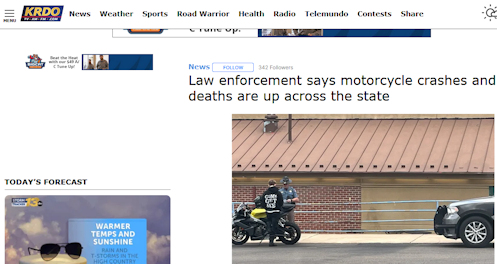
The revised article on the KRDO website.

In the middle of last week I saw a piece by KRDO out of Colorado Springs titled “State Patrol says confusion over new motorcycle law leading to more crashes.” This was in reference to the recent law that allows filtering–not lane-splitting–on Colorado roads. The new headline is “Law enforcement says motorcycle crashes and deaths are up across the state.”

The information KRDO got from the Colorado State Patrol (CSP) was so bad I knew immediately I had to do a blog post about it. It turns out, it was so bad that going back to the article today I found that KRDO had revised the headline and inserted a three-paragraph editor’s note pointing out the original inaccuracies and clarifying the information. Good for you, KRDO. Bad on you CSP. KRDO also extensively revised the article, which makes me wish I had copied it down at the time because now I can’t quote you the really bad information that had been given.

When I had initially mentioned to Judy what the CSP had said she just shook her head and said “The State Patrol is just rewriting the legislation the way they think it should have been written.”

Essentially, KRDO quoted the CSP as saying that confusion on the filtering law has led to more crashes. It also said people mistakenly believed that filtering was allowed on highways, when actually it only applies to city streets. That particular statement is mind-boggling in how far off it is. In fact, KRDO said in the original article that nothing in the law differentiates between highways and city streets, but CSP was saying if they see people filtering on the highway, even if traffic is at a dead stop, they will issue citations.

Here are a couple of the clarifications:

At the time, CSP stated that confusion over the law was contributing to an increase in motorcycle crashes and fatalities this year. They have since clarified that there is no data linking the law to the rise in incidents.

Additionally, CSP initially told KRDO13 that it is illegal for motorcycles to pass cars in standstill highway traffic. We sought confirmation multiple times and were assured this was correct. CSP has now clarified that under the new law, motorcycles are permitted to pass vehicles at 15 mph or less when traffic is stopped on the highway.

Now, there’s no question that some motorcyclists are using this filtering law as a justification for doing things the law does not allow. I have more than once seen riders blasting between cars at speed on the highway. If the CSP nails them I won’t shed a tear.

But dang, CSP, how can you guys enforce this law when you don’t even seem to understand it?

Biker Quote for Today

Darkness will always be looming in the background, somewhere in the distance, just around the bend. But at least we can have faith in our motorcycles to keep us grounded, to give us courage and perspective, and to light the way in the face of our demons.

Distractions On The Bike Are Just As Bad As In The Car

Monday, May 19th, 2025

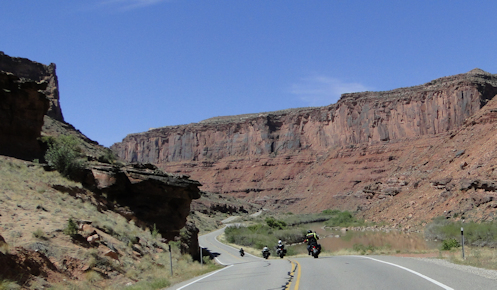
On the road to California.

Colorado has a newly instituted law prohibiting hands-on use of a cellphone while driving and from all accounts it is doing some good. Distracted driving is of great importance to motorcyclists because we know far too well how easy it is not to see us even when you’re not distracted.

Well guess what. That’s just as true on a motorcycle as in a car. Case in point:

On this recent (aborted for me due to sickness) RMMRC California trip we immediately got separated from one guy. Alan, who was leading, pulled off at Idaho Springs to try to find out where he was. He called and found he was in Evergreen so we just agreed to meet up at lunch in Eagle.

In order to make this call, Alan pulled into the parking lot of a restaurant and we all followed him. I tend to be fairly conscientious and so as not to take up a lot of parking spaces in this small parking lot I pulled into the same slot as Alan, a bit behind him.

Alan got on the phone and made his call and got the matter settled. At this point he was in communication with the other guys because we all had Cardo communicators but we had been unsuccessful earlier in trying to get me paired into the group. So I was not connected.

Well, Alan was so involved in making his call and then talking to the other guys that he apparently had not noticed that I was behind him. So we’re ready to roll again and I started to roll back but Alan came rolling back faster than me and though I scrambled to get out of his way he backed right into me. Down I went.

Now, there was no damage and I was not hurt but my point is, he was busy on his phone–his communicator in this case–and not paying attention to his driving. What if instead of me on my bike, there had been some person walking to the restaurant behind him? That person could easily have been hurt. Or heck, I could have been hurt. I wasn’t, but I could have been. Clearly he wasn’t looking very carefully where he was going.

So yeah, hang up and drive. Or maybe just look where you’re going. It applies on a motorcycle as well as in a car.

Biker Quote for Today

As long as you are on planet Earth, you’re not lost.

Reports Suggest Hands-Free Law Is Working

Thursday, April 3rd, 2025

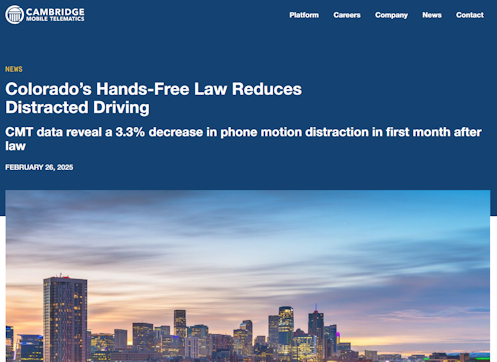
The CMT web page with the report.

Two recent reports suggest that Colorado’s law forbidding use of a cellphone while driving, except in hands-free mode, is having an effect.

The more significant of the two is from the Colorado State Patrol, which, according to an article in The Denver Post on April 1, said that distracted driving citations have increased in 2025 by 135% over the previous year.

As far as I can tell, it’s playing out exactly as I said it would. Driving with your phone in your hand is now illegal, but it is only a secondary offense, meaning you can’t be stopped just for that. So what will happen is that the cops will stop you for something else and then tack on the citation for using your phone, while perhaps being “nice” to you by not citing you for what they “actually” stopped you for. Or maybe they’ll cite you for that, too.

And the point, really, is that if they see you engaged in careless or reckless driving they could stop you for that before. It’s just that now, with the emphasis on getting people to be aware of and obey this new law they are apparently focusing more on stops for careless/reckless driving.

Either way, I’ll take it.

Meanwhile, a report from Cambridge Mobile Telematics (CMT) says that the data “reveal a 3.3% reduction in phone motion distraction statewide, an improvement that CMT estimates to have prevented 88 crashes, 49 injuries, and $3.5 million in economic damages since the law began.”

CMT uses data drawn from cellphone tracking. Just in case you wondered if your moves are being tracked, presumably anonymously, be assured that they are. According to the report, “CMT defines phone motion distraction as when a phone moves with its screen on while a vehicle is in motion. The study analyzed over 3.8 million trips in Colorado between December 1, 2024, and February 11, 2025, measuring changes in distraction before and after the law took effect.”

Mind you, the improvement is measured in seconds, but all it takes is about one or two seconds of inattentive driving for you to totally change your life or the life of someone else.

One question here that I wonder about is how they distinguish between phone use by a driver vs. by a passenger. I would guess they can’t, so the figures are overall. Still, considering how much of the time people are alone in their cars, sussing out how much of the phone use is passenger vs. driver is not of overriding consequence. If the amount of time is declining that’s a good thing.

Still, let’s not fool ourselves. Just in the last week I’ve been behind a car that repeatedly wandered over into the next lane and when I was able to shoot past the guy he was looking at his phone. In another instance I was behind a guy who had his phone on a mount on the dashboard. I watched as he repeatedly reached up and tapped it, scrolled it, and pretty much constantly interacted with it. That is not hands-free. We’ve got a long way to go to fix this problem but at least we’re making a start.

MOST Hearing Is Wednesday

Monday, March 17th, 2025

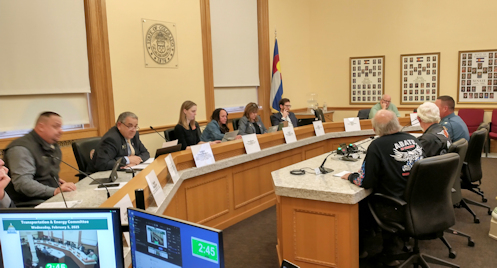
ABATE testimony at the most recent MOST hearing.

If you think the money you pay each year to enhance rider safety should be spent to defer costs for rider training the time to contact your legislative representatives is now. A hearing will be held Wednesday afternoon for the re-authorization of the Colorado MOST (Motorcycle Operator Safety Training) program. The hope is to have the simple re-authorization bill amended to mandate that the money–at least some of it–be used in that manner. I mean, come on, “Training” is in the name. Putting up road signs that say “Motorcyclists use extreme caution” does not constitute training in anybody’s book.

The word from Stump, ABATE of Colorado’s legislative liaison, is that there’s no good way to know when in the afternoon the bill will come up, but it would be good to have at least a few interested members of the public on hand to testify. ABATE members will presumably be there so that base is probably covered. The other thing that matters–what you can do, and should do if you care about this–is to immediately contact your reps to let them know what you want them to do.

This hearing is with the Senate Transportation and Energy committee. Here are the members who need to be contacted.
Faith Winter (Chair) — 303-866-4863 — faith.winter.senate@coleg.gov
Lisa Cutter — 303-866-4859 — lisa.cutter.senate@coleg.gov
Marc Catlin — 303-866-5292 — marc.catlin.senate@coleg.gov
Tony Exum — 303-866-6364 — tony.exum.senate@coleg.gov
Nick Hinrichsen — 303-866-4878 — nick.hinrichsen.senate@coleg.gov
Kyle Mullica — 303-866-4451 — kyle.mullica.senate@coleg.gov
Byron Pelton — 303-866-6360 — byron.pelton.senate@coleg.gov
Cleave Simpson — 303-866-4875 — cleave.simpson.senate@coleg.gov
Tom Sullivan — 303-866-4873 — tom.sullivan.senate@coleg.gov

Stump provided a little background on what’s going on. Here’s part of it:

Also related to our bill, Larry (Montgomery–ABATE’s state director) and I met with Chris Corbo (MOST Director) this week to express ABATE’s concerns with the program. He actually requested the meeting because he said he’s been getting inquiries from Legislators about the MOST Program. The hour and a half meeting was MOSTly good (excuse the pun) but a lot of his answers were, “You have to ask MSF about that.” He conceded that the 9 years till the next sunset review is too long and should be 5 years. He also gave reasons (excuses) why there shouldn’t be subsidies: too much paperwork, too much time to write checks, need another person to do the extra work, abuse by vendors, etc.

So it’s “too much trouble” to do what the program was set up to do. At least this shows that people have been contacting their reps and the reps are pursuing the matter. That’s good news.

Biker Quote for Today

Like dogs, motorcycles are social catalysts that attract a superior category of people.