Archive for the ‘Motorcycle legislation’ Category

HOV Lane Bill For Motorcycles Advancing

Monday, February 29th, 2016
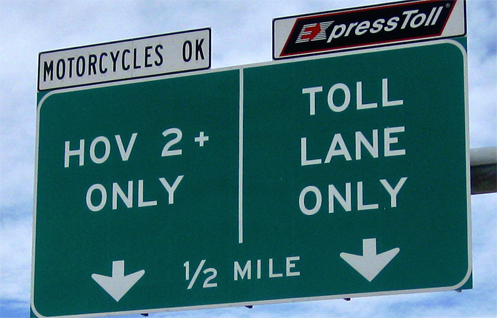
HOV lane sign

By law, motorcycles are allowed to use HOV lanes at no charge.

Stump is the lobbyist at the state capitol for ABATE of Colorado and he has been busy. It looks as though this whole issue with motorcycles being required to have transponders to use HOV lanes will be resolved soon. I’m just going to paste in Stump’s latest email on the topic.
___________________________________

This week was another busy week down at the Capitol. HB16-123 (HOV / Transponders) is more involved than I originally thought. The part of concern to us, motorcycles needing transponders, is the easy part. Everyone involved, CDOT, HPTE, Senators, and even opponents of the bill at the Senate Transportation Committee Hearing, understand that motorcycles are HOV per Federal Regulations. The discussion now is, “How do we go about giving motorcycles “free access” to the HOV lanes?”

The rest of the bill about switchable transponders is a lot more complicated. The bill was scheduled for 2nd reading on the Senate floor on Tuesday, 2/23. It got laid over to Thursday, 2/25. I talked to a few Senators on Wednesday, 2/24, to get a feel for the bill. I’ve heard in the past that a bill is sometimes laid over if the sponsor feels he doesn’t have enough votes to carry the bill. That morning there was also a meeting with CDOT, HPTE, and a few Senators. After much discussion, a compromise was offered by CDOT, but not accepted by the sponsor. (I wasn’t at the meeting so I don’t know the exact offer). Wednesday afternoon, I did have a meeting with Senator Todd, Scott Spendlove (lobbyist for HPTE & E-470), and Andy K. (lobbyist for CDOT). While a lot of the discussion was about the bill, all of us agreed that motorcycles shouldn’t need transponders. Scott said he would take the issue directly to the Director of HPTE and work on a solution. Sen. Todd emphatically stated she wants this done ASAP and if it isn’t handled soon and SB16-123 gets killed, she would sponsor a bill specifically about motorcycles not needing transponders.

So on Thursday, 2/25, the bill was read on the Senate floor. Senators Lundberg, Jones, and Neville gave some very strong arguments in support of the bill. (The bill wants to get rid of the switchable transponders and go back to how the HOV / HOT lanes operated before July 22, 2015). Senators Todd and Heath opposed the bill. After much discussion and confusion about the ramifications of the bill, it was voted to lay over the bill till Tuesday, 3/1. There’s a meeting on Monday, 2/29, with the same people that met Wednesday morning. Since the motorcycle’s issue seems to be separate and already agreed upon, I wasn’t invited to the meeting. I’m sure there will be more compromises offered. FYI, I talked to Andy on Thursday and he said he’d send me an e-mail to the effect that CDOT is working on a solution to the motorcycle / transponder issue. (I haven’t gotten it yet).

There’s other bills happening but I just wanted to bring you up to date on SB16-123. I’ll let you know what happens next week and if we need to contact our Representatives.

Stump

Biker Quote for Today

The only date I need has two wheels, can be full on under $10, always goes all the way, and definitely screams on top.

HOV Lane Bill Advances

Thursday, February 18th, 2016
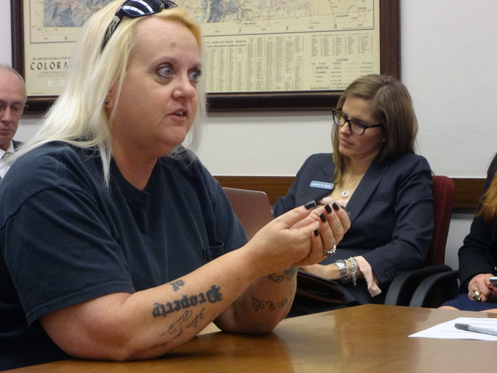
Tiger Chandler testifies

Tiger Chandler speaks to the Senate Transportation Committee.

A 4-1 favorable vote bodes well for an effort to resolve the issue of motorcyclists being assessed fees and fines for using high-occupancy vehicle (HOV) lanes in Colorado. Federal law mandates that motorcycles are always considered HOV but current practice here requires that you have a transponder on your bike or else you will receive a bill in the mail.

Senate Bill 16-123 was passed out of the Senate Transportation Committee Thursday and will move to the Senate Committee of the Whole. The only no vote, from Sen. Nancy Todd, was cast with the statement that if the bill had only addressed the motorcycle issue it would also have been a yes. As it is, the bill, introduced by Sen. Kevin Lundberg, calls for any vehicle that is permitted in an HOV lane be permitted without being required to have a transponder.

Testimony opposing this bill was based primarily on the practical challenges of using a single lane for HOV, rapid transit (buses), and tolled traffic (HOT). Representatives from the Denver Regional Council of Governments, Boulder/Boulder County, and the High-Performance Transportation Enterprise, which operates the tolling system, expressed concern about loss of revenues to pay for the new lanes on US 36 and suggested if the bill passes the ultimate result will be the elimination of HOV lanes entirely.

Alone among them, Matthew Applebaum, representing the interests of Boulder, suggested that the issue might be resolved by not requiring people signing up for transponders who express no intention of using the toll lanes to make the current $35 deposit to cover any fees incurred. He said the $15 for the transponder would be saved in one trip on the Boulder Turnpike and so did not suggest offering the transponders for free.

Motorcycles already can get transponders for free but they still have to give a credit card or bank account and have the $35 deposit drawn.

Bruce Downs, state coordinator for ABATE of Colorado, argued that even free transponders for motorcycles is not sufficient because it does not eliminate the situation where, for instance, an out-of-state rider might use the HOV lane and find an unpleasant surprise in their mailbox afterward. He said Virginia has addressed this issue by installing cameras that are capable of distinguishing motorcycles and ignoring them.

Deb “Tiger” Chandler, who represents the US Defenders and the Coalition of Independent Riders, asked why the motorcycling community had not been included in discussions leading up to this new system long before it was put into place.

Sen. Lundberg acknowledged that as the bill continues its path through the legislature it is likely that amendments will be made and those amendments could resolve some of the valid concerns of those currently opposing the bill.

This bill is still a long way from becoming a law but the response in the Senate Transportation Committee suggests that motorcyclists can reasonably hope for resolution of the issue that concerns them, even if that resolution is not found in this particular bill.

Biker Quote for Today

Ride as though you are invisible, not invincible.

Lane-Splitting Bill Killed

Wednesday, February 17th, 2016
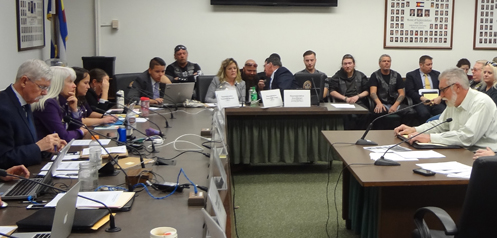
Hearing on lane-splitting

ABATE State Coordinator Bruce Downs speaks to the committee in support of the bill.

Lane-splitting in Colorado met with defeat on Wednesday, though in a way that possibly bodes well for future attempts.

Dying on a 5-8 vote in the Transportation and Energy Committee, House Bill 16-1205, which would have legalized lane-splitting, was noted to be a non-partisan bill but the vote was on party lines just the same. One Republican joined the Democrats in defeating it. But sponsor Gordon Klingenschmitt was please afterward that it had received as many votes as it did. We just have to keep working at it.

Reservations expressed by several of the representatives focused largely on a lack of comprehensive data to back up the existing data that seem to show that lane-splitting is safer than sitting in traffic because it reduces the likelihood of motorcyclists getting rear-ended.

Max Tyler, the committee chairman, argued that California experience with lane-splitting does not equate to Colorado because California has a mandatory helmet law. Another representative, Daneya Esgar, noted that she is “constantly worried” when her mother and the mother’s husband ride, not for what they might do but for what other drivers might do. Faith Winter expressed her concern that lane-splitting would be permitted on roads other than major highways. None of the opponents expressed any willingness to be the first state to officially legalize lane-splitting. Although it is not illegal in California, neither is it officially permitted and a bill to do that has been stalled for a long time.

Dave Hall, of the Colorado State Patrol (CSP), expressed that agency’s opposition to the bill. He, too, suggested CSP would be amenable to the possibility if further evidence could be developed that authoritatively supported the safety claim.

Rep. Klingenschmitt summed up his argument saying this is one of those rare times when liberty and safety are not in conflict. Allowing riders this freedom would also help make them safer, he said. However, this time at least, his argument was not enough.

Lane-Splitting And HOV Bills To Have Hearings

Tuesday, February 16th, 2016
BSA Motorcycle

Just a gratuitous photo of a cool old bike.

Hearings will be held this week on legislation concerning motorcycle lane-splitting and the need for transponders when motorcycles use HOV lanes.

The hearing on House Bill 16-1205, to allow lane-splitting, will be at 1:30 p.m. on Wednesday, Feb. 17, in room 0112 at the Capitol. Senate Bill 16-123, on HOV lanes, will be taken up on Thursday in Senate conference room 352 following the Senate’s adjournment, at around 10:30 to 11:30 a.m.

HB 16-1205, sponsored by Rep. Gordon Klingenschmitt (R), from the Colorado Springs area, reads as follows:

Concerning An Exception To The Prohibitions Against Driving A Motorcycle Around Motor Vehicles Blocking The Lanes Of Traffic Moving In The Same Direction.

Currently, the driver of a motorcycle is prohibited from driving between rows of motor vehicles or overtaking on the right. The bill allows motorcycles to drive between rows of motor vehicles or overtake on the right when traffic is moving at less than 5 miles per hour if:

  • The motor vehicles that the motorcycle is driving around are traveling in the same direction as the motorcycle and at no more than 5 miles per hour;
  • The motorcycle is driven no faster than 15 miles per hour; and
  • The motorcycle does not exceed by more than 10 miles per hour the speed of traffic the motorcycle is passing.

Overtaking on the right is not allowed when a vehicle is using the shoulder.

The Colorado department of transportation may notify the public of these changes.

FYI, this bill does not meet the criteria desired by ABATE of Colorado and because there was no time for the ABATE board to discuss it the group will not be taking a stand for or against it.

The Senate bill is quite brief:

Concerning Free Access For High Occupancy Vehicles To High Occupancy Vehicle And High Occupancy Toll Lanes On State Highways, And, In Connection Therewith, Prohibiting The Department Of Transportation And The High-Performance Transportation Enterprise From Requiring A Vehicle Owner To Use A Switchable Transponder Or Other Device In Order To Travel In A High Occupancy Vehicle On Such A Lane Without Paying A Toll.

The bill prohibits the department of transportation or the high-performance transportation enterprise from requiring a vehicle owner to use a switchable transponder or other device in order to travel in a high occupancy vehicle on either a high occupancy vehicle lane or a high occupancy toll lane on a toll-free basis.

Can’t get much clearer than that. If you’re on a motorcycle and use an HOV lane you don’t need a transponder to freely do what you are legally allowed to do. The bill is sponsored by Sen. Kevin Lundberg, from the Fort Collins area. ABATE will be supporting this one.

I’m planning to be there so I’ll report back on what happens. If you want your voice heard, come down and testify.

Biker Quote for Today

You’re a biker wannabe if you like to ride by stores with big picture windows so you can admire your reflection.

Showing My Ignorance

Thursday, February 11th, 2016

I went on Tuesday to the hearing on Colorado Senate Bill 16-122 expecting it to be in regard somehow to the Colorado Motorcycle Operator Safety Training (MOST) program. That’s what you get for assuming.

Broncos fans with their big Lombardi trophy

There was something else going on downtown Tuesday besides this legislative hearing.

All I had to go on was an email from Bruce Downs, state coordinator for ABATE of Colorado, saying the hearing would be happening and he was going to be testifying. I downloaded a copy of the bill and did my best to interpret what it was about. I was completely wrong.

Just as the bill said, it was about conducting audits of the Colorado Department of Transportation’s (CDOT) management of its contracts. So where does this tie in to motorcycles?

After his testimony Bruce explained it to me.

“I had a public forum and I could ding somebody so I did.”

The dinging in this case was in regard to both the MOST program and the requirement that motorcycles have transponders to use HOV lanes. From his statement:

Per the statute there was a limit put on how much could be spent on administration, yet CDOT’s actions indicate they do not feel they have to abide by the law and do not have to be accountable for their actions.

And:

Under federal law a motorcycle is considered an HOV under all conditions but CDOT didn’t seem to care. They wanted their $35 “deposit” for a transponder and if one was obtained three would be no “charge” for us to use the lane. If we did not have a transponder then there would be a fee and a fine. How does having a transponder make a difference if you are an HOV or not? What a double standard.

So while Sen. Randy Baumgardner was interested, with his bill, in greater transparency in CDOT, Bruce wanted to bring other issues to his attention, as well as to the attention of those on this committee. It’s a building block, not a whole building.

Did it do any good? Who knows. Maybe. After going through all the other formalities, rather than vote the bill up or down, Baumgardner asked that it be set aside, presumably for some revision. We’ll just have to wait and see what comes next.

Biker Quote for Today

Motorcycles are very useful and have almost annihilated distance and cheap clothes.

MOST Accountability Bill Set For Hearing

Monday, February 8th, 2016

Nowhere in the bill is the Colorado Motorcycle Operator Safety Training (MOST) program mentioned specifically but Senate Bill 16-122 is all about MOST. It is scheduled to come up for first hearing on Tuesday at 2 p.m. in Senate Conference Room 352.

Colorado MOST program logo

Colorado MOST program logo

Let’s recap the issue.

Soon after Colorado eliminated its mandatory helmet law, quite a few years ago, the MOST program was created–with support of the motorcycling community–to lower the cost of getting riders trained. Better training = fewer crashes was, and still is, the thinking. And from the bikers’ perspective, the fewer crashes the less likelihood that the helmet law would be reinstated. The program is paid for by an extra fee all bikers pay when they get their plates each year and when they renew their drivers licenses.

Long story short, it worked for a good while but eventually it turned out that some rider training programs were decidedly below the acceptable level and the decision was made to institute oversight of the trainers. First the trainee reimbursement was decreased and then it was eliminated. The Colorado Department of Transportation (CDOT), which handles the MOST program announced that it would hire an outside agency to do the oversight, essentially using all the money we chip in to pay for that oversight.

There are a few issues here. Colorado motorcyclists agreed to pay these extra fees in order to lower the cost to trainees. Now their cost is not lowered one dime. The MOST legislation also states that no more than 15 percent of the money raised can be use for administration. Now effectively all of it is to be used for administration. So now motorcyclists will pay extra to ensure the quality of motorcycle rider training, while people driving cars do not pay anything extra to ensure the quality of driver training. The general consensus is that that is unfair to us and totally unacceptable.

So what would SB 16-122 do? I’m not a lawyer so I can only interpret this to the best of my ability but here goes. I’ll quote from the bill summary and offer my best understanding.

Section 1 requires the state auditor to conduct a risk-based performance audit of CDOT no later than June 30, 2018.

I really can’t explain this, other than to conjecture that it relates to what follows.

Section 2 limits CDOT’s existing authority to enter into a lease-purchase agreement that requires total payments exceeding $500,000 without specific prior authorization by a bill enacted by the general assembly to lease-purchase agreements for the lease and purchase of personal property only.

This appears directly aimed at the CDOT plan to bring in outside oversight. That contract would run about $800,000 so CDOT would not be able to move ahead on this front without legislative OK.

Section 3 requires CDOT:
! To close each transportation project and release any money budgeted for the project as quickly as feasible and within one year following the substantial completion of the project unless a pending legal claim related to the project or an unusual circumstance beyond the control of CDOT unavoidably requires a longer time to close the project;
! To report on its public website within 2 weeks of a competitively bid transportation contract award, the identity of the winning bidder, the amount of the winning bid, and whether or not the bid awarded was the low bid, and, if not, why CDOT chose the bid over a lower bid;
! To annually report to the transportation commission regarding the percentages and total amount of money budgeted and expended during the preceding fiscal year for payments to private sector contractors for work on transportation projects and total transportation project costs for projects completed by CDOT employees, including indirect cost recoveries and employee salaries; and
! On or after July 1, 2016, and on and after July 1 of each year thereafter, to report to the transportation legislation review committee regarding amendments made to the statewide transportation improvement plan that were adopted during the most recently ended fiscal year and that added or deleted a project from the plan or modified the funding priority of any project included in the plan. The report must include an explanation of the reasons for each reported policy amendment and administrative action amendment.

There seems to be a number of things going on here. In one case it appears to be making it clear that if a decision is ultimately made to eliminate the MOST program, the state will not be able to continue assessing us the fees we now pay to support it. The second items appears to speak to concerns that the proposed awarding of this contract to the Motorcycle Safety Foundation was not fairly handled. Third, it would require CDOT to tell the legislature what it is spending MOST money on so that if more than 15 percent is going for administration that will be very clear. And fourth, it would require CDOT to get legislative OK in the future if other sweeping changes are proposed.

If someone wants to offer a clearer explanation I urge you to do so in a comment to this post.

So anyway, this is what will be going on Tuesday down at the Capitol. Bruce Downs, ABATE state coordinator, told me he will be there to testify and I’m sure there will be others as well. I’ll be observing, and will have a follow-up report afterward.

Biker Quote for Today

When I drag my elbow it’s part of the crash.