Archive for the ‘Motorcycle Gear’ Category

Now I’ll Have Warm Hands When I Ride

Monday, November 26th, 2012

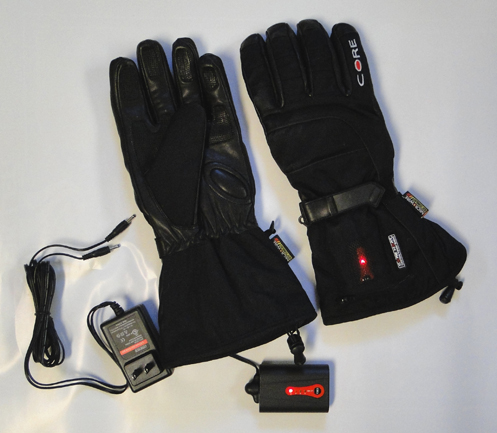
My new Gerbing Core S-2B heated gloves.

It’s a done deal, and an early Christmas. I’ve got a pair of Gerbing Core S-2B battery powered heated gloves.

I checked around town at all the shops that carry Gerbing gear and only one, Performance Cycle, on south Broadway just north of Evans, carries the battery powered gloves. As it was, they only had size Small and XXL in stock, but this weekend, the weekend of Black Friday and Small Business Saturday, they were on sale for only $170. That’s a bargain.

So we went over to the shop on Saturday because I wanted to see them for real and try them on. I figured I needed a Medium but if I bought them I would pay the sale price and then just wait for them to come in.

Turns out Small seems to be the size I needed. Judy whipped out her credit card and wished me a merry Christmas a month early.

At home, I immediately plugged in the batteries to charge and then last night we went for a walk to give them their first test. One thing I noticed immediately, as I had suspected might be the case, was that the battery in the gauntlet sits right on top of my wristwatch. For comfort I figure I’ll need to take the watch off when I wear the gloves. No big deal.

The controls work very easily. You plug the batteries in and insert them into the pouches on the gloves. Through a mesh window you can see the setting, so you push the Power button and then keep pressing it until it gets to the heat level you desire. What Gerbing says is that at 100 percent power the batteries should last you 2 hours. At 75 percent you should get 3 hours, at 50 percent 5 hours, and at 25 percent 10 hours.

I figure in the winter I’m not likely to be riding longer than 5 hours so 50 percent should do me well. On our walk they were set at 25 percent and though it was pretty cold, my hands stayed warm. Nice.

So we’ll see. Of course I want to take a ride and give them a real test as soon as possible, but Sunday was a warm day, in the 60s, so that didn’t seem like a good test. I’m sure we’ll have plenty of cold weather soon enough. Of course I’ll report the results here. Stay tuned.

Recent from National Motorcycle Examiner
Women motorcyclist research project seeks participants

Biker Quote for Today

I say, there’s no such thing as a bad day’s riding. — metaljockey

More On Heated Gloves

Thursday, October 25th, 2012

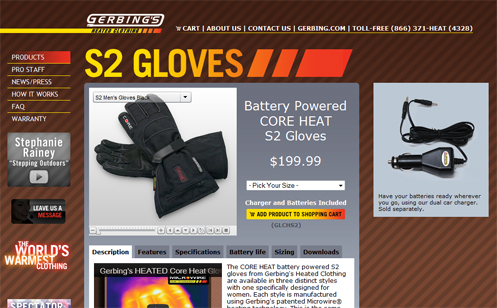
Gerbing offers battery-powered heated gloves.

My wife, Judy, was reading this blog and told me last night that I had better not go running out and buy heated gloves because that would ruin her plans for a Christmas gift. Then she thought a moment and said that actually, she probably ought to do some of her Christmas shopping early, before Gerbing realizes they lowered the price on their gloves to meet the competition, while the competition raised their price. I think I’m going to have warm hands when I ride this winter.

I also heard from my friend, Dan Leffert, in regard to his experience with heated grips and heated gloves, and I figured I would pass that along. Here’s what Dan had to say.

I have Gerbing heated gloves and I have heated grips on both bikes. On the Harley, with a full fairing, heated grips are enough down to about 40-45*. Heated gloves are much more comfortable below that for any extended riding (more than about an hour, not the Iron Butt stuff). But I hear ya about what a PITA all the cords are!

Riding the BMW 650 with OEM hand guards, grips are enough for me for rides less than an hour and only down to about 45-50*.

I just bought a pair of ridiculously expensive Lee Parks Design heavier weight gloves that have some magical insulation that changes phases and is supposed to be good in both heat and cold, and to work better with heated grips. I’ve worn them in 80* temps and switched back to my summer weights, while the jury is still out on the lower limits since it really hasn’t gotten that cold, yet. I have worn them in temps in the higher 30s and they’ve been fine, just haven’t done lengthy rides in those temps.

So there you go. Hey, why have cold hands when you can have warm hands? I look forward to sharing my experience with all of you.

Recent from National Motorcycle Examiner
Going over the edge of the Grand Mesa

Biker Quote for Today

Experience is what you get when you don’t get what you want.

Hoping For Warm Hands In Winter Riding

Monday, October 22nd, 2012

Mobile Warming's website showing the LTD Max gloves.

I’ve had my eye on getting some battery-powered heated gloves for winter riding, and I thought the time had come, but things do change.

I am specifically interested in battery-powered gloves because I tested a pair awhile back that had cords plugging into the bike and those cords were a pain in the butt. I know some companies make heated jackets where you can just plug the gloves into the sleeves of the jacket, but that means you need to buy the jacket, too. Now we’re talking expense.

So last winter I ran across this company called Mobile Warming and they were new in the market with battery-powered gloves that were much cheaper than their main competitor, Gerbing. I decided to ask them to send me a pair to test and review, and I added what I figured was a sure-fire selling point, I said “If I really like them I’ll buy them.” The woman I reached replied that she’d love take me up on that, but late in the season as it was, they were all out of stock. Get back in touch in the fall, she said.

So OK, I got back in touch with her recently and this time she said she can’t handle this, I need to contact someone else. Now I don’t know about you, but when someone offers me an opportunity to sell a product and generate some significant favorable publicity, I would tend to do what I could to bend the rules a little to make it happen. Oh well.

Then, I don’t recall how this came about, I checked their website again and found that they have raised the price of the gloves substantially. Checking Gerbing’s site I also found that they–perhaps in response to competition–have lowered their price substantially such that the two have completely shifted positions. Gerbing now sells for what Mobile Warming was asking while Mobile Warming is now selling for what Gerbing used to cost. Obviously, if I’m going to buy I’m going to be interested in the Gerbings.

But there is a third option, though it’s not as good an option. My friend Jungle recommended getting some Aerostich Warm Wrap Grips, which are pads that wrap around the grips and connect to the bike. One huge difference is the price. They only cost $45, whereas the Gerbing gloves are $200 and the Mobile Warming gloves are $270. Heating the grips instead of my hands would mean no fuss with the wires once they were installed on the bike. And at that price I could get the wraps for both my bikes and still pay less than for either pair of gloves.

The disadvantages would be that the heat would only be on the palm side of my hands, and I would not be able to walk around with warm hands as I would with battery-powered gloves. I mean, I figure that with battery-powered gloves I could take the dog for a walk in the dead of winter and keep my hands warm. That’s part of the appeal.

So I don’t know. I do intend to do something, I’m just not sure yet what. But one thing for sure is that I won’t be buying the gloves from Mobile Warming. They had their chance and blew it.

Recent from National Motorcycle Examiner
Going over the edge of the Grand Mesa

Biker Quote for Today

There’s no adventure in turning around. — Shoganai

Ensuring Motorcycle Safety by Using the Correct Tools

Thursday, September 6th, 2012

The following is a guest post provided by ProTool Warehouse.

sport bike

Using the correct tools helps ensure your bike is safe.

When discussing motorcycle safety, we usually only think about riding gear. There is another aspect of motorcycle safety that isn’t thought of as often though, and that is to make sure that you use the right tools when repairing your motorcycle. This is a very important part of motorcycle safety that when done correctly can help to prevent mechanical failures that could lead to an accident that could have easily been avoided. This article will touch on some of the most basic points to ensuring that you are using the correct tools to do the job.

Be Prepared for the Job Before Starting

To start, you want to make sure that your area is uncluttered and it helps to have the tools that you will need for the job set out beforehand. If you are unsure about which tools to use, you can always check with your repair manual, or find a guide online. Also, you will want to make sure that you have your motorcycle sitting safely upright, using a motorcycle wheel chock stand. If you don’t have one you can find them easily on the internet for under $200. Just make sure that you have the motorcycle locked firmly so as to avoid a tip-over when using force to remove a part or tightening and loosening nuts and bolts.

Use the Correct Sized Wrench

When using wrenches, make sure that the part of your engine that you will be working on is clean and free of oil. There have been many sore knuckles as a result of the wrench slipping off the bolt. And make sure that you always use the right size wrench that the job calls for. If it is a metric bolt head, it would be best not to substitute it with a standard sized wrench because it’s possible to strip the head of the bolt, leaving it looser than is required; not to mention that it would make the bolt harder to remove in the future.

The Benefits of Using a Torque

Speaking of tightening, it’s best to use a torque wrench when tightening nuts or bolts on your motorcycle. Your repair manual should give you the specifications of each nut and bolt. This is important because engine vibration can cause bolts to loosen if they aren’t tight enough to withstand the vibrations. If you can’t find the torque specifications in your manual, you can always call your local shop. They will be glad to help you.

Recent from National Motorcycle Examiner
More motorcycle thieves arrested thanks to LoJack

Biker Quote for Today

I always pack the bungee net. You never know when you might pick up something that needs to be strapped down.

A Couple Riders In The Rain

Tuesday, August 14th, 2012
wet motorcycle

My Kawi has been getting wet quite frequently of late.

An appropriate biker quote at the end of this post would be, “If you don’t ride in the rain, you don’t ride.” I’ve already used that, though, so we’ll just mention it here.

I’ve done a lot of riding in the rain recently, most particularly yesterday. Judy and I had been up in Eagle over the weekend, doing some riding with Willie and Jungle and others as part of a tour they were running. As you may recall, Willie runs Ball O’ String Custom Adventure Tours and when she has only one paying customer on a particular tour, she invites friends along to make a larger, more fun group. Of course we pay our own way.

We went up on Friday, had a couple good days of riding Saturday and Sunday, and then when Monday morning dawned we found the sky grey and dripping. No problem, we have good rain gear.

As we layered the stuff on, I offered Judy my rubber booties because she just had hiking boots, while my riding boots are pretty water-resistant all on their own. Jungle had a pair of neoprene gloves–the stuff they make wet-suits out of–that are too small for him but fit me perfectly, so I also gave Judy my rubber mittens. She stood there like a little kid getting all prepared by Mom to go play in the snow and when we were done there was no way any moisture was going to reach her other than the occasional drops that do get in under your helmet.

We took off and quickly ran into what proved to be the worst of the storm. Just the day before, between Eagle and Vail, we had seen a car that had apparently hydroplaned into the guard rail, and the ruts in the road in the car tire tracks were filled with water. Now here we were on that same stretch of road with those same ruts filled with water again. Yes, I was nervous. I stuck as best I could to the crown of the road but that’s not always possible. I tip my hat to the people who design tires for doing their job well. We had no problems.

Heading up over Vail Pass it was cold and colder. It doesn’t matter that this is August, when you get up over 10,000 feet it’s cooler than at lower elevations. Once we got over the top, though, I felt good knowing that was the worst we would be encountering. The rain continued to just past Georgetown and then the sky cleared a bit. Fortunately, it didn’t actually get warm until we were in the city, or else we’d have been stopping alongside the road to peel all this gear off.

Along the way I couldn’t help but wonder about Tom and Marsha, the paying customers we had been riding with, who I knew were also headed back to Denver. I knew Tom had good rain gear but as far as I was aware, neither of them had much to wear for warmth. Plus, they only had half helmets that Mile High Harley-Davidson had supplied to them. I couldn’t help but suspect the ride was going to be much more unpleasant for them than for us. And I did hear from Willie today that they got there safely but, yes, they got very cold.

So if there’s anyone out there reading this who is planning a riding trip to Colorado, this is why this site has the Good to Know page. It opens with this paragraph:

If you’re coming to ride Colorado’s passes and canyons in the summer you may think you won’t need warm clothing. You would be wrong. With some passes higher than 12,000 feet, it is not unusual to run into temperatures in the 40s even in August. Snow is not out of the question. Be sure to bring all your winter gear: gloves, electric vest, leather chaps, whatever.

Believe it.

Recent from National Motorcycle Examiner
More parks and more memories on OFMC 2012 ride

Biker Quote for Today

You’re a biker wannabe if you don’t own a rain suit.

My Lesson In Changing A Motorcycle Tire

Tuesday, August 7th, 2012
Loading my Connie onto the tow truck.

Loading my Connie onto the tow truck.

I’ve thought for a long time that I ought to learn how to replace a tire on my motorcycle. Having a flat on the first day out of the annual OFMC trip seemed to offer the perfect opportunity. I had the bike towed to Eagle, where my friend Jungle Fuhrman would help me get moving again. Let’s do this job.

My initial intention was to tell Jungle I wanted to do the work myself and just have him give me directions. But he dove right in and I stood and watched closely. The first thing he did was remove the cotter pin from the rear axle. Then he demonstrated to me that I will never change the tire on my bike because the next step was to remove the bolt that the cotter pin held in place. The problem is that the bolt is recessed and in order to get to it you have to have a wrench with a lip that reaches down into the recess. Count me out right there.

So I watched. In order to fully access the various bolts it was necessary to remove the mufflers. That was simple enough, just comprising two bolts per muffler. Then Jungle worked the axle loose and extracted it from the left side. Here he was faced with a problem. He knew from working on his own Concours that he was not going to be able to get the wheel out from under the fender without doing one of two things. What he had done on his own bike, and what he made it clear he was prepared to with mine if I consented, was to cut the lower six inches or so off the rear fender. I didn’t like that idea so I declined to say “Sure, go ahead,” as I knew he wanted me to say.

That meant he also needed to remove the shaft housing where the rotation of the drive shaft is converted 90 degrees to power the rear wheel. That was a matter of removing four bolts and I was pleased to find it wasn’t that much effort. Now the wheel could be pulled out and we could go to work on the tire.

Jungle’s tire-changing tools are over at a friend’s house so we went there for that part of the work. I had seen this done often enough that there was nothing new here. The tire was pulled off and Jungle applied a patch. He put the tire back on the wheel and aired it up and . . . it still leaked. Off came the tire once again and now we went to another friend’s shop to get a tool to truly prepare the inner tire surface to take good hold of the patch. With a patch applied in a way that had to be good enough, the tire was remounted, aired, and . . . it still leaked.

Now Jungle was thinking that there must be some damage to the plies allowing air to pass through and out. Which meant the tire could not be saved. A plug might work, or it might not. But it would be better to replace it.

Of course, this really hurt considering that I had just bought that tire six days earlier and had only put 1,500 miles on it, but you’ve gotta do what you’ve gotta do. Normally, getting a replacement tire in Eagle on a Saturday could have been simply out of the question, leaving me to get even further behind my friends and possibly ending my trip right there.

But this is where the amazing good fortune of having this occur just 55 miles from Eagle came into play. Jungle has a Concours just like mine so I figured he just might have a tire on hand. In fact he had two. One was a brand new tire that he had bought for another bike, but it was the right size. Only thing is it was bias ply and the Connie usually takes radials. Plus, that would mean mixing a radial front with a bias-ply rear. The other was an old tire off Jungle’s Concours. He and Willie do a lot of traveling and when the tires on the bike aren’t going to be good enough to last the entire trip he will put on new tires before the trip. Thus, he had a partially used, radial Avon tire of the right size. My tires were Dunlops so that meant mixing a Dunlop front with an Avon rear, but I figured that was the best bet.

So Jungle mounted up the Avon, got everything put back together, and I was in business! I was able to leave Eagle around 2 p.m. that afternoon and then had to do some hard riding to catch up with the guys, who had since gone on from Grand Junction to Marysvale, Utah. I arrived there around 9 p.m. and finally the OFMC was together and off on this year’s ride.

Just a word about Jungle. He’s a mechanic but doesn’t work out of a shop. He is an I-come-to-you mechanic, so if you’re in the Eagle area and need a motorcycle or auto mechanic, give him a call. He’s in the phone book.

Recent from National Motorcycle Examiner
Problems, miscues kick off OFMC 2012 ride

Biker Quote for Today

Before enlightenment, change oil and adjust valves; after enlightenment, change oil and adjust valves.