Archive for the ‘Motorcycle Safety’ Category

Spread the Word: Abolish Traffic Signs and Signals

Monday, September 15th, 2008

This may sound strange at first but give it time to sink in. I know it can work because I’ve seen it in action.

We were struck this summer when we were over in Europe by how in the entire city of Rotterdam there must not be more than 30 traffic signals. Contrast that to any city in the U.S. where almost every single intersection has either a signal or stop signs. And yet pedestrians, bicyclists, cars and trucks, and people on scooter and motorcycles mingled easily and safely. How can this be?
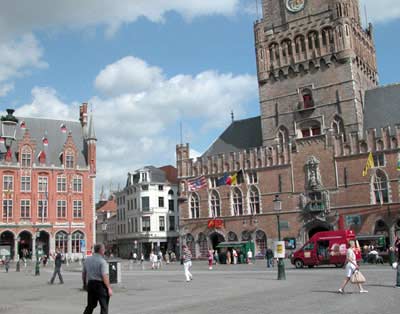
plaza in BrugesIf you want a better discussion of the concept than I can give, I refer you to this article in the Christian Science Monitor. It tells about a small town in Germany where the main street is a busy highway and yet they removed all signs and signals and also removed all curbs and sidewalks, making the whole thing into a “naked” square. And it works!

We saw the same thing in Bruges, Belgium. Bruges has several large plazas where the entire area is cobblestone, with no lanes or anything. Each person, whether on foot, bike, car, or what have you, takes the most direct route to where they’re going. The key is, rather than paying attention to traffic signals and such, everyone pays attention to everyone else. You have to pay attention to where you’re going and make eye contact with the other person when your two paths intersect. And it does work.

This excerpt from the article shows in part just how it works:

Two months into the experiment, “Instead of thinking, ‘It’s going to be red, I need to give gas, people have to slow down, to look to the right and the left, to be considerate” says Ms. Rubcic.

The bonus? Town people recognize they have become a bit closer to one another. “The whole village has become more human. We look at each other, we greet each other,” she says.

There are some issues, as there are with all changes. In particular, the new “shared space,” as it is called, can be difficult to navigate by those who are blind and who previously depended on sidewalks and signals. Efforts would surely be needed to address such issues, but surely answers can be found.

In the meantime, shared space experimentation is a variety of European countries has resulted in a reduction of accidents, and the idea is spreading. As high gas prices prompt changes in American transportation choices it seems inevitable that we will need to revise our thinking, too. I look forward to the discussion.

Biker Quote for Today

When everything is coming your way, you’re in the wrong lane.
Colorado Program Promotes Rider Training

Friday, September 12th, 2008

Live to ride. Ride to live.

That’s a slogan we all know and appreciate. And clearly the first half of it is especially important. In Colorado last year there were 90 riders and passengers killed in motorcycle crashes, the highest ever recorded. You’ve got to live or you’re not going to ride.

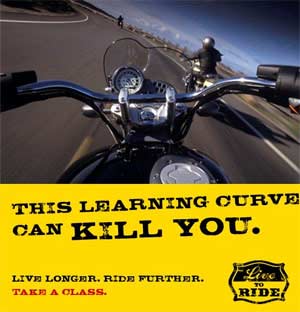
Live to RideIt seems appropriate then that when the State of Colorado set up a motorcycle rider training program they named it the Live to Ride Program. Here’s a look at what the state put together.
The Live to Ride program is based around what is called “MOST,” which stands for Motorcycle Operator Safety Training. The MOST mission is “to provide high-quality, low-cost motorcycle training to residents and active-duty military personnel.” The fees we pay for motorcycle endorsements on our driver’s licenses and motorcycle vehicle registration fees fund MOST. The law that set all this up specifies certain minimum requirements for trainers who wish to participate in the program. MOST training classes are based on the Motorcycle Safety Foundation (MSF) model.

A list of certified MOST trainers is listed on the site. Currently there are 12 organizations on the list, including, not surprisingly, ABATE, and a bunch of others that I have frankly never heard of. That sort of raises my interest. Maybe I’ll have more to tell you about some of them later.

So anyway, Colorado is putting our money where our mouths are by setting up this program. Now it’s up to us. I know I took an Advanced Rider course through the MSF some years ago, as well doing a training day at a racetrack that was set up through the Concours Owners Group. It’s probably time for a refresher.

If we don’t want the state imposing safety measures we don’t want, such as helmet laws, we have to make it our duty to bring down these accident statistics. Helmets are great if you go down but it’s more important to not go down in the first place. Fewer accidents, not safer accidents, should be the primary goal.

Biker Quote for Today

Ride To Eat! Eat To Ride!

Does Your Group Use Signals?

Monday, August 18th, 2008

It can be tricky trying to communicate with your buddies when you’re out riding and you don’t all have radio communicators. Do you have signals that you’ve agreed on? Does everybody know what they are? Do you use them?

Signaling a hazard aheadThe OFMC is probably pretty typical in this regard. Early on, John and Bill and I recognized that there were a couple things we needed to be able to communicate to each other. We didn’t knock ourselves dead trying to think of every eventuality. We just came up with about three that we considered extremely necessary.
Were they what other bikers use? Heck, we didn’t know, and we didn’t really care. As long as we understood them that was all that mattered.

Now, however, we travel with a much larger group, generally eight or nine. And have we sat down and discussed signals with all these guys as they have joined the group? No.

With that lapse in mind, about a week before we took off on this year’s bike trip I emailed the group a link to a page I had found on the Colorado VTX Range Riders site. This page shows a number of signals that I presume are pretty widely understood. I figured we might as well at least think about how we might communicate better.

So the interesting thing is that while none of the guys sent a response to my email, it turned out they did check out the page and even paid attention to it. I only realized this at one point during the trip when I heard one of the guys say to another that “You must have looked at that list of signals because I saw you indicating that dead animal on the road.”

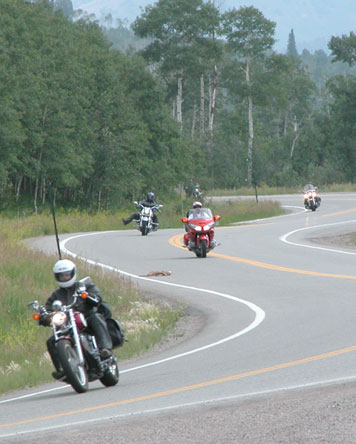
And what is even more surprising is that I recorded it on film (pixels?). I had ridden ahead of the group to shoot some pictures and heard them coming along, so I turned to shoot some shots of them riding by. When I looked at the shots later, son-of-a-gun, there’s Johnathon kicking his right foot out to tell the guys behind him that there’s a hazard in the road ahead.

Gosh, I felt like maybe I’d done something good.

Biker Quote for Today

Practicing the dark and forgotten art of using turn signals since ’88.

DOT Sec. Mary Peters Good for Bikers, Wrong on One Priority

Friday, August 15th, 2008

I’ll cut straight to the chase. I still disagree with U.S. DOT Secretary Mary Peters in her effort to divert money earmarked for motorcycle rider training to promote helmet usage.

The Motorcycle Riders Foundation sums up the issue in this way:

The . . . funds were a direct result of years of intense lobbying by state motorcyclists’ rights organizations and individual motorcyclists from across this country, and were intended for two very specific aspects of motorcycle safety — motorcycle rider education and motorist awareness of motorcycles. These two aspects of motorcycle safety have been grossly under-funded at the state level for years, often solely at the direct expense of motorcyclists themselves through licensing and registration fees. . . . Should Peters get her way, that trickle becomes nothing but a drip.

A little background. I wrote about this first in this post after reading about it in American Motorcyclist, the monthly magazine of the American Motorcyclist Association. I was pretty down on her. Randy Bingner then replied that what Mary Peters is doing for the motorcycling community is substantial and overall, “It is very difficult to be critical when you look at the big picture.”

I told Randy I’d take another look and delve deeper into the issue. Well, I’ve done that. I wrote favorably about her efforts in general two days ago but I still have to disagree on this one point. And I’m not the only one.

Here are three quotes from three organizations that sum this matter up pretty succinctly:

The only true steps to motorcycle safety are proactive measures which prevent a collision from occurring at all rather than reactive steps that may offer some level of injury reduction only after a crash has already taken place. — Motorcycle Riders Foundation

The evidence is obvious: Crashes kill bikers. Conversely, Crash Prevention saves lives. — ABATE of North Carolina

We all know that “safer crashes” are no substitute for “crash prevention.” — ABATE of Arizona

This is what I’ve said right from the beginning. To quote myself, I said “That’s why I believe that diverting funds from motorcycle safety training to mandating helmets is wrong-headed. We all need to wear helmets at times; some of us wear them all the time. We should all also take an occasional refresher training course. The Motorcycle Safety Foundation and ABATE have expanded their offerings lately due to demand. What we don’t need is some bureaucrat, even one who rides, cutting training funds.”

I stand by that statement. The point I want to make however goes back to what Randy was saying. We are better off having a biker sitting in her chair than not. Mary Peters has done a lot of good things in her tenure in office. But nobody is perfect, and even family members can disagree. What we need to do now is not scream obscenities at her for her one mistake, we need to applaud her for the good things she is doing and work diligently and patiently with her in trying to help her see the error of her ways in this one area. And fight it hard in Congress if that becomes necessary.

Biker Quote for Today

Most vehicles have one person in them. So if you have one person riding a 400-pound vehicle, and another person riding a 4,400-pound vehicle, why are you putting the restrictions on the motorcyclist? You should really be putting the restriction on the person driving the SUV. — Jay Leno

Follow-up on Mary Peters, Secretary of US DOT

Wednesday, August 13th, 2008

At the urging of Randy Bingner I have been doing some research to learn more about U.S. Secretary of Transportation Mary Peters’ efforts in regard to motorcycles and motorcycling. Let me recap.

Mary Peters rides a Harley. She’s one of us. And as one of us she has used her authority to promote issues of concern to us. For the most part this is very good. You can read the DOT’s recommendations in its Action Plan to Reduce Motorcycle Fatalities. The proposals include:

  • Conducting the Motorcycle Crash Causes and Outcomes Study, a comprehensive examination of the factors that causes crashes, which will help the Department develop stronger programs and strategies to combat the rising trends in motorcycle crashes.
  • Developing National Standards for Entry Level Motorcycle Rider Training that will set the baseline for novice motorcycle rider training programs conducted in the United States.
  • Amending Federal Motor Vehicle Safety Standard (FMVSS) No. 218, Motorcycle Helmets, to address the falsification of helmet certifications facilitated by the current labeling requirements of the motorcycle helmet standard.
  • Distributing Roadway Safety for Motorcycles, a brochure containing official guidance on designing, constructing, and maintaining roadways for increased motorcycle safety, to road planners, designers, and engineers.
  • Creating a training program designed to educate police on motorcycle safety and the specific enforcement efforts they can undertake to reduce motorcycle crashes.
  • Marketing a “Share the Road” campaign kit for use by States, local communities, and motorcycle organizations.

There is no question that reducing motorcycle fatalities is of concern to us all. As reported in the Action Plan, “In 2005, the motorcycle fatality rate was 73 per 100,000 registered motorcycles. By comparison, the fatality rate in the same year for passenger vehicles per 100,000 registrations was 14.” Put a little differently, in 2006 motorcycle fatalities exceeded pedestrian fatalities for the first time ever since records have been kept.

Far too many of these deaths are at least associated with alcohol use and riders who are not licensed to ride a motorcycle. These deaths can be prevented. As Randy said in an article he wrote for his local HOG group, “far too often, we are killing ourselves.”

So what’s the issue? Well, as I reported in an earlier post, Sec. Peters has proposed that money earmarked for rider training programs be diverted to efforts to increase helmet usage. And while we may all be family, family members sometimes disagree. That would be the case here. A number of organizations that you know, and may even belong to, are not happy with this proposal. They include the American Motorcyclist Association, the Motorcycle Riders Foundation, and various ABATE chapters.

I’ll address their concerns in my next post.

Biker Quote for Today

There are drunk riders. There are old riders. There are NO old, drunk riders.

MRF Meeting of the Minds Set for Denver in September

Monday, August 11th, 2008

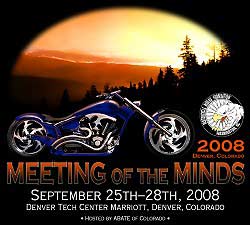
MRF Meeting of the MindsWe all know that bad legislation that would unfairly affect motorcyclists gets introduced and sometimes passed in legislative bodies at all levels. Who should we thank when these proposals are defeated or revoked? I’ve mentioned the American Motorcyclist Association on numerous occasions, and they do a lot of work in this area. Another organization fighting for our rights is the Motorcycle Riders Foundation.
Here’s what the MRF says about itself on its website home page:

The Motorcycle Riders Foundation (MRF), incorporated in 1987, is a membership-based national motorcyclists’ rights organization headquartered in Washington, D.C. The MRF monitors and when necessary, sways federal legislation and regulatory action that pertains to street riders. The MRF concerns itself with what is going on in the arena of motorcycling safety education, training, licensing, and public awareness. The MRF provides members and state motorcyclists’ rights organizations with direction and information to protect motorcyclists’ rights and motorcycling. The MRF sponsors annual regional and national educational seminars for motorcyclists’ rights activists and publishes a bi-monthly newsletter, The MRF Reports.

Well, the MRF is coming to Denver. Every year the organization holds two regional and one national conference. The Meeting of the Minds, MRF’s national conference, will be held in Denver this year Sept. 25-28. This is the kind of conference you will want to attend if you care passionately about protecting our rights. Registration before Aug. 18 is $60 for members, $70 for non-members.

The agenda includes topics such as “The Motorcycling Community – Working Together,” an international transport forum on motorcycle safety, impaired riding, state legislative updates, and more, as well as some fun activities and — or course! — a ride.

I’ll be bringing you more information about this as it draws near, and with any luck I’ll manage to attend at least part of it. If you want to attend, here’s the link for registration.

Biker Quote for Today

Training, the best safety and performance “equipment” you can get!