Posts Tagged ‘motorcycle crash statistics’

Motorcycle Safety Stats

Monday, September 15th, 2025
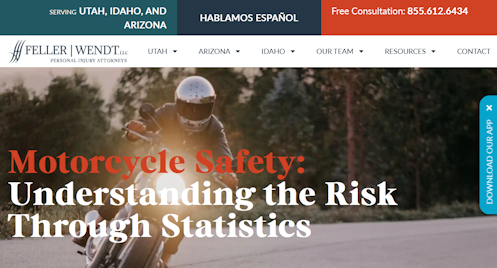
The Feller Wendt web page

I got an email the other day from a law firm that does advocacy for motorcyclists involved in crashes. Feller & Wendt, LLC™ appears to operate only in Utah, Idaho, and Arizona but maybe they’re interested in my blog because they’re considering expanding to Colorado. Just speculation.

Nevertheless, they were offering for my use here a link to an article they have put out that looked kind of interesting. “Motorcycle Safety:Understanding the Risk Through Statistics” can be summed up by this introductory line: “This guide brings together the latest statistics and expert insights to help riders make informed choices. Whether you are a seasoned biker or just starting out, understanding the data can make a life-saving difference.”

It is broken down into these sections:

  • Motorcycle Accidents: By the Numbers
  • How Weather Conditions Impact Motorcycle Safety
  • The Importance of Wearing Protective Gear
  • Speeding: A Leading Factor in Motorcycle Accidents
  • The Risks of Riding a Motorcycle at Night
  • Fatigue and Motorcycle Safety: The Dangers of Riding While Tired
  • Distracted Driving: A Growing Concern for Motorcyclists
  • Age and Its Impact on Motorcycle Safety
  • Safety Tips for Beginner Motorcyclists
  • Road Safety Tips Every Motorcyclist Should Know
  • Practice Driving Safely

I took a look at each topic and while I can’t say I encountered anything that was completely new to me, some of it stuff I hadn’t thought about in a long time, so good to refresh. It’s not actually very long, and it does seem better conceived and put together than a lot of what you’ll find out there, so I’d say it is worth taking a look.

Biker Quote for Today

“There is a delicate ridge one must ride between fear and reason on a motorcycle—lean too far in either direction and there will be consequences.” — Lily Brooks-Dalton
OK, One Final Post About The 2018 Crash Report

Thursday, December 19th, 2019
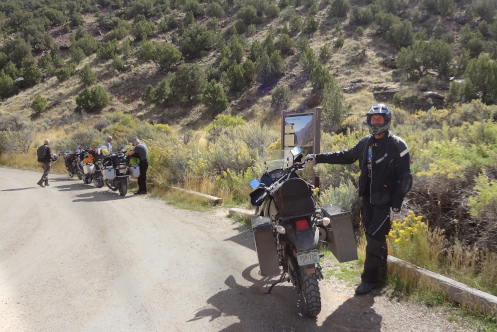
Motorcycles at a rest stop

Taking a break.

In all the previous articles about this data dump I have drawn from the tables, which had been extracted and sent to me. I went to look at the full report and found just a bit more info of interest. Then I promise I’m through with this discussion.

The first thing is location. Where in the state are bikers most at risk? A table on annual motorcycle fatalities from 2014 through 2018 shows a lot of interesting numbers. Adams County is always one of the high ones. Over that five-year span the count of fatalities has been 7, 7, 13, 13, 10. Alamosa County, on the other hand is usually very safe but 2015 was a terrible year: 0, 7, 0, 0, 0. What the heck happened in 2015?

Not surprisingly, the metro area counties–which have the greatest population–mostly have the highest fatality rates, although for some reason Douglas County usually trends a bit lower than the others.
Arapahoe County–3, 0, 11, 6, 9
Denver City/County–7, 14, 14, 13, 7
Douglas County–3, 5, 10, 5, 3
Jefferson County–11, 14, 15, 9, 12

Boulder County is also surprisingly low, considering how many people there are: 5, 5, 4, 5, 3.

El Paso, Gunnison, Larimer, Mesa, Pueblo, and Weld Counties are also higher, in conformity with their populations.

Of all Colorado counties, Baca, Bent, Cheyenne, Costilla, Crowley, Dolores, Hinsdale, Kiowa, Kit Carson, Lincoln, Otero, Phillips, and Sedgewick Counties report zero motorcycle fatalities in this five-year span. That’s pretty impressive.

By age, the most fatalities occur among those who are 20-29 or 50-59. The five year totals for each age group are under 20–14; 20-29–125; 30-39–86; 40-49–87; 50-59–119; 60-69–74; over 70–25.

OK, that’s enough. I just thought that all these numbers in this whole series of posts were interesting and could hopefully be helpful to people in understanding what the greatest risks are. I hope I haven’t bored you too much.

Biker Quote for Today

We know you’re a poser if you think that a kick-starter is a mocha latte.

Where Were You On The Road And What Was It Like When You Crashed?

Thursday, December 12th, 2019
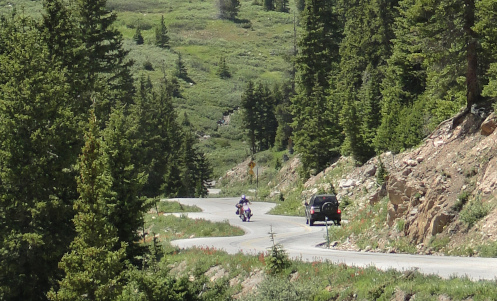
motorcyclist on Independence Pass

A rider heading up Independence Pass.

I believe this will be the last post about this Colorado MOST 2018 report on motorcycle crashes. The only tables left that I haven’t discussed have to do with what parts of the road riders were on when they crashed and what the conditions were.

With 1,247 crashes counted, the number one location was essentially anywhere except at an intersection. The table lists it as “Non-intersection.” Were they going straight, was the road curvy? No way to know. But then number two was “At intersection,” with 688 crashes counted. The lesson here should be obvious: be extra careful when you’re approaching an intersection.

Number three is “Intersection related” but it’s not obvious what that implies. There were 278 of those.

“Driveway access related” is next, with 127. So yeah, be alert at driveways, too. Heck, be alert all the time. It’s your skin we’re talking about here.

The remaining tallies are “Ramp” with 85; “Roudabout” with 24; “Alley related” with 15; and “Unknown” with 6.

And then we come to road condition. Here the preponderance is overwhelming: “Dry” with 2,341 crashes tallied. “Wet” is in second place with just 83. So OK, it seems that road condition not anywhere near the factor I would have expected it to be. That’s why you study data.

Barely one crash in 100 involved “Foreign matter.” To be specific, 24. “Wet w/visible icy road treatment” tallied only 5.

The rest were “Icy” with 3; “Snowy” with 2; “Muddy” with 1; “Slushy” with 1; and “Unknown” with 10.

Not a lot of surprises there. Not too many of us get out on our bikes when the roads are icy, snowy, muddy, or slushy. If we did I’m sure those numbers would be a lot higher.

Just to wrap up, here are some overall stats that the report broke out.

Motorcyclist Fatalities
• 103 motorcyclists were killed in motorcycle crashes in 2018, 94 were male and nine were female. Ninety-nine were motorcycle operators and four were motorcycle passengers.
• Motorcyclist fatalities represented 16.3% of Colorado’s total traffic fatalities (103 of 632).
• The number of motorcyclist fatalities remained the same in 2018 compared to 2017.
• 77 motorcycle operators involved in fatal crashes were determined to be “at fault.”
• 39 of the fatal motorcycle crashes involved only the motorcycle and no other vehicle.
• In 2018, 54 motorcycle operators killed in a fatal crash tested positive for alcohol or drugs. Fourteen of the motorcycle operators tested positive alcohol (BAC >=0.08) only, 28 operators tested positive for drugs only, and 12 motorcycle operators tested positive for both alcohol and drugs.
• 54 motorcycle operators killed were not wearing a helmet.

If you’re reading this you weren’t one of these folks. Please don’t be one of them next year, either.

Biker Quote for Today

Sometimes the road you travel doesn’t lead to the destination you had hoped for. But if you can look back on it and still smile, then it was worth it.

Helmets, Licenses, And Motorcycle Crashes

Thursday, December 5th, 2019
MOST Program annual report

MOST Program annual report

Now we come to what I consider a particularly interesting portion of the 2018 report on motorcycle crashes put together by the Colorado Motorcycle Operator Safety Training (MOST) program. I’m talking helmet usage and rider legality, i.e., having motorcycle accreditation on your driver’s license.

Unlike the other tables in this report, where they list the top 10 items, there are only 7 choices here. There are 2,470 crashes counted.

“Helmet properly used” was ticked off for 1,223, or 49.5% of all motorcycle operators, and 66.7% for all riders trained through MOST. “No helmet” comes second at 882, for 35.7% of all riders and 18.0% of MOST-trained riders. So far rider training is looking pretty good, although we again have the unanswerable question of, did they get the training before or after the crash?

Number three on the list (109) is “not applicable.” These 177 are explained as “(Cars/Trucks).” Which seems odd. If these were people in cars and trucks, why were they included in this listing of motorcyclists? Then, with 54, is “Helmet improperly used.” Gosh guys, if you’re going to bother wearing a helmet maybe you should at least strap it on properly.

Then there is “Available, not used” at 20 and then “Bicycle helmet” at 5. Really? You think a bicycle helmet is going to do much good in a motorcycle crash? Heck, I don’t see how bicycle helmets do much good even in bicycle crashes. They sure haven’t helped my sister-in-law in the two crashes she has had on her bicycle.

That’s the list. What we are told elsewhere in the report is that there were 103 fatalities in 2018 and of them, 54, or 52%, were not wearing helmets. Which means 48% were wearing helmets, which, as always, gives the lie to those who seem to think the answer to motorcycle fatalities is to make everyone wear a helmet. Helmets help but it’s going to take more than just helmets.

Then we come to licensing. Out of 2,470 riders, there were 1,393 total listed as “Endorsement required & complied with.” For MOST-trained riders it was 64.0%. Again, that’s looking good for training though it also is particularly muddy regarding training before or after the crash.

A total of 563 riders had no endorsement, and then we have 371 with “Endorsement required & not complied with.” I’m really not at all sure what that is supposed to mean. How does that differ from no endorsement?

Then there are 51 listed as “Endorsement required & compliance unknown” and another 92 with “Unknown.”

I don’t know about you but I tend to suspect that riders who have MC endorsements are more likely to be safe riders. At the very least it presents a certainty that you have at least a minimum of ability to control the machine. No it doesn’t say a thing about the ability to maneuver a tight curve at a high speed but at least it’s a start. That’s where further rider training is a good thing. I’ve taken five rider training courses and done one track day and I can tell you pretty confidently that I’m a better rider than my friends who have done none of these.

Biker Quote for Today

You know you’re a biker if you can identify bugs by taste.

What Were You Doing When You Crashed?

Thursday, November 28th, 2019
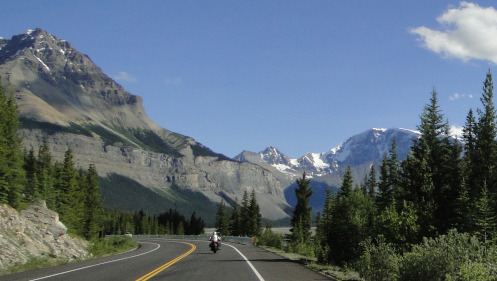
motorcycle on highway through the mountains

Riding like this is much more fun that crashing.

The next table in the 2018 report from the Colorado Motorcycle Operator Safety Program (MOST) addresses the movements of the riders who were found to be at fault in their crashes. This is an interesting one.

What were the huge majority of riders doing when they crashed? Going straight. Out of 1,297 riders counted in the top ten categories, fully 845 of them were going straight. Wow. I’d really like to know just what was going on that all these folks crashed going straight. I mean, I can understand if in going straight they were also running a red light, but I doubt that was the case with even very many of these 845.

The number two on this list, at just 96, was slowing. Once again these raw statistics seem to raise more questions than they answer. Were these folks slowing because they saw danger ahead? Were they just not paying attention because they were stopping, so what is there to watch out for? And if they were slowing because they saw danger ahead, were they really at fault, unless they were moving at excessive speed and otherwise would have been able to stop safely? Is it just assumed that in a single-vehicle crash that the driver/rider was at fault?

We have to get to number three on the list to get to what I think most of us would have assumed was a much higher item: turning left. This only totaled 75 crashes. This one at least doesn’t make you wonder what the heck was going on; we all know the screw-ups that can happen in left turns.

The rest of the list runs out as follows: Spun out of control–69; Making right turn–61; Changing lanes–49; Passing–36; Avoiding object in the road–31; Weaving–24; Making U-turn–11.

I would really have expected changing lanes, passing, and avoiding objects in the road to be higher on this list. It goes to show that data beats guessing most every time.

And by the way, the breakdown of all riders vs. MOST-trained riders is also of interest. Among those going straight, the figures were 60% of all riders but 68.8% of MOST-trained riders. In the other nine categories, in five cases the all-riders group had higher percentages and in four the MOST-trained riders had higher percentages. Most out of whack was avoiding objects in the road. The all-riders percentage was 2.2%; MOST-trained hit 5.2%. I mean, sheesh, you’d really think the trained riders would be better at avoiding stuff. Or were these riders who took the training after they crashed?

Biker Quote for Today

Squid: A textbook “squid” in MC instructor lingo was typically male, 16-20 years old, sport bike, insufficient safety gear, who rode/rides like an idiot, pulls power wheelies in heavily pedestrian traveled areas to showoff, angering non-riders and riders alike. The type of idiot that you see being a bonehead as they scream by your favorite summer outdoor patio where you face palm and shake your head.

Does Rider Training Work?

Thursday, November 21st, 2019
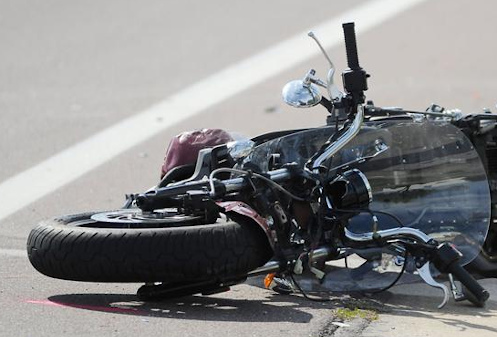
crashed motorcycle

Not something you ever want to see.

I’ve been writing about Colorado motorcycle crash statistics from 2018 and–in part–how these numbers related to rider training. That prompted a note from a friend with considerable experience in this area. Being a modest guy he asked that I not name him.

What this all related to was what I had pointed out about how the crash figures for rider trained through the Colorado Motorcycle Operator Safety Training (MOST) program seem to suggest that these riders crash more than those who have not taken the training. The question I asked was, did these riders crash before or after the training? When I queried Colorado State Patrol (CSP) coordinator for the MOST program he told me he couldn’t answer that question now but in future tracking they would include that data. He said he sure hoped the crashes occurred before they took the training.

Not to be too repetitive but, as I pointed out before, many riders take the course in order to get their license after they have been cited for riding without proper licensing. Often that occurs when they are involved in crashes, thus they get counted as MOST-trained riders but the crash occurs before they take the training.

Well, what my friend tells me is that back in 1976 the National Highway Transportation Safety Administration (NHTSA) did a study to see how effective driver’s training for teenagers. He told me that “the study made waves when it was reported that driver training actually resulted in no fewer crashes, injuries and fatalities. The theory was that trained drivers were more confident and took more risks, but because they were still inexperienced, they still made bad judgments.”

Now apparently, there were some folks who didn’t like having the government–at whatever level–putting up the money for driver training programs, so they took the findings of this report and soon the in-school driver’s ed program, such as the one I took as a teenager, were gone. In fact, it has been claimed by some people in a position to know, that the books were cooked a bit on this study in order to reach that conclusion, for that purpose.

My friend continues: “Fast-forward to today, and many safety-crats have long held that driver (and rider education) is not worth investing public dollars. It is an argument that is sometimes summoned to push back against SMROs (state motorcyclist rights orgs) that seek to replace helmet mandates with rider education programs.

“If stats are being published that suggest rider education does little to reduce crashes and fatalities, be prepared for pushback from the safety community to reduce or eliminate funding, and possibly attempt to reinstate the helmet mandate.”

So wow, I didn’t realize I was poking such a hornet’s nest when I innocently wondered if those crashes took place before or after the rider received training. That makes it really important now that CSP tracks the timing of crashes vis a vis time of training. We’ll have to wait for the 2019 crash data to find out.

Biker Quote for Today

Experience is what keeps a man who makes the same mistake twice from admitting it the third time around.