Archive for the ‘Biker Issues’ Category

Helmets and Helmet Law Statistics

Friday, April 25th, 2008

I got the obligatory newspaper clipping from my mother the other day. You know, the one that talks about how motorcycle deaths are up at the same time that some states are relaxing their helmet laws.

Let’s face it, moms are just being moms when they send these things. They would rather you didn’t ride at all because “it’s too dangerous” but if you’re going to ride “you’d better wear your helmet every time.” They also tend to believe strongly that all states should mandate wearing helmets all the time.

I disagree. I do wear my helmets (I have several) a lot of the time. But there are times when I do not, and I would argue that I know more about the risk I am taking than someone who has never been on a motorcycle in their lives. I’m also a registered Libertarian, so obviously I believe the government has no business telling me I have to wear a helmet.

So let’s look at the information this particular article presents. It came from the Gannett News Service so presumably it appeared in a number of papers, maybe yours.

I’ll give them credit, it talks about deaths rising on the basis of per 1,000 riders. So many such articles say simply that deaths are up, but fail to mention that the number of riders is up as well. And if deaths per thousand riders are increasing then that is definitely of concern to us.

My issue is with the interpretations that people put on the statistics. They’re much too simplistic. Helmets are not some miracle cure for motorcycle fatalities. For example, the article states that “About 42 percent of riders killed were not wearing helmets.” What that means then is that 58 percent were wearing helmets — and they were killed anyway. It also implies that some percentage of those helmetless riders who were killed would have been killed even if they had been wearing a helmet. To me that says the cause of the accident should be more the focus than the gear the rider was wearing.

Another factor noted is the increase in the age of the average rider. Decreasing physical dexterity and slower reaction times are listed as the suspects.

Then it goes on to say that “Half of motorcyclists killed between 2002 and 2006 lost control and crashed without colliding with another vehicle.” This is what I’m talking about above. How did these accidents occur? Surely some involved other vehicles that may well have been the cause but were not involved in any contact. But in other cases, what we are talking about is rider error. This calls for better training but, again, has nothing to do with the gear the rider is wearing.

The article goes on to say that southern states have higher death rates, and they attribute that to the longer riding season. More time on the road equals more opportunity for accidents. That makes sense.

Then it talks about how the National Transportation Safety Board has taken the unprecedented action of unanimously recommending that all states mandate helmets at all times. Their justification for this is that “Medical and other costs for unhelmeted riders involved in crashes are staggering.” OK, then how about this: Let’s require all drivers and passengers in cars to wear helmets. There are a heck of a lot more of them getting into accidents and surely the costs are mega-staggering. Race car drivers wear helmets. Why shouldn’t mom and pop and the kiddies? Of course I’m sure they intend to imply that motorcyclists who do wear helmets and get in accidents cost the system nothing. That is what they’re saying, isn’t it?

And then finally, at the very bottom of this 51-inch article, they mention that, oh by the way, the two states with no helmet laws of any kind, Iowa and New Hampshire, have death rates of 3.5 and 3.0 per 1,000 respectively. Meanwhile, for example, Mississippi and Maryland, which require all riders to wear helmets all the time, have death rates of 20 and 12 per 1,000 respectively. Of course these numbers are discounted, and are explained away saying that in New Hampshire the riding season is short and in Iowa the ground is flat and visibility is good.

So thanks for caring Mom, I love you, too. But I’ll continue to make my own decisions and I’ll continue to belong to the American Motorcyclist Association and support their efforts to protect our right to decide.

Biker Quote for Today

Gray-haired riders don’t get that way from pure luck.
On The Road Again: An Update

Friday, April 18th, 2008

OK, it took a new battery to get me running again. That’s after having put in a new battery in October. That’s just wrong.

Unfortunately, all the issues did not get answered. The first question is why did this new battery go dead after just five months? Then, why didn’t it take a charge at home? Why did it take a charge in a shop but then turn up dead again a few weeks later?

I bought the previous battery from Pep Boys in October. That store closed so I took the battery yesterday to a different Pep Boys. There I was told 1) anything sold from the other store was on an “all sales are final” basis since it was closing. 2) The battery had only a three-month warranty so they had no obligation to do anything about it. 3) We’ll be happy to sell you another battery.

Thanks but no thanks.

So I went to Performance Motorcycles down the street and described the situation. The very savvy woman behind the counter said what I was describing said that the battery took a surface charge and that was what got the bike started, but why it was then dead a couple weeks later. She also said this Energizer battery was a low quality battery compared to the Yuasa battery that is OEM on Hondas. So I bought a new Yuasa. It has a one-year warranty.

Then things got complicated when I got home. First I discovered that my battery charger somehow got switched from 12 volt to 6 volt. That could explain why the battery wasn’t charging properly, if in fact it was not defective. And then I found that I did not have good contact between the cables and the battery previously. The way it works, I have the cables coming to the battery posts, and then I also have the wires for my trickle charger and my electric vest to hook up there as well. When I removed the battery in March, the first time I had the problem, I did not connect the vest wires because it’s getting warm now. But what I discovered is that that meant the screws I used were too long, and when screwed in as far as they would go did not snug the contacts up to the posts.

So between 6 volts versus 12 volts, and not a good connection, it is no wonder that I couldn’t give it a charge, or even that it went dead between rides. That Energizer might have been perfectly fine after all. Except that it had gone dead the first time. No new battery on a bike that has been regularly ridden should be dead.

That means I’ll never know what the true situation was. But what I do know is that I’m running again and went for a ride yesterday. That’s what it’s all about, right?

Biker Quote for Today

A bike on the road is worth two in the shed.

Easy Way To Confirm A Defective Battery?

Wednesday, April 16th, 2008

I was going to ride my CB750 yesterday, but it wouldn’t start. This is just like what happened a few weeks ago. The battery was dead.

The problem is, this is a new battery. I just bought it back in October. It worked fine then, it worked fine in November, it worked fine in December, it worked fine in January, it worked fine in February . . . and then in March it was dead. I put it on a trickle charge but after two days when that didn’t do any good I took it to a shop and they put it on a charge. A few hours later I took it home, put it in, and the bike fired right up. And now it’s dead again.

OK, I’m good at troubleshooting so here’s what I’m looking at. If anyone has any thoughts they’d like to offer please do.

It could be that the battery is defective. One sure way to confirm or refute that would be to buy another one and see if the problem arises again. That would confirm that it is not the battery. The problem with that is the expense, and if it turns out the battery is not the problem then I’ve got two batteries and still have a problem.

It could be a short. This is what I would expect if a second battery did the same thing, and if it is then that’s going to be a pain to track down. But I don’t think it’s a short. If it was a short I suspect the entire battery would be dead, but as it is, there’s enough juice to turn the light on and if it were a short I would expect it to have no power at all.

It could be that there’s a problem with my charger. The last time I let it charge for two days and still got no response at all when I pushed the starter button. A two-hour charge at the shop got me going. This wouldn’t explain why it went dead again but it would explain why two days of charging did nothing. Do I have two problems? There is definitely electricity coming out of the outlet I plug into–I checked that. How do you check a charger to see if it’s working?

It could be the starter. I wondered about that the first time but once I got the battery charged it fired up with no problem, so I don’t think that’s it.

It could be the fusible link, too, but I checked that and it’s fine. Plus, as with the starter, that was a non-issue last time.

This is all complicated by the fact that the shop I bought the battery from has since closed its doors. I can’t just take the battery in and ask them to test it and give me a new one if it’s defective. This is really a pain. Yesterday was a gorgeous day and I wanted to ride. Bah.

Biker Quote for Today

A good mechanic will let you watch without charging you for it.

MoTow Is A Lifesaver When You Need Them

Tuesday, April 15th, 2008

Have you ever had a problem on the road? Or have you gone out to start the bike and it wouldn’t, and it’s not the battery?

At times like this it can get expensive. Having your bike hauled somewhere to be worked on can easily cost you $100. Unless you’ve had the foresight to sign up for MoTow.

MoTow Roadside Assistance is offered by the American Motorcyclist Association (AMA) for the piddling fee of $25 per year. You have problems, you call for assistance, and they have “people who know how to tow motorcycles” available to help you out 24/7. The service covers all your bikes and it doesn’t matter what you ride.

Now, maybe you have a pretty new bike and don’t generally have mechanical problems. Good for you. On my old bike, my 1980 CB750 Custom, it can get dicey at times. There have been a couple times that bike has just quit on me. But the MoTow guy has showed up quickly and hauled the bike to the shop. Not a dime out of my pocket (not counting my annual membership).

It doesn’t have to be a problem on the road. A buddy of mine called just yesterday hoping I would have some great idea to get his bike running so he wouldn’t have to spend a bunch on it. He has a newer, more dependable bike, but it seems he left it parked all winter, never fired it up, and didn’t put in gas stabilizer. Bad decision. I’m no miracle worker. But he has MoTow so he called and got the bike hauled to the shop. He’ll have to pay for the carb cleaning himself. That one use of his MoTow membership will pay for his membership for three years.

There is a catch here. MoTow is only available to AMA members. AMA membership is $39 a year. So that’s not quite such a savings, right?

Well, you get a lot more from AMA than just access to MoTow. You get a monthly magazine, American Motorcyclist, which has a lot of good reading, but that’s not really the important thing. What you get with AMA membership is representation in government. We all know the limitations non-bikers continually try to put on us and it’s not pixies who fight those battles to protect our rights. It’s the AMA.

Here in Denver they recently passed an ordinance that allows the police to ticket bikers whose exhaust pipes are not OEM. The idea is to fight noise but it is so wrong in its implementation. It basically says that it doesn’t matter how quiet your bike is, you can get a ticket if it is not an OEM muffler and pipes. Never mind that while the cop is writing you a ticket, a really loud car or truck may pass by, ignored by the cops. The ordinance is clearly discrimination against motorcyclists. And the AMA is on the case. They haven’t gotten it changed yet but they’re still working on it.

I could talk a whole lot more about what the AMA does, I’m a real believer in the organization. But I’ll save that for another time. Right now, just think about the fix you might find yourself in if your bike breaks down on you and how good it would feel in that case to know that help from MoTow is just a phone call away.

Biker Quote for Today

A friend is someone who’ll get out of bed at 2 am to drive his pickup to the middle of nowhere to get you when you’re broken down.

Ride Your Motorcycle To Work Day Is July 16

Wednesday, April 2nd, 2008

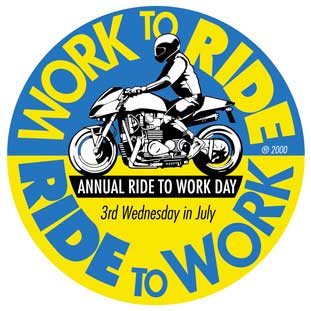
It’s getting toward that time again, so as I always do, I’m cluing you in to this year’s Ride Your Motorcycle to Work day.

This year the date is July 16. As always, that’s a Wednesday, the third Wednesday in July. This is a day to get as many bikes out on the streets and highways as possible, to make an impression on the non-riders as to just how many of us there are. Not for intimidation or anything negative, just to let them know we’re here and that they need to be mindful of us as they drive. I mean, have you ever been on the highway when someone in the next lane pulled into your lane without looking over their shoulder to see if perhaps someone might be there? No, it’s never happened to me either. Right!

So the point is to get out in force and impress upon them that they MUST look, MUST be aware, and MUST share the road. Maybe their lives don’t depend on it, but ours do!

If you really want to get into this, you can go to the website at www.ridetowork.org and download logos and artwork, public service announcements, and various other things to pass along to the local media or put up in public places. Here’s the logo.

Ride to Work Day logo

Who knows, maybe this year I’ll be able to take part. The funny thing is that each year as I’ve promoted this thing, I’ve not been able to participate. Last year I was working a job that had me working at home. The year before that I was on vacation. This year I may be unemployed on that day, but if so I’ll at least get out and ride a bit just for the heck of it.

Anyway, I’ll bring this up again just before the date. In the meantime, take today’s quote with a grain of salt. Maybe.

Biker Quote for Today

If the person in the next lane at the stoplight rolls up the window and locks the door, support their view of life by snarling at them.

Discuss Signs And Safety Practices

Wednesday, March 26th, 2008

If you ride with buddies — and who doesn’t? — I cannot over-stress the importance of making sure that everyone understands the principles your group will follow on rides.

Let me give you an example of what I mean. My buddies John and Bill and I have been riding together for nearly 20 years. We take week-long summer trips and go on various other rides over the year. We have had the good fortune not to have had any accidents along the way. Barely. That’s the issue.

We very nearly did have a serious accident on one of our early rides. I was in the lead, with Bill behind me, and John behind him. We were coming up a road that was snaking up a mountainside and I saw ahead of us a pull-out on the left with a terrific view of the valley below us. I slowed down as I considered stopping, and just as I decided that I would pull over Bill went shooting past me on my left. If I had made my decision to pull over half a second sooner he would have T-boned me and who knows how bad the injuries might have been.

So essentially, what I’m saying is that the most serious danger we have ever encountered was not at the hands of some inattentive driver, but at our own hands. There’s no excuse for that.

Every group needs to have signs and signals, and use them. The first and most obvious one is to signal your turns and look before turning. That applies to anyone on the road and should be so obvious as to not need mentioning, but I didn’t do either that day.

Other good things to have agreed-on signals for are gravel or other obstacles on the road, and reminding someone to turn off their turn signal. Indicating you want to make a stop is another obvious one.

What about the less obvious? For example, when it was just the three of us we all understood that when passing through a town we would stay bunched close so that everyone would make it through any traffic lights. It was up to the leader to judge before going through whether the others would have time to make it. Now that we ride with a bigger group I don’t think we’ve had this discussion with the other guys. Consequently, we end up getting all disjointed and needing to pull over and wait. Sometimes, with a larger group, that’s just inevitable. But not always. It’s guaranteed, though, if the last guy is half a block behind the next guy. Stay close.

It should be understood, too, that when making a turn at a crossroads, you wait until you’re sure the guy behind you has seen which way you’re going.

What else? I’m sure there are more things to discuss and agree on. The main thing is to raise the subject and then make sure everyone is on the same page. It will make your rides safer and help avoid stupid delays and hassles. Do it!

Biker Quote for Today

Don’t lead the pack if you don’t know where you’re going.