Archive for the ‘ABATE’ Category

Examiner Resurrection: Broken Wings: When A Biker Goes Down Hard – Part 2

Wednesday, November 23rd, 2016
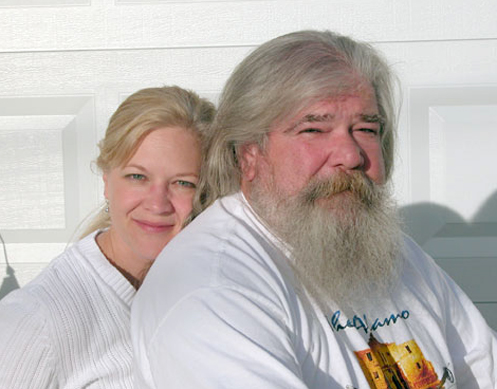
Randy and Joan Savely

Randy and Joan Savely

Two weeks after Randy Savely lost his left leg below the knee in a car/motorcycle accident, his wife Joan and her son Vince were awakened by crashing noises. Racing to see what happened, they found Randy laying at the bottom of the stairs with two garbage bags beside him. He had been carrying one bag in each hand, trying to navigate the stairs with his crutches, and had fallen.

On one hand she was relieved that he was not badly hurt or bleeding from his injured leg, but on the other hand, “I wanted to kill him.”

“Leave those trash bags where they are, I’ll take care of them,” he told Joan and Vince. “This trash will not get the best of me.”

The road to recovery

The ramifications of losing a leg are not all as obvious as climbing stairs with crutches.

“You don’t realize the limitations a prosthesis presents,” says Joan. “He can’t crawl under the car to change the oil like he used to. He can’t get up on the roof to replace shingles the wind blew off. He wears out so much more quickly that we have to schedule things and not try to do them during the week when he’s tired out from work. It’s not that he can’t do some things, it’s just that he’ll be worn out for a couple days afterward, so we plan those things for the weekend.”

Joan explains that amputees require as much as 50 percent more oxygen than before, which is where the exhaustion comes from. Randy’s leg is also permanently weakened, and there are limits to how much he can lift.

Dealing with the artifical leg, the prosthesis, has its own issues. Randy has different feet for different functions, and “my walking foot is spring-loaded, and pushes me into the next step. I’m fortunate to have my knee and be able to do what I can.”

Every time Randy changes shoes he must readjust the prosthesis to compensate for different heel heights, using shims.

“Each morning I spend 45 minutes walking around getting the shims just right. I take them with me everywhere I go and adjust things several times a day.”

Physical adjustments were not the only issue the family had to deal with, and the friends who gathered in support at the hospital continued to show their concern afterward.

“They brought an enormous amount of food, and raised a lot of money,” says Joan. “They made sure we didn’t just fold up, made sure I was still functioning on the planet, staying engaged.”

Friends came by frequently and took them boating and camping. “We went tent camping, and both air mattresses went flat so we slept in the car,” Randy laughs. “I’m going to try this year to get out bird hunting.”

Support came from all directions. When Joan’s car broke down her boss handed her the keys to his Hummer and told her to just drive it until her car was fixed. Then a friend, Tim, took her car for repair, and when it was ready told her where to go to pick it up. When she asked how much the repairs would cost the folks at the shop told her “It’s paid for” and would not tell her by whom. She finally learned that Tim and another friend had covered it.

Although Randy’s medical care was covered by health insurance, he did not have disability coverage and the loss of income was crippling. Told by the doctors that it could be a year before Randy would walk, they knew they could not make their house payments. They informed the mortgage company of the situation and went into foreclosure. Ultimately they also filed for bankruptcy.

Losing the house wasn’t all negative. It had four levels, which made things pretty hard for Randy with all those stairs. The rental they moved into is all on one floor. And when the day to move arrived, friends in eight pick-ups and trailers showed up and “We made it all in one trip. We started at 8 a.m. and were done by 2 p.m.”

Part 1 – The Accident and the Hospital
Part 3 – Back in the Saddle

Biker Quote for Today

Bikes are like wives; if it ain’t yours don’t touch it.
Examiner Resurrection: Broken Wings: When A Biker Goes Down Hard – Part 1

Monday, November 21st, 2016

OK, it’s Thanksgiving week and I’m going to give myself a break and go completely with these Examiner Resurrections. But that’s great, because this three-part piece that I will post on Monday, Wednesday, and Friday is what I consider one of the very best things I ever did in eight years writing for Examiner.

A bit of an update is in order, however. Randy and Joan have since divorced, and Randy is no longer active in ABATE. He does still hold the Randy Run for Fallen Bikers.

motorcyclist who lost a leg

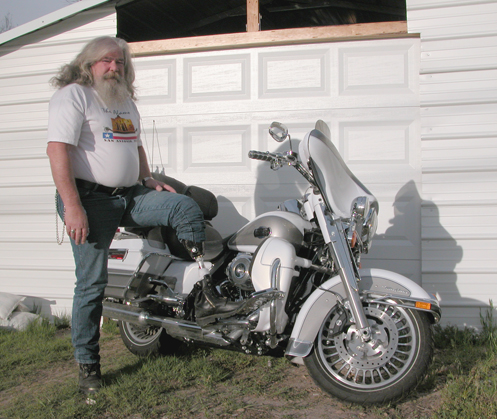
Randy Savely displays his new Harley-Davidson Ultra Classic and his new leg.

Broken Wings: When A Biker Goes Down Hard – Part 1

When everything finally came to a stop, Randy Savely sat up, thinking, “Well, I’m alive.”

A couple moments later he noticed his boot laying in the middle of the intersection.

“That boot don’t come off,” he thought. Then he turned to the driver who had hit him and asked for his belt to use as a tourniquet on his leg.

At that early morning hour on March 8, 2007, life changed forever for Randy and Joan Savely. Randy lost his left foot and lower leg, and he and Joan gained an understanding of what is truly important in life: friends and family and people who care about you.

The accident and the hospital

Randy needed to be at work early that March day, so, with only one car, he decided to let Joan sleep and take the Harley. They worked close to each other so normally they went together.

Riding east approaching an intersection, Randy saw the car coming the other way, looked to the left at the car stopped there, and looked back to see the oncoming car was turning into his path.

Awakened by the phone, Joan hurried to the hospital. Randy and Joan are ABATE members, and word flew out through the ABATE grapevine so that by 7 a.m. Joan was joined by 15 friends who sat with her the entire time until Randy came out of surgery at 3 p.m.

Before going into surgery, Randy informed the surgeon that “I will walk and I will ride again.”

The doctor replied, “You do understand that we’re going in the operating room and I’m going to amputate your leg?”

Randy replied, “Doc, you do what you’ve gotta do, I’m going to ride again.”

Under other circumstances, they learned later, the surgeon probably would have removed the leg to above the knee. Considering Randy’s determination, the doc worked extra hard to save the knee, and he was successful.

“The doc was awesome,” says Randy. With the knee still attached, he is able to bend his leg, which makes a world of difference sitting on a motorcycle.

Joan was with him through it all. “She put up with more than I did,” Randy says, and when Joan came in his room one time looking obviously exhausted he told her to climb in bed next to him and sleep.

“I hadn’t slept in three days,” Joan says. Randy kept the nurses away and Joan slept there the entire afternoon.

During his hospital stay, Randy has a constant stream of visitors. Most were friends and acquaintances, but one day he noticed someone he did not recognize in the hall in leathers, just standing there.

“Do I know you?” Randy asked.

“No,” the stranger replied, “I just heard a brother had gone down and I wanted to see how you are.”

The two talked awhile and Randy has never seen him since.

“It choked me up, holy for crying out loud. You feel so insignificant, but then you feel so important to some people.”

“It’s changed what’s important in our lives,” says Joan. “There are so many things that are just not important any more.”

Randy had four surgeries in the week following the accident, and whereas most patients would have stayed in the hospital for three weeks, he recovered so well and so quickly that he was released after one week. Far from being the end, however, this was just the beginning.

Part 2 — The Road to Recovery
Part 3 — Back in the Saddle

Biker Quote for Today

I’m a biker’s wife. Just like a regular wife but way more badass.

MOST Will Not Die

Monday, October 31st, 2016

The Colorado Motorcycle Operator Safety Training program, or MOST, is up for renewal in the legislature this next session and despite the desires of much of the motorcycling community, it will probably be continued. That was the word at ABATE recently.

The issue now, said ABATE State Coordinator Bruce Downs, will be to figure out how to live with it as best we can.

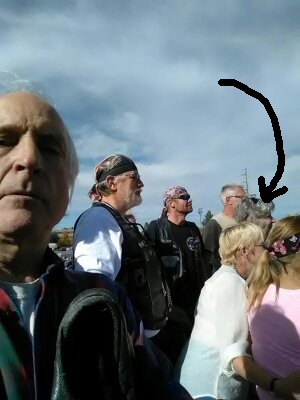
selfie with Senator Todd

This first selfie I have ever shot shows the group at the Piper Inn, with the arrow pointing out Sen. Nancy Todd.

How times have changed! Just a few years ago ABATE was battling in the legislature to keep MOST alive. Back then the program was doing what it had done for years, providing substantial funds to motorcycle rider training programs to keep training affordable for as many riders as possible. One arm of ABATE of Colorado does rider training, so it was a comfortable arrangement.

Now, however, the amount paid to lessen the cost has been radically reduced and the program is spending its money–money paid in by motorcyclists as add-ons to our license renewals–is being spent in large measure for oversight of the program. Let’s see . . . MOST is no longer helping make training affordable but is spending the money to keep itself functioning. For what reason? I mean, if not for rider training, for what reason? So ABATE would now like MOST to die.

But as Bruce says, that does not appear likely to happen, at least not this time around. So the issue becomes figuring out how to get that money going back to training. This is where State Senator Nancy Todd comes in. For a number of years, Sen. Lois Tochtrop was one of the strongest motorcycling proponents in the state legislature. She was term-limited and is now gone from the Senate. Nancy Todd has stepped into the void. ABATE arranged a meet and greet with Todd and others interested in motorcycling issues about a week ago at the Piper Inn, which is a popular biker bar in southeast Denver.

Sen. Todd was the one who held the Colorado Department of Transportation’s (CDOT) feet to the fire over this recently resolved issue of motorcycles being required to have transponders in order to freely use HOV lanes. And according to Bruce, she agrees that there appears to be some conflict of interest in the idea that the Motorcycle Safety Foundation (MSF) is serving as both one of several competing rider training curriculum providers AND as the overseer of motorcycle rider training programs in Colorado in general. And of course, as ABATE points out, the funds paying MSF for its role as overseer are coming out of MOST funds far in excess of what the legislation seems to allow.

Sen. Todd said she intends to set up a meeting soon with CDOT and MOST to ask them to justify these issues.

And the beat goes on.

Biker Quote for Today

You’re not leaving work early, you’re just stretching your legs . . . all the way to your bike.

Legislative Priorities For Colorado Motorcyclists

Thursday, September 22nd, 2016
motorcycles queued up to begin a group ride.

Getting ready to ride.

ABATE of Colorado is a motorcycle rights organization, and one of the strongest voices on motorcycle-related issues that we have down at the state capitol.

Of course a lot of what ABATE deals with at the capitol is dictated by what bills are introduced each session. Nevertheless, it is useful to also set priorities as to which issues we want to push to have addressed. Stump is our legislative liaison down there and he has asked the group what we think the priorities should be for the next session, which will start in January. He offered six and would like to hear how we would rank them, plus I’m sure if someone offered another one that made everyone say, “Well, of course!”, then that would be welcome, too.

So I figured, why not throw this out there for anyone I can reach to offer their thoughts, too. I’m going to list the six, with a bit of explanation, and would love it if you would leave a comment with your thoughts. Thanks.

Lane-splitting: Although it has been allowed there for years, California just became the first state to officially make lane-splitting legal. This allows you to go up the middle between cars when traffic is either stopped or going extremely slow. I don’t really need to explain this further, do I?

The MOST program: The Motorcycle Operator Safety Training program was originally set up as a way to encourage riders, or especially prospective riders, to take training courses so they can become better, more competent, and presumably safer motorcyclist. The idea is that we all pay a couple bucks extra when we renew our plates and licenses each year and that money goes to reduce the cost for the trainee.

The Colorado Department of Transportation, which administers MOST, may argue differently among riders it is generally considered that MOST has strayed far from its mission and needs to either be revamped or eliminated. This is especially pertinent this year because it is up for sunset review. Is the riding community going to support keeping the program alive or will we push our elected representatives to kill it?

Autocycles: These are this proliferating group of three-wheeled vehicles that, because legislation does not keep up with society, are now classified as motorcycles. This classification creates a number of problems. When crashes occur, even though the factors involved may be completely unique to the three-wheelers, they get counted in motorcycling statistics. Plus, to ride one you might need a motorcycle rider designation on your driver’s license, which hardly seems appropriate if you’re riding one of those little Polaris Slingshot things.

There is movement all across the country to create a new classification of vehicle, the autocycle. Certainly this is something we should support here, but how much of a legislative priority is it considering that so far none of our legislators seems to be pushing it on their own.

Red light bill: Not all traffic signals that require triggering by vehicles to make the light turn are capable of detecting motorcycles. You can sit there for a long time waiting for it to turn. At some point you really ought to be able to go through the red without fear of being ticketed.

Right-of-way enhanced penalties: I posted on Monday about this Michigan legislator who was killed on his motorcycle when a car turned in front of him. He had the right-of-way and that driver violated his right-of-way. We all know this happens to us way too often, and it is often due to inattention or distraction. Should those people face extra harsh penalties for their negligence that led to a rider being killed? As it is, reports are all too common about these drivers getting fined $50 or some other such minor slap on the wrist.

Motorcycle-only checkpoints: Some states like to set up checkpoints where all they do is pull over motorcyclists to see if they have a valid motorcycle operator’s license and perhaps to do equipment safety checks on the bikes. They only pull over bikers. And they don’t always take motorcyclists’ special needs for stable footing and such when they select the places they’re going to do this. There is pressure to have these profiling events banned; some states have already done so.

That’s the list. What are your priorities?

Biker Quote for Today

It’s not a phase, it’s my life. It’s not a hobby, it’s my passion. It’s not for everyone, it is for me.

More HOV Lane Info

Monday, June 27th, 2016
Motorcycles on the interstate

Going up I-25 on your bike? Go ahead and use the HOV lane.

I got a bit more information on the push to exempt motorcycles from needing transponders to ride in HOV lanes without paying fees or having to get a transponder. The intent is clear and undisputed but the problem stems from not getting input from the public when the system was designed.

Carol Downs went with her husband, Bruce, and Stump to see how the systems of cameras and tracking works that enables the new system of toll lanes. Everyone had assumed up to that time that it would be simple to just recognize a motorcycle and send that file to the trash, with no dunning notice sent to the owner of that license plate.

Not so easy, Carol told me. While it easy enough to recognize a motorcycle from the photos, the photos feed through to the people charged with issuing the fee statements from the entire system with no way for them to tell if this rider is in the HOV lane on I-25 or on the E-470 toll road. If you’re on the toll road you have to pay a toll, no matter what kind of vehicle you’re in/on. If you’re in an HOV lane you don’t. But if they can’t tell what road you’re on they can’t just trash your file, unless they are willing to let some riders use the toll lanes for free. And maybe until they get this fixed that is exactly what they should do.

Funny how easy it could have been if there had been public input. ABATE would surely have gone to any hearing and raised the very same issue that was raised after the fact. And the software could have been designed from the very beginning to deal with this situation.

In the meantime, ABATE has been assured that any rider who wrongly receives notice of a fee to be paid can have that fee canceled. And in fact, one rider, who is not an ABATE member, contacted ABATE about this very thing and when ABATE spoke to the tracking company that fee was dropped. Not that the person who called decided to join ABATE to show their support for this kind of action, or even bothered to say thanks, but the group was looking for just that sort of situation in order to push the matter.

And then Larry Montgomery, the ABATE metro region coordinator, told me he deliberately rode his bike in the HOV lane its full length up I-25 just to see if he would get a letter in the mail. To date he has not.

In the meantime, the High-Performance Transportation Enterprise, which operates the tolling system, can’t get started on redesigning their software until they get the go-ahead from the Colorado Department of Transportation. And CDOT is entangled in all sorts of bureaucratic issues so there’s no telling when that will happen. But go ahead, ride in the HOV lanes. And if they send you a fee statement, give them a call and tell them to cancel it.

Biker Quote for Today

Motorcyclist: A person willing to take a container of flammable liquid, place it on top of a hot moving engine, and then put the whole lot between their legs.

Session Ends, Legislative Update

Thursday, May 19th, 2016

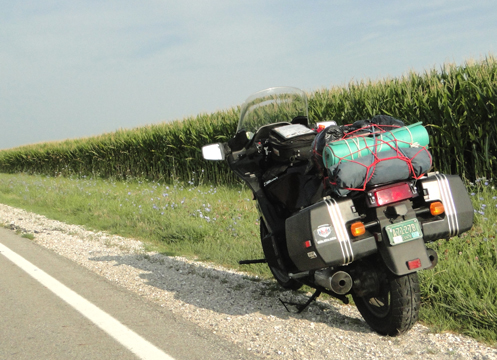
Corn and Motorcycle

I really don't want that corn in my gas tank.


After my last post dealing with ethanol in gas I was interested to receive several comments from people in the ethanol industry contesting the remarks I passed along from the American Motorcyclist Association (AMA) and from Stump, the legislative liaison for ABATE of Colorado. These guys were pretty vehement that I didn’t know what I was talking about (“You are an idiot if you believe any of this bulls***.”). I replied that I was passing along what I hear from the AMA and I trust what the AMA tells me on things like this. But I also said I would try to dig deeper and do a follow-up addressing what they were saying.

Well, that is still my intention but we’ve been out of the country and busy since we got back and we’re leaving again in a few days for another trip, so I haven’t had the time yet. In the meantime there are a few more related things I wanted to pass along.

Of course, as you probably know, the legislative session ended. Here’s what Stump said about that.

In my last LegTeam update I urged you to write the Senate Finance Committee Members to oppose SB-175 (E15 Fuel Bill) and show up on Thursday, 4/14 for the Committee Hearing. Thanks to those who wrote and to Bruce, Bear, and Harry for showing up for the hearing. I also sent e-mails to the committee members and actually had meetings with 3 of the 5 members. All 3 agreed to oppose the bill. As it turned out, Sen. Grantham, the sponsor of the bill, requested the bill get laid over till 4/12. In essence, it killed the bill since the session ends on 4/11. So even though we stopped the increase in the amount of E15 being brought into Colorado by killing this bill, which would have given retailers a tax credit to sell E15, there is a much bigger problem with E15 on the National Level.

Bruce, Bear, Harry and I met with Sen. Neville after the hearing and he told us about a Federal grant from the US Department of Agriculture (USDA) to expand the number of fueling pumps that supply E15. Colorado could get $600,000 to install 7 tanks and 28 pumps at 7 gas stations. Of course the money has to be met 1:1 by the CO Department of Agriculture or private partners. Here are 2 links so you can read more about it:

www.fsa.usda.gov/programs-and-services/energy-programs/bip/index and www.usda.gov/wps/portal/usdahome?contentid=2015/10/0300.xml .

I also found out Kum & Go is the company pushing to introduce E15 in Colorado, so if anybody wants to boycott them, feel free.

Related to this, as noted in the action alert I sent out yesterday, a bill has been introduced in Congress to promote wider availability of E15. On March 22, US Rep. David Loebsack (D-IA) introduced H.R. 4673 (the Renewable Fuel Utilization, Expansion, and Leadership Act – REFUEL Act) which would provide federal grants to purchase and install new or existing infrastructure for E15. It has 4 cosponsors already (2 from MN, 1 from IL, and 1 from WI) and with President Obama being from the 2nd largest corn producing state, is there any doubt who’s pushing for E15? Tell your US Representative to oppose H.R. 4673.

Of course, what I’m much more interested in is this thing with needing a transponder to ride in HOV lanes without getting fined. Stump hasn’t sent anything out about that so I’m still in the dark. And I haven’t had time to contact him to ask.

The legislature did pass and the governor signed the bill to do an audit at the Colorado Department of Transportation, so that could have an impact on the MOST program.

I’m feeling like this is kind of ragged. I’ll get back more in the swing of things when we get back from this next trip and I finally have time to really settle in again.

Biker Quote for Today

“Why ride?” Why breathe?