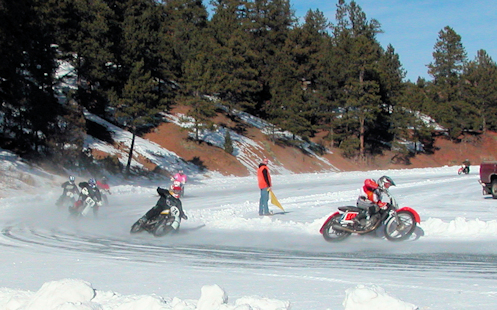
You don’t suppose there might be some inherent risk involved in racing a motorcycle on ice, do you?
If you’re not familiar with the concept of inherent risk you probably will be soon. It’s a movement that appears to be spreading state to state, and it will affect motorcycle riders.
Essentially, inherent risk is a recognition that some things people like to do carry some amount of risk. The current crop of laws being passed regarding inherent risk made a clear statement that if people choose to engage in these activities they do so recognizing the risks and accepting those risks. That is, if you do it and get hurt, it’s on you. Don’t try to sue someone else for your misfortune.
The first thing you might think of in this category could be motorcycle racing, but that’s really not the case. Racers uniformly are required to sign waivers stating they will not sue the track if they screw up and get hurt. Of course this is only true if the track is in good shape and the crash was the rider’s fault, or perhaps the fault of another racer. If there is a big pothole in the middle of a tough turn then the track is at fault. But how often is a track going to allow that hazard to exist?
The legislation is aimed more at places such as an open space area where the governmental entity that owns or controls it allows dirt bike riding. Or a farmer who lets local kids ride in his pasture. If you get hurt, don’t go suing the nice person who let you ride in his pasture. He didn’t cause your crash, you did.
So far Arkansas and Texas have enacted inherent risk legislation. The concept is supported by the American Motorcyclist Association, which put out a report that stated, “The American Motorcyclist Association, alongside Texas motocross track owners, motorcycle dealers, and riding enthusiasts, was closely engaged with efforts to pass HB 5624. The AMA commends the Texas state legislature for its passage, as HB 5624 aims to create a more consistent and predictable liability environment for property owners and off-road riding enthusiasts.”
The AMA also noted, “This form of legislation has picked up steam across the country, and the AMA is focused on additional efforts, primarily in Iowa and Missouri, where similar inherent risk bills are taking shape for re-introduction in each state’s next legislative session.”
Everyone knows the story of the woman who bought coffee at McDonald’s from a drive-up window, put the coffee between her legs, and then spilled it, burning herself. She sued McDonald’s and won. That would seem to fall under this policy. You bought the hot coffee and would have been unhappy if it had been cold. Nobody forced you to put it between your legs as you drove away.
I think we can all expect these laws to come to our own states. Look for them.
Biker Quote for Today
My comments to my neighbor who rides horses but thinks motorcycles are dangerous – “I’m not riding anything that has a mind of its own . . .” — markbxr400
Hi Ken,
I really enjoy your blog. A lot. Especially now when (as a Pennsylvania resident) outside is nothing but frozen snow, ice, and salt.
Your comment about the McDonald’s Coffee Lady bothered me though. Like most things in life, there’s more to it. I would encourage you to read a little about it so here’s what Wikipedia says. https://en.wikipedia.org/wiki/Liebeck_v._McDonald%27s_Restaurants
I think I am in the majority by considering lawyers in the same category as cat fish (bottom feeders) and think there are way too many (both lawyers and lawsuits) and society would probably be better off with a lot fewer of them, but I also hate to see this woman unfairly singled out as having won by using the system.
I was sorry to hear about your accident a while ago and hope you are doing well.
Keep up the great writing!
-Bruce Roper
Bruce, I did read that wikipedia article. Based on that I do have to agree that McDonald’s was partially at fault, and probably should have recognized that and agreed to settle.
Thanks for the kind words.
[…] where the concept of inherent risk comes in. I wrote about this a little while ago. The idea is that we need state legislatures to pass legislation that protects land and facility […]