Archive for November, 2017

Letting It Rip On Track Day

Thursday, November 9th, 2017
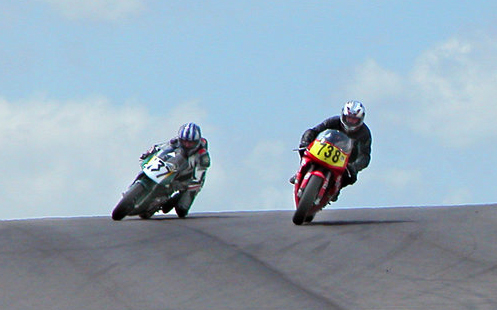
Do yourself a favor and do a track day.

Do yourself a favor and do a track day.

Have you ever wished you could get out on your motorcycle and just let her rip? No worry about speeding tickets. No worry about hitting that pocket of gravel as you carve that turn. No worry about that idiot cager who’s just about to pull out in front of you at the intersection.

That’s why God invented race tracks.

The really cool thing is that race tracks are not just for the pros. As a matter of fact, there are a lot of days when race tracks sit idle and you’d better believe the people running them welcome additional users. The perfect scenario is for your riding club to hire the track for a day, bring in a couple riding instructors to give pointers and offer critique, and then each of you pay your share of the cost to go ride the track for a day. Alternatively, sometimes the tracks themselves set it up and provide the instructors. Then all you have to do is sign up and pay.

The Concours Owners Group that I have intermittently belonged to organized a track day at one point and I jumped at the chance. The day was set up in segments, alternating classroom instruction and parking lot practice with track time. They divided us up into three groups based on skill level. I knew I wasn’t in the top tier but I sure didn’t want to think of myself as bottom tier, so I went for the middle. My thinking seemed to predominate, so there were more than could be accommodated in the middle, but I was not one of the ones forced to join the lower group.

My group started in the classroom, and in many ways it was very much like the Experienced Rider Course (ERC) sanctioned by the Motorcycle Safety Foundation, just omitting the portions on looking out for other traffic. They talked about braking before entering the turn, late apexing, where you go deep into the turn before initiating a sharp turn, and other such techniques.

Then we moved out into the parking lot. We practiced swerving, turning our heads to look as far into the curve as possible, standing the bike up before braking, and modulating braking to achieve maximum stopping power without skidding. Then it was time for the track. Hot dang!

As each group took to the track, the instructors also mounted up and rode with us. Singling out each rider individually, at times they would ride behind and observe your technique, and at other times they might pull ahead and motion for you to follow them as they demonstrated what you should do.

It turned out you really couldn’t blast your way down the track at warp speed because the straightaway was not long enough to reach that speed before you needed to start backing off. And no, there were no worries of gravel in the curves but there was one spot coming into a curve where an asphalt patch was much softer than the area around it and, of course, target fixation lead me to hit that spot consistently. One of those times my rear wheel would have slid out from under me in a low-side get-off but I planted my left foot well enough to recover and stay up.

I also found that my riding ego was a bit puffed up. While I had not wanted to be relegated to the low-skill group, I was the slowest rider in the middle group. Everyone else kept passing me, and I never passed anyone. Time for a little humility.

After lunch we repeated the circuit, with the added input of the instructors’ critique of our earlier riding. We each now had a better understanding of our strengths and weaknesses, and what we needed to work on. But the track day is only a beginning. Techniques do not become skills unless you continue to practice them. I have, and I believe I’m a better rider because of it, but nothing beats a refresher course once in a while.

Biker Quote for Today

This is a motorcycle rock. Throw the rock into the air. If it hits the ground, go ride.

Motorcycle Link for Today

Heading to Australia? Check out Procycles.
Riders Who Don’t Ride Any More

Monday, November 6th, 2017

We don’t stop riding because we get old, we get old because we stop riding.

I’ve heard that line for years but now I’m starting to question it. People I know are no longer riding and while age is not the reason in and of itself, the more specific reasons are directly related to age.

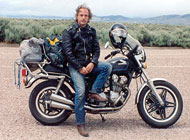
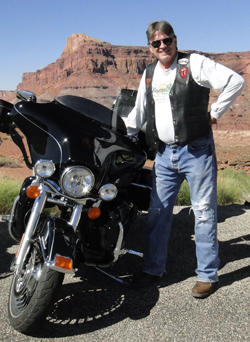
John with his bikeJohn is the perfect example. John had a Cushman scooter when he was a kid but then went years without a bike. Later, when he bought a 750cc Virago he opened the door for a lot. First he took me riding on behind and then before long I bought my own bike, my CB750 Custom. Then Bill got a Shadow and the OFMC was born.

That was a long time ago. Well, John has hung up his spurs. More specifically, he sold the Harley. He’s done riding.

John’s decision is based on health. He has started suffering from esophageal cramps, which basically render him almost comatose. He got hit by one while riding on this year’s OFMC trip. Scary situation. On top of that, he is suffering macular degeneration, which is causing him to lose the vision in the center of his eyes. He sees around the edges but when he looks directly at something it disappears.

This is very sad, and the OFMC will not be the same. This might be John’s motto: When I was younger I was afraid I’d die riding. Now that I’m old and falling apart, I’m afraid I won’t.

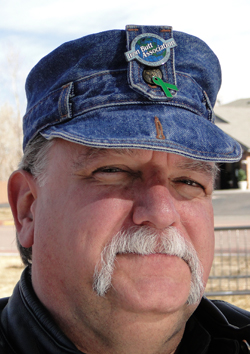
Dan with Iron Butt medallionThen there’s Dan. With Dan it was more direct–he suffered a stroke. More than a year later he’s still struggling to perform everyday functions; riding a motorcycle is out of the question, and the bike was sold long ago.

Mind you, this is a guy who used to routinely ride more than 30,000 miles every year. Dan had a decal on his bike that showed a map of the 48 states with the label, “My riding area.” He meant it. But now he doesn’t ride. So very sad, and so unfair. He had seemed to be in great health until one day he wasn’t.

This might have been Dan’s motto: Young riders pick a destination and go. Old riders pick a direction and go.

I know a bunch of other guys who used to ride but don’t any more but for them it was a decision; in some cases the dad decision, as in “I have a child and he needs a father–I’m giving up the bike.” Maybe in later years they will be back.

What this has meant for the OFMC is that this year there were only 6 riders on the trip. Not long ago we had had 10-11.

So don’t take it for granted. Get out there and ride every chance you get. And I’m going to take seriously the motto Roy told us he has subscribed to all his life. Roy just turned 86 but he’s as spry and active as someone 40 years younger. Here’s his take on life: Does as much as you can for as long as you can.

Yeah, what he said.

Biker Quote for Today

Hop on your steel horse and go find your soul in the wind.

Examiner Resurrection: Sidecar Racing: High-Speed Ballet

Thursday, November 2nd, 2017
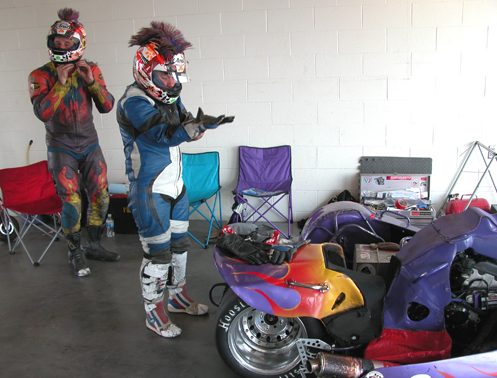
sidecar racers prep

Wade Boyd and Christine Blunck gear up to race their #6 Formula 2 sidecar.

Money and horsepower do not produce winners in sidecar racing. It takes teamwork, and a good team can make a poor machine very, very fast.

So say the folks who ought to know, the sidecar racers I spoke with (and rode with!) at last weekend’s Bonneville Vintage GP and Concours.

Wade Boyd and Christine Blunck are the points leaders for both driver and passenger as this racing season nears its end, and they were the ones I chanced to strike up conversation with as I sought to learn more about this sport. I also spoke with Rick Murray, the outgoing president of the Sidecar Racers Association-West.

Wade got into sidecar racing unexpectedly when he showed up at the Isle of Man TT one year expecting to race in three events. Finding that he had been shut out of two events, “I told my girlfriend to find me a sidecar.” He had never ridden a sidecar before but she found a driver in need of a passenger and he agreed to take Wade.

“I had a dynamite time, and then for four years it was like I had my thumb out. I’d go without having anything set and I’d find someone who needed a rider. Then I got to drive . . .”

Christine’s first involvement with racing was as an umbrella girl at various races, but she had a friend who ran a motorcycle shop, and who said of sidecar racing, “We could do that.”

That’s often how it happens, says Rick. “Quite often you have two friends or relatives who want to race together. We have many husband/wife, father/son, sister/sister teams. We have a fairly high percentage of women in the sport.”

Wade concurs, saying “Where else do you get to take a buddy for a ride?”

Wade is a steel fabricator by trade and he built his own rig for the most part, although “Mr. Bill” Becker of Becker Motor Works helped him out putting the motor in and with some of the other big stuff. Mr. Bill is known by all U.S. sidecar racers because he helps nearly all of them keep their rigs running.

That sort of helpfulness is characteristic of sidecar racing. “We’re competitive but friendly,” says Wade. “We want you out there and I want to pass you fair and square.”

It’s all about teamwork
The key to running a fast race is the teamwork. Each team pre-rides the track and then maps out their strategy for each turn on the course. On most turns the passenger will hang their weight out to enable fast turns without the third wheel rising off the pavement, or floating. That loss of traction cuts speed. However, in some instances, “letting the chair float” allows the rig to cut the corner sharper in order to get up speed in a hurry for the straightaway.

The passenger needs to know his or her position on each turn and the driver needs to be aware of the passenger’s location. On occasion the driver will look back but usually, “I feel her, the ESP is strong,” says Wade.

The passenger also needs to make their moves smoothly and gracefully. Harsh, forceful moves from one position to another will negatively affect the handling of the rig. Wade calls this coordinated, smooth movement “high-speed ballet.”

Despite the seemingly dangerous risks the passengers take, leaning far out of the rig just inches above the ground, sidecar racing in the U.S. is actually very safe. By comparison, Wade says, at the Isle of Man TT “they put a bale of hay in front of a telephone pole. After doing the TT, this (the track at Miller Motorsports Park) is easy. We rarely touch, but if you do touch you’re probably going to spin out, and if you spin out the passenger can get launched.”

According to Rick, the last sidecar racing fatality in the U.S. occurred in the 1980s, and there have been only three fatalities since the 1960s.

Passengers do sometimes get “spit off.” Christine’s most memorable such occasion came in Ramsey, on the Isle of Man when her driver clipped a curb in an S-curve. “It spit me off and I flipped through the air and landed upright on my feet in some gentleman’s front yard. I said ‘Hi’ and introduced myself.” She adds that there are times when the passenger wishes he or she was a monkey, and had that tail as a fifth hand to hang on with.

Sidecar racing is an inexpensive way to race, Rick notes, because you split the cost two ways. Plus, using wide, slick tires, as modern sidecars do, the costs are low because a set of tires will last one to two years. And most racers run stock engines so reliability is very high.

Still, there aren’t that many sidecar racers in the U.S., and they’d love to see that change. That’s one reason Rick and others love to offer “taxi rides” to spectators when they can. These taxi rides let non-racers suit up and take two laps around the track with an experienced driver at the controls.

“I tell people you’ll love it or hate it,” says Rick. “I’ve never seen anybody go half way. They’re either ‘Get me off’ or ‘Where can I buy one?'”

And if you do love it, says Rick, “You can spend $4,000 to $5,000 and have something to have fun with.”

Biker Quote for Today

Sometimes your knight in shining armor turns out to be a biker in dirty leathers.