Archive for September, 2013

A Top Box for My V-Strom

Monday, September 9th, 2013
Top box on V-Strom

My new top box is even blue to match the bike. That was part of what sold me on that particular one.

The first thing just about anyone who buys a motorcycle does is customize the bike to fit their own specific needs and/or wants. I generally haven’t ever gone very far down that road but I always travel it to some extent. I’m extremely pleased to say that I now have a top box on my new V-Strom.

It’s a good thing to have photos–specifically that one above–because these things don’t seem to go by any clear-cut name. I call it a top box, other people call it a variety of other things. Whatever you call it, from what I’ve seen they get the most use as a place to quickly and easily stash your helmet or your jacket–both if it’s big enough–when you get off the bike. Also a good place to carry odds and ends you might want during the day so you don’t have to go digging for them in the bigger side bags. (Presuming, of course, that you have side bags.)

It’s also a good place to put the stuff you’re carrying to work if you’re riding to work, which I do. I can wear my riding boots to work, take them off and stick them in the top box while putting on shoes that you can actually walk in, and switch back at the end of the day.

Sure the V-Strom came with side bags and they’re huge, but that’s part of why I wanted the top box. The side bags are so huge that they make parking the bike in the space I have for it a difficult thing to do. I ended up taking the bags off each time I came home before I parked, then putting them on when I was going somewhere. Now the side bags can just sit in the garage except when I’m traveling. Traveling is the only time I need anywhere near that much space.

Of course, getting the top box mounted was no easy feat. Theoretically it might have been but reality dictated otherwise. Fortunately I had the assistance (read: he did almost all the work) of Ron Coleman, the guy who runs Western Dual Sport Motorcycle Adventure. Ron has been a great help in getting this bike fixed up and because he runs a fleet of V-Stroms he knows far better than I what needs to be done. And he has the tools.
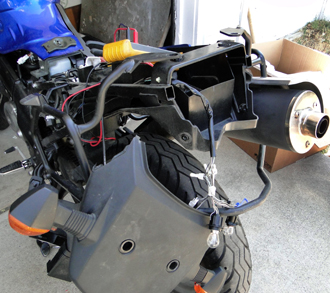
V-Strom rear-end disassembled

This gives you a bit of an idea what we ended up doing.

So what theoretically might have taken an hour, hour and a half, ended up taking four hours. The actual mounting was not that bad, it just took drilling out some of the sheet metal in the mount so the bolts could go where they had to go. But the trunk (that’s what some people call these things) has LED lights on it to give you greater visibility, and hooking those up was the real bear.

After putting it all together it didn’t work. So we tried one thing after another, and in the process disassembled almost the entire rear end of the bike. You can see that in the other photo. We did get it done, though, and hot diggety! I’m really pleased. Thank you Ron. Now just a few more mods and I’ll have this bike just the way I want it. Stay tuned.

Recent from National Motorcycle Examiner
Only a biker knows . . .: Motorcycle wit and wisdom #28

Biker Quote for Today

There’s roads and there’s roads and they call, can’t you hear it? Roads of the earth and roads of the spirit. The best roads of all are the ones that aren’t certain. One of those is where you’ll find me till they drop the big curtain. — Bruce Cockburn
Checklist for Scooter Friendliness: How Does Your City Stack Up?

Thursday, September 5th, 2013
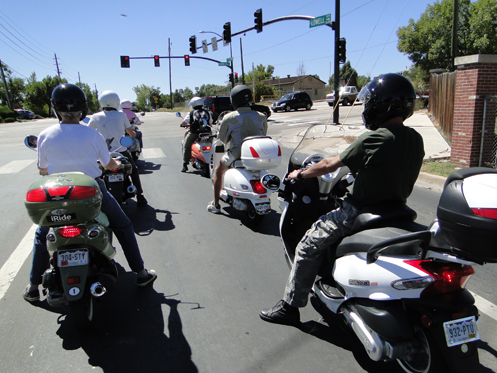
Scooters at a traffic light

What makes a town scooter-friendly?

This is a guest post provided by Amy Moczynski.

With two-wheeled transportation becoming more popular because of gas prices, more people are making scooters and motorcycles their primary form of transportation. Bicycles or walking might be the preferred way of transportation in cities that allow for it, but the majority of people will need some form of motorized vehicle to get them from point A to point B. With most scooters offering nearly 70 miles per gallon, scooters not only help you save on gas but also help lower your carbon footprint.

If you’re considering switching to a scooter as your primary mode of transportation, there are some things to consider before making the switch. Aside from making sure you have the proper license and training to ride said scooter, you should consider how scooter friendly your city is before making the switch full time.

For anyone unsure of how to determine how scooter friendly a city is, here are some considerations to keep in mind.

Scooter Repair and Retail

Just like any automobile, you’ll need to take your scooter in for periodic tune ups. You’ll also need to make sure you purchase any gear before hitting the road (a helmet is a must, and you might want to trick out your scooter with some sweet swag). Consider how close you are to repair shops and retailers so you know where to turn if you need something last minute. For example, the website for Bintelli scooters has a store locator so you can see if your scooter’s retailer has a nearby location.

Parking and Storage

Parking might seem like a breeze if you own a scooter (it’s small, so it can fit anywhere, right?), but in certain cities, there isn’t dedicated parking for scooters. Instead, scooters have to use regular size parking spaces, and that often means they need to purchase parking decals also meant for full-size automobiles, so there’s no cost savings involved.

Something to consider is the number of (or presence of) parking devoted just to scooters or motorcycles. San Francisco, Seattle, Philadelphia, and Cincinnati are several cities that have created special parking areas just for scooters, and the mayor of Boston has designated free parking for scooters and motorcycles, offering scooter owners in this city an added benefit of scooting as opposed to driving.
You’ll also want to consider where you will store your scooter, both overnight and during the seasons you won’t be driving it. Is the area you live safe enough to leave your scooter outside overnight? Do you need to park it in a garage like a car? If you need to park it in a garage, that’s an extra expense to consider.

Weather

If you live in an area with consistent rain throughout the year, you might be less inclined to purchase a scooter. The same goes for areas that have several months of snow and ice in the winter, or places with pretty steep inclines and rough terrain. While that’s not to say you can’t enjoy your scooter in the warmer seasons like spring and summer, consider how much use you’ll get from it throughout the year before deciding to purchase. Clear, sunny days are made for scooting, so make sure your city offers plenty of ways you can take advantage of the climate.

Also make sure you know how to ride your scooter in not so favorable conditions. If you live in a location that is prone to sudden downpours, you might not have the option of only traveling when it’s clear and sunny. Make sure you feel confident enough driving through these conditions when needed.

Incentives

Are there incentives for owning a scooter in your city? For example, Austin Energy offers $50 to $300 incentives for people who use two-wheeled electric vehicles. See if your town offers any sort of credit or rebates when you switch to a greener form of transportation.

Recent from National Motorcycle Examiner
Another day going separate ways from the OFMC

Biker Quote for Today

Speed bumps never seem to make me go any faster.

The Simplest Throttle Lock Around

Monday, September 2nd, 2013
Go Cruise Throttle Control on Suzuki V-Strom 650

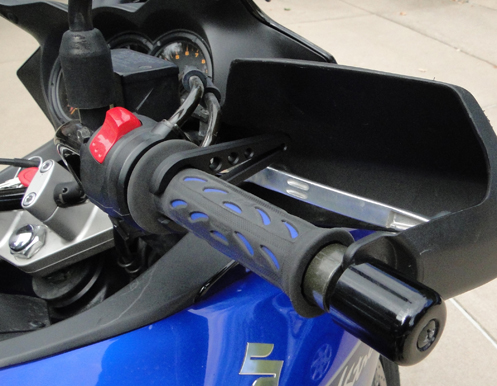
My new throttle lock on my V-Strom.

Cruise control is nice, but pricey. I’ve always had a throttle lock on my bikes and now I have one on the V-Strom and it could not be a simpler device. That’s it at the left end of the grip in the picture above. And that’s all there is to it. You open the jaws enough to slip it onto the grip and then it rotates easily in what from this position would be forward, but does not slip in the other direction.

What that means is that when you twist the grip to speed up, the device rotates with the grip in a counter-clockwise direction. You then get up to cruising speed and, with your thumb, push the device in a clockwise direction until it is pressed against the brake lever. You can then let go of the grip and the device–pressed against the brake lever and therefore immobile–stops the throttle from rolling clockwise, backing off on the speed. When you do want to slow down you just roll off on the throttle manually and the device easily slips back to where it no longer comes into play. Rinse and repeat.

So how well does it work? Pretty darn well. First off, you need to twist the throttle a little beyond where you actually want it to sit because it does back off a little once you release it. So if you want to cruise at 70 you might get up to 73 or so, move the throttle lock into position against the brake lever, and let go. As for manually rolling off, you don’t even feel that the thing is there.

As with any throttle lock, if you don’t touch it you will slow down on uphills and speed up on downhills. What’s nice about this one is that if you have it set at a pretty good place you can just twist the throttle to speed up going uphill and it doesn’t affect the positioning, so as soon as you let go it goes right back where it was. If you don’t mind going a bit fast downhill you just don’t have to touch the thing once you’ve got it set.

This kind of thing is so much preferable to the other option I was looking for on this bike. Oh, and before I go any further, let me mention that this device is called the Go Cruise Throttle Control and it cost about $20. So anyway, on my Honda I have a throttle control that loops around the bar and has a flange that catches on a bit of hardware to hold it stationary. Then to engage it I flip the thumb tab down and it grips the throttle and holds it steady. I have the same thing on my Concours but there was no place for the flange to butt against anything to hold it in place so I had to experiment with various glues until I found one that would hold. That has worked on that bike for about 14 years now.

Neither of those options was going to work on the V-Strom. The only other workable unit I found would have required loosening things like the mirror to move it over to make room, then attaching a clamp around the bar over there, with a spanner that connects with a clamp on the grip. Again, you push the thumb clamp closed and it holds the throttle in place. But what a pain to do all that.

By contrast, this Go Cruise thing took about 15 seconds to install, and about 10 seconds was spent just getting a good enough grip to spread the jaws far enough to slip it on. I wasn’t quite sure at first that I would be able to get it on, it was that snug. But it has to be snug to work in the way I’ve described, and it did go on.

So now I’m set, and I like it. I know some guys ride without any kind of throttle control device and while you may be able to do that around town, if you’re out on the highway going hundreds of miles, that gets painful for your wrist. Me, I want a throttle lock. And now I have one on the Suzuki.

Recent from National Motorcycle Examiner
OFMC dips into New Mexico

Biker Quote for Today

I am taking the advice of all those people who told me, “Hey kid, why don’t you go play in traffic!”