More From The 2018 MOST Crash Report

November 14th, 2019
motorcyclists on the road

Guess what? You are the biggest factor in whether you come home from your ride safely.

I’ve been looking at the crash statistics in the 2018 report from the Colorado Motorcycle Operator Safety Program (MOST). Previous posts are here and here.

The next table in the MOST report on 2018 motorcycle crashes focuses on the “First Harmful Event (FHE)” which I take to be the nature of the crash, more or less, after whatever actions occurred that led to the crash. Number one on the list, by a lot, was overturning. In a car, overturning would be big deal; on a bike, it has to be pretty much standard. This happened to 377 riders, 26.8% of all riders and 40.3% of MOST-trained riders.

Here’s what may be a surprising number two: front to rear collision (201 total). I’d have to wonder who was in back and who was in front. I’ve know more than one rider who got rear-ended but I don’t know anyone who hit the vehicle in front of them. We stop quicker. But this shows us that you do need to be alert to the guys behind you as well as those in front or on the side.

All the rest were collisions of various sorts: with curb, with wild animals, with guardrail, etc.

Then we get to the top human contributing factors with at-fault riders. This has got to be key, right?

The top factor was driver (rider) inexperience: 247 total (17.5%) and 24 MOST-trained (31.2%).

Again, that looks ugly for the idea of rider training unless the bulk of these are riders who crashed and then went for training. As MOST coordinator Chris Corbo said, we don’t know this time around whether the crashes were before or after the training. We would hope they were primarily before. That data will be tracked the next time around.

Number two on this list was aggressive driving (162). That should give you some idea of what not to do.

Number three was DUI, DWAI, DUID (110). I don’t think we need to say anything more here.

Number four is interesting: driver unfamiliar with area (95). I wonder if that means they did something such as a lane change that someone who knew the intersection (for example) would not have done, or if they were meandering trying to figure out where to turn.

These tables only include the top 10 but in this case by the time you get to number nine there are only two instances so number 10 is “Other.” There were 181 of those, which says there are a whole heck of a lot of things that can lead to a crash.

More to follow.

Biker Quote for Today

Good people are good because they’ve come to wisdom through failure. We get very little wisdom from success, you know. — William Saroyan

Exploring Beyond The Blacktop

November 11th, 2019
muddy County Line Road

I was not up for the mud on this day–later!

Once again I took off with no idea where I was going to go. Somehow I figure it out. Today I was on the V-Strom.

Here’s an idea. I know on the way south on the Kiowa-Bennett Road there is a point where the road jogs west and if you wanted to you could continue west on whatever road that is. I know I’ve always expected that some day I would take that road and see where it comes out. Maybe today is the day. I headed out Parker Road and then turned east on Hampden.

Now, here’s how my thinking goes. I got to wondering, how far east does Hampden go? Have I ever taken it out as far as I could? Maybe I had but I couldn’t remember. So let’s do that.

Well that didn’t last long. Hampden ends out on Gun Club Road where it runs into a huge landfill operation, Trash Mountain in my parlance. Back to plan A. I turned south on Gun Club to Quincy and then turned east again.

I knew I’d been out this way before and a couple names I was familiar with came along: Tom Bay Road and Brick Center Road. I had checked them both out before and they both quickly go to gravel. Now I went past them until I reached Kiowa-Bennett and turned south.

The jog came at County Line Road. I didn’t know this at the time because there were no signs to that effect but I continued west. Right away there was a sign saying the pavement was ending. That jogged a memory that perhaps I had tried this once before and–not being on the V-Strom–turned around. Well I was on the V-Strom now so no turning around today.

It was a good gravel road, although the surface varied, with some loose sand, some washboard. I don’t know how far I went–at least five miles–and it was a pretty area.

And then there were the construction zone signs. No problem, I can deal with that. But although I never saw any construction equipment, I came up on the area where they had been working and it was all mud. Oh yuck.

Now, I had the bike and the tires to do mud. What I did not have was the riding skills and experience. But there’s no better way to get the experience . . .

On another day I might have done it, but this day I turned around. It was Tuesday and the forecast was for warm and dry so maybe by Saturday, which was also forecast to be in the 60s, maybe it will be dry and I can ride it then.

As I headed back I saw a sign for Brick Center Road. Really? Does that come all the way through? That would save me having to go all the way east to Kiowa-Bennett. But what kind of condition is it in? I guess I’ll find out on Saturday.

So Saturday came and I headed back. Turning south on Brick Center Road I found it to be about the best gravel surface you could hope for. Smooth, solid, and not a lot of loose gravel. As if perhaps it got graded recently.

Brick Center ended at the road I was headed for and I turned west again. I reached the construction zone and although I was totally psyched up to do the mud today if necessary, everything was completely dry. I cruised on and was surprised to find that in less than a mile I reached pavement. What do you know.

Cruising further and further west the road signs kept reading County Road 194. Finally, when I reached Delbert Road the sign said County Line Road. So that was my answer. Not that it ran into County Line Road over by I-25. Just past Powhaton Road it became Sampson Gulch Way and wound its way through a housing development. It hit a T intersection at Aurora Parkway, I went north, and soon came to Arapahoe. I headed west on Arapahoe and on home.

Biker Quote for Today

Why motorcycles are better than men: If your motorcycle is misaligned, you don’t have to discuss politics to correct it.

What Did We Riders Do To Cause Crashes In 2018?

November 7th, 2019
dirt bikers

These guys are not likely to be guilty of most of the crash-causing actions included in this list, at least not on this ride.

Let’s continue looking at the stats on motorcycle crashes in Colorado in 2018.

The Colorado State Patrol (CSP) report breaks the data out into tables, with each table addressing one specific consideration. The first table is labeled, “Top Driver Actions among at-Fault Motorcycle Riders in Crashes, 2018.” That poetic, symbolic title sums up pretty well what the table has to tell us.

The number one driver action leading to a crash was careless driving. OK, now if there is one thing that is preventable it should be careless driving crashes. Drive carefully, you know? You life may well depend on it.

Careless driving was the primary crash factor for 446 riders, or 31.7% of them. Of those 446, 22 were MOST-trained riders. That looks like a very good figure except the next column is not so good. This included 28.6% of the MOST-trained riders.

Now here’s where the questions I raised last time factor in. If, as I speculated, this tagging of MOST-trained riders only counts those who received their training in 2018, and if many of those who received training were required to do so after they had crashed, then this does not look so bad. Well, I contacted Chris Corbo, the CSP guy who manages the MOST program and he gave me some answers. Yes, the riders counted as having MOST training only counts those trained in 2018. As for question of whether the crash occurred before or after the training was taken, here is Chris’s reply.

That is a great question and one that will be answered going forward. When the data was presented to the data analysis the date of when the rider took the BRC was removed and therefore a correlation of when a crash happened and when the rider took the BRC was not able to be made. We are hoping the crash was prior to the BRC, but cannot make any statements of that.

Pushing on now, the next biggest crash factor was excessive speed, or more specifically, “Exceeded Speed Limit.” Starting here and continuing I’ll give the break-outs as follows: Total riders / Percent of riders / Total MOST riders / Percent of MOST riders. So for speeding the break-out is 150 / 10.7% / 6 / 7.8%. One thing we need to note here is that these percentages do not add up to 100% because this is a list of only the top 10 actions leading to the crash.

Here is the entire list.

Careless Driving: 446 / 31.7% / 22 / 28.6%

Exceeded Speed Limit: 150 / 10.7% / 6 / 7.8%

Followed Too Closely: 140 / 9.9% / 7 / 9.1%

Lane Violation: 124 / 8.8% / 7 / 9.1%

Reckless Driving: 72 / 5.1% / 7 / 9.1%

Fail to Yield Right of Way: 34 / 2.4% / 1 / 1.3%

Improper Turn: 25 / 1.8% / 1 / 1.3%

Failed to Stop at Signal: 24 / 1.7% / 1 / 1.3%

Improper Passing on Left: 16 / 1.1% / 1 / 1.3%

Improper Passing on Right: 8 / 0.6% / 0 / 0%

So these are the primary ways in which we are harming ourselves. We can rail against drivers texting all we want but we also need to take responsibility for our own actions. Of course, that’s what rider training is supposed to lead to–safer, better riding.

Biker Quote for Today

While cagers continue to conduct their affairs while driving, to the detriment of their driving, those of us on motorcycles are (should be!) totally focused on safely negotiating our way amongst them. That deadline at work is not a priority at this time.

Warmth Brings Some Riding Days

November 4th, 2019
motorcycle in the snow

I didn’t just shoot this picture but this is pretty much what it looked like just a few days ago.

The cold finally backed off a bit on Sunday and the mid-day high was around 60, so I went riding. I wasn’t the only one.

The thing that gets me about the guys who are adamantly opposed to wearing a helmet is that in the winter a helmet keeps your head warm. I mean, there was a time–years–when I rarely wore a helmet but I always wore one in winter. There were two reasons.

One, as I said, was to keep my head warm. Sure you can wear a stocking cap and that would be better than nothing but it doesn’t compare to a helmet. And I especially like my helmet that has a velcroed cloth that encloses my chin to keep my face warmer. It’s probably not my highest quality helmet but it sure as heck is my warmest one.

The other is that from the first snow and ice of the season you are guaranteed that in some spots on the road there is sand and gravel. And with sand and gravel lurking, the likelihood of going down is increased by a lot.

I guess in my younger days I told myself I was not going to go down so I didn’t need a helmet, but I couldn’t convince even my younger self of that in winter.

So I dressed warmly and wore my helmet and it was a darn nice day to be out on a motorcycle. First I ran some errands and then I went for a cruise. And yeah, let me tell you about one crazy move I witnessed.

I was westbound on Hampden and traffic was heavy. Coming up to an intersection the guy in the second lane from the right suddenly sped up and shot in front of the car next to him to make a right turn. Holy crap! Keep that in mind any time you find yourself losing your focus on riding safely and being aware of what the folks around you are doing.

There was nothing else eventful on my ride but coming home I got to where I turn south off Hampden onto Tamarac. I’ve made that turn a few dozen thousand times but this time I thought maybe I ought to take it a bit slower. There might be sand there.

So I slowed and what do you know? There was a bunch of sand. No problem for me.

Biker Quote for Today

Why bikes are better than women: You can kick your motorcycle to wake it up.

A Lot To Be Gleaned From 2018 Colorado Motorcycle Crash Stats

October 31st, 2019
motorcycle crash

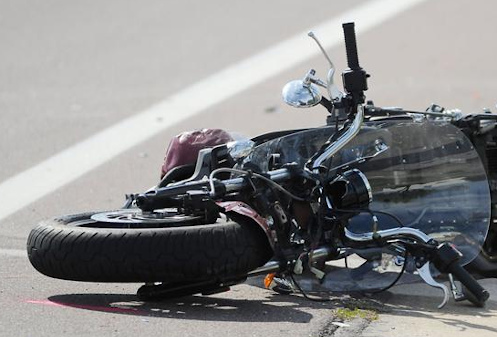
Crashing is a bad thing, OK?

I recently acquired a trove of motorcycle crash information for 2018, put together by the Colorado State Patrol (CSP). This is going to take several blog posts to present.

The report starts with a summation, presenting the overall stats up front. I’m just going to copy/paste that summation here.

  • Statewide in 2018, there were approximately 120,000 motor vehicle crashes and 2,206 (1.8 percent) of those crashes involved motorcycles. There were 111 MOST students (from fiscal year 2018) involved in a crash in 2018.
  • Of the 2,206 crashes involving a motorcycle, 522 crashes resulted in a serious injury and 97 crashes resulted in a fatal injury.
  • The motorcycle operator was at fault in the crash 63.8% of the time (1,408/2,206). Among the 111 motorcycle operators who were MOST students in 2018 and had a crash, 77 were at fault in the crash (69.4%).
  • In 2018, there were 141 crashes where alcohol or drugs were suspected among motorcycle operators at fault in a crash. 116 of the motorcycle operators were suspected of alcohol use only, 6 operators were suspected of drug use only, and 19 motorcycle operators were suspected of both alcohol and drug use. Only six MOST students were suspected to be impaired by drugs or alcohol at the time of the crash.
  • In 2018, among all motorcycle operators and passengers involved in a crash, 49.5 percent (1,223/2,470) were properly wearing helmets.

You’ll notice that these stats tell us how many and what percentage of these crashes involved riders who had received rider training through the Motorcycle Operator Safety Training (MOST) program. This is the first year this information has been tallied and it came following a request from ABATE of Colorado. ABATE thanks you CSP.

The one thing I’m not clear on–and maybe I can get this answered at the next ABATE D-17 meeting–is that this reads in a way to suggest that we’re only talking about MOST students who took the training in 2018. Is that really the case? Did 111 2018 MOST students crash? Like, in their first year riding after taking the training? I’d like to know how many riders MOST trained during the year. What percentage is this? And then what about the tally if you consider all riders who have ever had MOST training? I have, but not in 2018. I also didn’t crash in 2018.

The one number above that really strikes me is that third bullet. It says that the rider was at fault nearly two-thirds of the time, and a bit more than two-thirds of the MOST-trained riders were at fault.

Wow, what does this say about rider training? Or what does it say about the riders being trained? I have no concrete answer to those questions but I can relate anecdotally some information I have heard. That is, many of the riders being trained are there because they have to be. They were caught riding without being licensed to do so and in order to avoid worse punishment they agreed to take rider training and get accredited to ride a motorcycle. Maybe for them it was just a formality and they then went back to their wild and crazy style of riding that got them stopped in the first place. Makes you wonder.

Or here’s another thought. Those numbers don’t show if the crash happened before or after training. Perhaps a lot of riders crashed, were found not to have accreditation, and took the course afterward to minimize penalties. I’m going to need to talk with Chris Corbo, the MOST coordinator, and ask some questions.

On the more positive side is that fourth bullet that says 141 crashes involved drugs or alcohol but only 6 of those were MOST-trained riders.

There’s a ton more information in this report. Y’all come back now, hear?

Biker Quote for Today

I used to think I’d go out with a bang, on the back of a Harley, racin’ a train. — Joe Nichols

Another ‘Where Does That Road Go’ Ride

October 28th, 2019

Oh my goodness, Indian Summer has come and gone, just that quickly. Now the forecast in Sunday’s paper is calling for a high over the next week of 38 and a low–on Wednesday–of 2. Yikes! About the only motorcyclist likely to be out in all this is Dom Pacheco. With his Ural sidecar rig he goes out in anything.

But I did my best to take advantage of the warmth while it lasted. As I had been coming up or going down U.S. 83 the last few times I had noticed a road that ran off a bit to the northeast just where the highway runs off to the northwest. Where does that road go?

Well, I actually learned where it went another time when I saw that it intersects U.S. 83 again further north just a little south of Franktown. But that still didn’t answer the question of where it went in between. I had to find out. I had no choice in the matter. The world simply requires some things of each of us. This is my own personal burden.

So I headed south on 83. It was a wonderful, delicious Indian Summer day and I intended to take advantage of it.

Down to the south junction I went, intending to head north. I could have come the other way but this was how I chose to do it. I suspected correctly that this was a saving the best for last move.

It’s pretty much open prairie at that junction and that was the way it was as I turned north. But you’re also right about at the Palmer Divide, so it’s high prairie. And sure enough, it didn’t take long until I was in the hilly, wooded crest line of the Palmer Divide. And just as in the Black Forest area further west, it was beautiful. And that beauty is not lost on a lot of people who have built very pricey homes in the area. Wow, was it gorgeous.

All too soon, though, the road turned west and led me back to U.S. 83. I didn’t want to just go back the same way I came so I jogged north just to Franktown and took the road west toward Castle Rock. Nearing the main part of town I came to one of those housing developments and I know they all are built these days with a central road running all the way through them. Hey, I’m exploring, so let’s just cruise through this development.

Well, this development is still being built so that road only goes so far. I wandered my way back out to the highway. Then I got to where I had to make a choice and my choice led me into the main part of the old town. But here was a road heading north that I had never been on. Let’s take it.

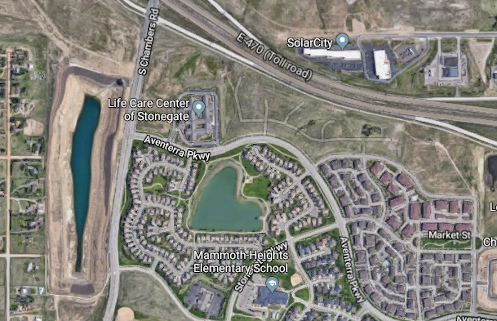
So I wound through a very nice, hilly area to the east of the Castle Rock outcropping and once again it was an interesting and somewhat scenic route. You can zoom in on that map above and see exactly where I went.

From Castle Rock I didn’t want to get on I-25 to get home so I wandered my way north. You can see that on the map above, too.

All in all it was a pretty darn nice way to spend an Indian Summer afternoon. Too bad there don’t appear to be many more of those in store for us.

Biker Quote for Today

Well, I might go get me a new tattoo or take my old Harley for three day cruise. Might even grow me a fu man chu. — Travis Tritt