Archive for the ‘Biker Issues’ Category

Motorcycling Fact or Fiction?

Thursday, September 15th, 2011

Motorcycle on Squaw Pass Road

I just want to pass along this information I saw in this month’s issue of ABATE of Colorado‘s Spokesman publication. It’s something they got from the Motorcycle Riders Foundation, and has to do with the statistics that so often are used to justify “fixes” for problems. Here’s what the MRF put out.

Possible Errors? When errors, omissions or inaccuracies are discovered in reports or statistics, it calls into question the integrity of results. Additionally, small numbers can be easily skewed by slight or seemingly insignificant variations. Furthermore, numbers may be exploited if uncharacteristic highs or lows are used as a baseline. None of these discoveries are intended to argue against helmet use, but rather to demonstrate that suggesting a helmet law is not the solution to motorcycle safety. Individual states need to maintain the ability to determine what measures best address the needs and desires of their residents as suggested in the National Agenda for Motorcycle Safety (NAMS).

FACT Comparison of studies is complicated due to varying criteria, wherein one report references riders, it is unclear if that includes passengers or specifically operators. Other papers may refer to the numbers of persons, crashes or vehicles intermittently. This can be quite confusing as the numbers are usually very close and are frequently compared in error.

FACT A Minnesota motorcyclist survived a crash only to be struck by a car while standing on the road attempting to flag down a motorist for assistance. This was subsequently counted as a motorcycle fatality.

FACT A Pennsylvania taxi driver, with multiple suspensions,was responsible for about two percent of the state’s total motorcycle fatalities when he caused a crash with three motorcycles and killed five helmeted riders in a single incident.

FACT Motorcycle fatalities dropped by 10% in 2009 and preliminary reports indicate that 2010 numbers will be further reduced by at least 2%. The Motorcycle Industry Council advises that sales of replacement tires were up by 6.1% in 2010, suggesting an increase in motorcycle usage. A decrease in fatalities despite an increase in exposure would suggest that motorcycle safety and awareness programs, specifically rider education courses, have been successful.

FACT The National Transportation Safety Board has investigated over 120,000 airplane incidents, over 60,000 surface transportation incidents, and just 6 individual motorcycle incidents in their entire 44 year history — Apparently enough investigation to warrant adding mandatory helmet laws for motorcyclists on their “top ten most wanted list.”

FACT According to preliminary data from the Governors Highway Safety Association, states that have a mandatory adult helmet law had 6 fewer fatalities in 2010 than in 2009, while free choice states saw a reduction of 74. The state with the single largest decline in fatalities (Texas -60) is a choice state and a state which requires helmets on all riders tied for the greatest increase (New York +24).

FACT FARS (Fatality Analysis Reporting System) continues to include “mopeds” in motorcycle crash statistics despite the fact that most states do not require registration of these vehicles. This practice skews the most respected method of measuring the effectiveness of motorcycle safety programs, which is the ratio of accidents, injuries and fatalities per 10,000 registrations.

For more information, contact Jeff Hennie, Motorcycle Riders Foundation, 202-546-0983, jeff@mrf.org

Recent from National Motorcycle Examiner
Creating a comfortable, high-mileage motorcycle that carries groceries

Biker Quote for Today

She pulled out into his path. Classical modus deathus for a biker.

Hesitations With The Old Honda

Monday, September 12th, 2011

I love my 1980 Honda CB750 Custom. It’s the first bike I ever owned and I’ve had it for what seems like forever. I still ride it regularly and though my Kawi is a more dependable bike, the Honda is just more fun to ride. It’s that “dependable” part that’s getting to me, though.

Me on the CB in CaliforniaI rode the Honda today. And as I got on it and fired it up I had the same thought I always do anymore when I ride it: Am I going to get home today without any problems?

I can safely say now, after the fact, that I did indeed get home without any problems. But that’s the problem. Too often in recent years the answer to that question has been “No.” Last year it was out of commission for a lengthy period and in the last few years I’ve only put about 700 to 800 miles on it a year. Most of the time I ride the Kawi. Whereas I used to take the Honda everywhere (of course, it was the only bike I had), now when I plan to take a trip I always take the Kawi. First off, frankly, the Kawi is a better highway bike. But secondly, and also a big factor, I just don’t trust the Honda.

So why don’t I just get rid of it and get a newer bike? That’s pretty much what my mother said once when I told her one of our critters was sick. But no, it just doesn’t work that way. I love this bike. I wanted a bike for so many years and I finally got one. I got this one. And this bike has brought me more joy than I can begin to say.

OK. Fine. So what’s the big deal? Keep the bike, and keep riding it. But now we’re right back at the start. I really don’t enjoy wasting hours of my day waiting for the tow truck to arrive. I really don’t enjoy helping to ensure that my mechanic lives an affluent life while I scrape by. And I’m not equipped and I don’t have the time to do all my own repairs the way some folks say I should.

When you’re talking love for your kids you always think unconditional love. There’s nothing they could ever do that would cause you not to love them. But a motorcycle is not your kids. And sometimes, regret it though you may, the time comes to get rid of the bike. I know it will shock many of my friends to hear this–even my wife–but that day may be coming.

Recent from National Motorcycle Examiner
French Association of Angry Bikers fights back

Biker Quote for Today

I don’t think duct tape is gonna fix that.

How Quickly We Turn To Fall

Thursday, September 8th, 2011

It seems like only last week we were cooking through the hottest August on record in Colorado. Oh, wait. It was last week. And now here it is September and yesterday’s high was about 65 degrees. Is that cool enough for you?

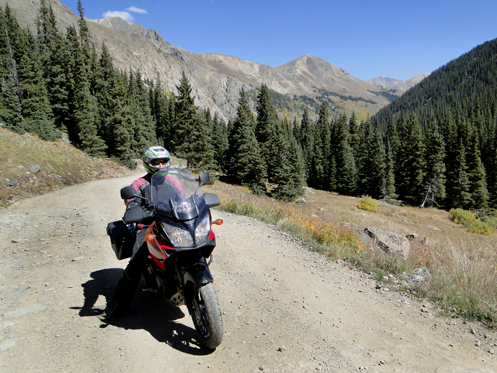
Dual-sport riding in the mountains in the fallMore importantly, we know what that portends. It’s not going to be long and the leaves will be turning and there will be snow. The riding season anywhere higher than the prairie will be ended. Fortunately, the riding season on the prairie never ends, it just takes a hiatus now and then. But I ride 12 months out of the year, every year, no exceptions, and I know others who do the same. It would be different if I lived above 8,000 feet. Maybe even 7,000.

With that in mind I was interested in a piece put out yesterday by Lisa Petrocelli, the Albany Biker Culture Examiner, called “Season of the biker.” What she said was that, “An interesting thought occurred to me today – that the seasons of the year seem to last twice as long for bikers.”

Her gist was that winter, when we can’t ride, seems to last twice as long. And summer comes early and stays late because while others are resigning themselves to the seasons, we are claiming the warmth sooner and clinging to it later.

As Lisa says, “while most people around me (family members, co-workers) seem to be geared toward the coming season, the bikers around me are still at rest in the Summertime. Yes, we all know this is the last month of Summer, but it IS STILL SUMMER! I have seen absolutely no movement by the bikers in my world to even consider slowing down or start to think about storing their bikes for the winter.”

It is, of course, only early September right now and there is some great riding to be done in the next several weeks. Fall color rides are a great thing to do and there’s no better way to see it all than on a motorcycle. But I still need to get out and do some dual-sport riding. That’s something that does have a time factor on it.

I’ve been trying all summer to find time to get up to Gunnison and go riding with Kevin Smith, who runs Colorado Mountain Moto, and that time has not been found. I finally emailed Kevin the other day saying I’m ready to throw a dart at the calendar and just do it. Likewise, I’ve been planning to ride with Ron Coleman of Western Dual Sport Motorcycle Adventures and Dan Patino of Go 2 Motorcycle Tours and it just hasn’t happened. I think it’s safe to say you can look forward to several dual-sport riding reports here in the very near future. If not, I’m going to be kicking myself hard.

It’s time to ride. Everything else can wait.

Recent from National Motorcycle Examiner
Motorcycle rentals for a lot less

Biker Quote for Today

When the sun shines two wheels always win.

Guest Post: Q&A for Cheaper Motorcycle Insurance

Thursday, February 10th, 2011

wrecked motorcycle

http://www.flickr.com/photos/gentleman_rook/ / CC BY-ND 2.0

How can you save money on motorcycle insurance? Pam King, who writes about such things for Direct General, a company dealing in motorcycle insurance, contacted me to ask if she could do a guest post here discussing that question. After reading her piece I told her yes, but that I would be adding my own comments in a few spots where I take a different view of the matter.

10 Simple Questions for Cheaper Motorcycle Insurance

Whether you’ve just purchased your first motorcycle or have been riding for years, motorcycle insurance can make a HUGE impact on your budget. As with auto insurance, your rates will depend on things like your age, the type of bike you own, your driving record, and your geographic location.

Aside from these factors, there are several other ways you can save money on your motorcycle insurance. All it takes is knowing the right questions to ask! Here are 10 questions to ask your insurance agent and potentially save yourself quite a bit of money on your policy.

1) Do you have a detailed copy of your current policy? If you currently have a motorcycle insurance policy, having it in front of you when talking to your agent can be a big help. The agent will want to know the specifics of your current coverage and how much you pay for each portion. This can help them determine the best rate – and hopefully save you money in the end.

2) Does your state require bodily injury coverage? Many locations require you to have bodily injury coverage, which pays for injury to others if the accident is your fault. In most states, the legal minimum is $10,000 per person, per accident. However, insurance companies recommend you carry as much as three times the minimum in case of litigation or a lawsuit.

Ask your insurance agent for the specifics of their policy, but as a rule, bodily injury coverage pays for the medical bills incurred by injured parties and their guests, the cost of repairing or replacing damaged property, the lost wages of the injured party, and more.

3) Can you afford to increase your deductible? Increasing your deductible, the amount you pay for a claim before insurance kicks in, is a great way to lower your monthly payments. Having a higher deductible will cost more if you get into an accident, but it can save you quite a bit of money from month-to-month. If you do increase your deductible, you may want to consider putting part of the money you save each month into a savings account. Then, this can be saved in case of a future accident.

Ken says: I hear this all the time and I personally take a different approach. Yes, you can reduce your monthly premium if you take a higher deductible, but if you have a single claim in 5 years or even more, what you save with the lower deductible can easily more than pay the extra premium amount. I can deal with paying a few dollars extra each month. I don’t want to get hit with that BIG expense all at once in case I have a claim.

4) Do you plan to ride with a guest? Unlike auto insurance, passengers aren’t automatically covered under a policy. If you plan on riding with guest — and this means ever — you’ll want to add guest passenger liability coverage to your policy. This will pay for any injuries your passenger gets while riding with you.

5) Do I need collision coverage? Take a look at the following factors. If any apply to you, you may want to consider dropping your collision coverage:

Your bike is more than five years old
Your bike is valued at less than $3,000
You’re a safe driver and haven’t had an accident in the last years
You’ve saved enough money to pay for repairs if needed

Talk with your insurance agent before you decide to drop it completely. They can help you determine if this is a good choice based on your deductibles and the value of your motorcycle.

Ken says: Both my bikes are more than 5 years old and I say yes to the other points except that my Concours is worth more than $3,000. I carry only liability on my Honda CB750 but I have collision on my Connie. The reason is the bodywork on the Connie. That stuff is expensive. Coupled with my low deductible, an accident that does not total the bike but causes serious damage would not cost me much, and it would more than justify my choices for a lot of years.

6) Do you need all the extras? Motorcycle insurance plans sometimes include things like roadside assistance, extra medical coverage, and towing. Sit down and consider whether or not you can live without these items, or if the money you’ll save by dropping them is worth it.

Ken says: This should be a no-brainer. Don’t pay extra for roadside assistance or towing: join the American Motorcyclist Association and get these at no extra charge as part of your membership, provided that you sign up for automatic renewal each year via credit card.

7) Do you want accessory or custom parts coverage? Some policies don’t cover the extras you add to your bike, even if they are damaged or destroyed in an accident. This includes things like highway pegs, radios, CBs, custom seats, a luggage rack, safety guards, and more. If you want coverage for these, be sure to add it to your policy. If you can live without it, don’t opt for the coverage and save yourself some money each month.

8) Do you plan to drive your bike to work? If not, let your insurance agent know. Some companies give discounts for putting less than a certain number of miles on your bike each year. Quite the opposite, others give discounts for using your bike for transportation to and from work. Of course, this will be something you’ll have to bring up with your agent to get the appropriate discount.

9) Do you live in a low-cost or high-cost area? If you plan to move in the near future or garage your bike in a different area than you live (For example, a vacation home), make sure to tell your agent this. Generally, the more urban the area you live, the higher your premium. And, rates can vary significantly from state to state. If your winters are spent in Arizona, but your bike is stored at home in South Dakota, your rates may be significantly different.

10) Do all drivers on your policy use the motorcycle? This is particularly important for young drivers. If you have a student who’s moved away to college and no longer drives the motorcycle, drop them from your policy. Why? Because the insurance rates are much higher for teens. However, be cautious–if you take a driver off your policy but they eventually take your bike out for a joy ride and have an accident, you’ll be liable for everything.

There you go, my friends. Consider the above questions before talking with your insurance agent about motorcycle insurance coverage. It will not only help you be well-informed, but will also help negotiate the best rates and save money in the long run.

About the Author:
Pam King writes on frugality, safety and insurance literacy for Direct General, a motorcycle insurance provider. When not saving money on her insurance, Pam enjoys knitting, NASCAR, family and watching rollerderby! :)

Recent from National Motorcycle Examiner
Helmets reduce cervical spine injury in crashes, study says

Biker Quote for Today

Sweat wipes off. Road-rash doesn’t.

Lane Splitting That Didn’t Happen

Monday, January 17th, 2011

Lane-splitting in Paris

It’s 2011 and motorcyclists in Arizona are not legally permitted to lane-split. That’s only news because the legislature was in favor of allowing a test. The governor, however, had other ideas, and vetoed the legislation.

In Oregon it looks like it might be tried. The Governor’s Advisory Board on Motorcycle Safety held a public meeting on Nov. 19, 2010, and the hall was packed with motorcyclists speaking in favor. It’s up to the legislature now.

Lane-splitting, for anyone who doesn’t know, is when motorcycles ride up the middle between cars in two lanes. This usually only occurs in extremely slow-moving or completely stopped traffic. Except in France, of course. When my wife and I were in Paris some years ago we were amazed to see motorcyclists zipping not just up the middle but down the shoulder, along the dividers separating oncoming traffic, and all of this with traffic moving at full speed.

It was in the heart of Paris, though, where you could really see the sense of the idea. Every time a light turned red and traffic stopped, small motorcycles and scooters filtered through to the front and as soon as the light went green they were off! With quicker acceleration than cars, the two-wheelers were gone by the time the cars started to move and the cars just moseyed on their way. Riders in California, the only U.S. state where splitting is allowed, will tell you they cut half their commute time in that way. Each one of them also represents a car that is not on the highway creating even more congestion and smog.

I did have the opportunity to split when I was in California in October on the EagleRider media tour. On our last day we had come around the San Francisco Bay on the east in order to enter the city across the Golden Gate Bridge. We were making our way through Sausalito on city streets and cars were inevitably mixing in between our bikes. At a stoplight, I was the first of several riders behind a car, with more of our group in front of the car. The driver had left space ahead of her.

I turned to the guy to my left and motioned for him that we go around the car. He nodded and we did. Presto! A few more of our group were able to come around as well, the light turned green, and our partially reunited group took off.

Who knows when lane-splitting will come to any other states. California has been alone in this for a long time now. But maybe, if they give it a try in Oregon and it works out well, the dam may start to crumble.

Recent from National Motorcycle Examiner
Cyclepedia.com may be the wrenching motorcyclist’s best friend

Biker Quote for Today

It’s not a real sport unless you can die from massive internal injuries.

First Year Ever with More Miles on the Bikes

Monday, January 3rd, 2011

For the first time in more than 20 years on motorcycles I rode more miles than I drove last year. In fact, nearly double. I’m pretty amazed.

motorcycles in Spearfish CanyonEvery year on January 1 I check my odometers on all my vehicles to see how many miles I covered on each. This year I rode my Kawasaki Concours 10,004 miles. Not surprisingly, that’s also the first time I’ve ridden more than 10,000 miles on a bike in a year. In 2009 I rode the Kawi 5,016 miles.

My car, on the other hand, racked up only 5,581 miles. That compares with 8,660 miles in 2009.

I didn’t do much on my Honda CB750 Custom, partly because it spent too much of the year in the shop. Mileage for 2010 was only 662 miles, compared to 1,037 the year before.

Altogether that puts my bike mileage at 10,666 or a bit less than double the car. Double the car would be 11,162, so that’s about 500 shy.

I’m happy to say that a lot of those miles came from the fact that I took a lot more trips this past year. I went out to the Laughlin River Run, I went to the Sturgis Rally, and of course I went on the annual OFMC trip.

But all those miles also mean I rode more at home. I made it a point to use the bikes for transportation as much as possible, even when it would have been more convenient to drive my car. And I’ll continue doing that, too. I like being on the bike more. That’s what it’s all about, isn’t it? Riding the dang thing!?

Oh, and by the way, those figures actually don’t even represent all the miles I rode this past year. They do not include the four days I spent doing the EagleRider media tour in California, the dual-sporting I did on other people’s V-Stroms, or the week I got around exclusively on a scooter. So if you add those miles I did ride more than double the miles I drove in 2010.

I don’t know about you but I kind of like the sound of that.

Recent from National Motorcycle Examiner
New motorcycle-related laws kick in with the new year

Biker Quote for Today

Warning: If this bike is on a trailer it is being stolen.