OFMC Into And Through The Park

August 5th, 2019
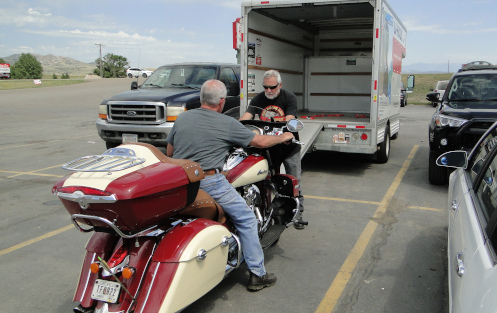
motorcyclists and their bikes

We’re not even in the park yet but it’s gorgeous just the same.

Not to take anything away from Yellowstone National Park–it’s an incredible place, no question–but we’ve been there before, as in more than 4 or 5 times. I myself have probably been to Yellowstone at least 15 times over the years. So as we headed out of Cody toward the park the main thought in our minds was, just how terrible was the traffic going to be?

Dennis had aptly noticed that riders coming into town from the west were warmly dressed, so we followed suit. Good plan; the morning was definitely cool.

One thing you need to understand is that the beautiful scenery you come to a park for does not begin at the entrance to the park. You’ll ride 20 miles west out of Cody before you actually enter the park but it is a stunningly beautiful ride. And on this morning, fresh and cool, with–as it turned out–very little traffic, it was heaven.

We got into the park, still expecting but not finding heavy traffic, and enjoyed the relaxed ride. The road runs up and over a line of hills and yes, we did get behind some campers at times, but they usually pulled over and let us pass so it was a good run. Then, approaching Yellowstone Lake, we hit a construction zone. Good-bye pavement.

Because I was on my V-Strom I actually welcomed the unpaved road, but Dennis hates it on his Indian and Bill does not love it on his Harley. No matter; you just have to do it. It’s not like we had any choices. And it wasn’t bad. Dennis and Bill said later they had no problems.

We hit pavement again at Fishing Bridge, where we turned north to run up to Canyon Village. Now we had traffic. This is a stretch where bison are common and yes, we did find ourselves behind a camper that stopped dead in the middle of the road to look at a bison. Really? You can’t pull off to the side at least? This is Yellowstone.

While I blasted on around this guy, Bill and Dennis did not, so I rode for miles with an unobstructed view at my own pace. And yes, there were a heck of a lot more bison further along. With most of the tourists pulled off to look at them, the road for me was largely unobstructed.

At Canyon Village we turned west, heading over to Norris Geyser and U.S. 89, which goes north and on out of the park. Traffic continued to move pretty well so we were making good time while enjoying an easy ride. There were more bison along here, including one big fellow who was lounging pretty much right on top of the white line at the edge of the pavement. So yeah, we steered a pretty safe distance away from him.

Then guess what? More construction zone and unpaved road. Here we go again, only this time it’s a little slick because the tanker truck we saw filling up from the stream apparently just wet the road down to control dust. But that makes things a bit trickier on street tires. Again, though, no issues. The bikes did get dirty.

Reaching Mammoth Hot Springs we passed through the village and found ourselves descending a steep incline down into the canyon of the Yellowstone River. This was when we realized that none of us had probably ever gone this way before. We had been at Mammoth Hot Springs before, but then had turned east to go out the northeast gate and on to the Beartooth Highway. Not this time.

And it was a beautiful ride. Again, the scenery doesn’t stop at the park boundary.

After lunch at Gardiner we continued north just a short distance to where we turned off for Chico and the old Chico Hot Springs resort. This is not a place you’re just going to see riding along, and it was probably a good thing Dennis had his GPS fired up to guide us to the off-the-main-road establishment.

Although we stayed in the old lodge, which features restrooms down the hall as so many old places did, there are more modern facilities where I assume the restrooms are in the rooms. But it’s a grand old place with hot springs pools, restaurants, horseback riding, hiking, and more. We opted to play Frisbee golf which, through the sage brush and going up and down hills, was some good exercise, especially after spending the last three days on the bikes. And then the hot pools were just what sore muscles needed.

Biker Quote for Today

Why bikes are better than women: Motorcycles always feel like going for a ride.

OFMC Hits The Road For 2019 Trip

August 1st, 2019
motorcyclists stopped along the road

The OFMC (just three of us!) stopped along the road.

It was like the early days of the OFMC when Bill and Dennis and I took off for this year’s trip. Originally the group was three of us–Bill, John, and me. John no longer rides and a lot of others who used to ride with us have gone their separate ways so now we are back to three. We miss the camaraderie of the others but riding with three bikes–rather then ten–is a pleasure.

On a blazing hot day we headed west on I-70 and then north on U.S. 40 over Berthoud Pass and down to Winter Park and Granby. Just west of Granby we turned onto CO 125. This road goes over Willow Creek Pass to Walden, in North Park. I don’t have Willow Creek Pass on this website but after riding it a number of times I have concluded I need to add it. We’ll see if I get it done this year or not.

We have ridden Willow Creek Pass north to south before but I’m pretty sure this was the first time we’ve ridden it south to north, so it was sort of the first of several firsts on a variety of roads on this trip. And it was terrific. A really nice road through a very nice area–albeit with about a million dead pine trees–and almost zero traffic.

We stopped for lunch in Walden and as we were getting ready to head onward three other guys on bikes–younger guys–pulled in. Of course we talked. Like us in the old days, they were out for a week and had no plans as to route or stops. And like us back then, if there were no motels available they had their camping gear. The one difference was that they were on much more capable machines and their gear was probably better than even ours is today. For us in the beginning, gear consisted of two gym bags loaded with stuff tied together and thrown over the seat behind us, plus tent and sleeping bag bungeed on.

Heading north out of Walden we entered Wyoming and made our next stop at Saratoga. All we wanted besides to stretch our legs was shade–it was still blazing hot! Then on to Rawlins for the night.

In the morning we expected more heat so we didn’t put on anything for warmth. We were going to be crossing central Wyoming on U.S. 287 and that is usually a long, hot, dry run. And we got cold. In fact, we stopped twice in the first 80 miles to put on more layers because that heat just never showed up. Meanwhile, it was above 100 in Denver that day.

So north and west on 287 as far as Sweetwater Station and then north on WY 135 to Riverton. Then U.S. 26 to Shoshoni and U.S. 20 to Thermopolis. Then finally WY 120 to Cody, our destination for the day. And just a few miles out of Cody it did finally get hot.

Cody was a bustling place. Apparently the hundreds of motorcycles roaring up and down the main street were there in connection with the Beartooth Rally, which we had not been aware of. Of course, this is why we make our motel reservations in January, and this was not the only time we were glad we had done so.

Tomorrow would be crossing Yellowstone National Park. How ugly is that traffic going to be?

Biker Quote for Today

Do you really have to ask why I would want this big vibrating machine between my legs?? – Anonymous Female Racer

Big Mistake At The Pumps

July 29th, 2019
red diesel at an Indian dealership

Take a good look at this photo. It tells the whole story.

“We’ve got a diesel truck running out there.”

Those are not the words you generally want to hear about your motorcycle. Dennis was ecstatic.

We’ll start at the beginning.

We stopped for gas in Livingston, Montana, at a big station where the pumps in front were all busy. So we went around back and filled up. Then we headed west on I-90, destination Missoula. But right from the start Dennis could tell the big Indian wasn’t running properly. Bill, just behind Dennis, smelled something that puzzled him.

After about 60 miles Dennis decided to pull off at another station. He figured he had gotten some bad gas and that adding some good gas would dilute the bad. But after he filled the tank the bike would not start at all. It wouldn’t even turn over.

Maybe that bad gas had fouled the plugs. He didn’t have the tools to pull the plugs so Bill gave him a ride to the nearest town where he bought tools. Pulling the first plug it looked just fine. Now he was truly stumped.

Checking online Dennis found that the nearest Indian dealer was in Idaho Falls, about 235 miles away. The towing company he reached said that would cost $900. A U-Haul truck, 25 miles away, would cost $260, plus he would have to buy tie-downs. A no-brainer. Bill took him to Whitehall to get the truck and we returned to the station that was now becoming a second home to us.

Now, how do you roll a non-running 800-pound motorcycle up a steep ramp into a truck? When we first got to this station there were several burly young guys around who we sorely needed. None now. We finally recruited a couple older guys who seemed kind of iffy but you take what you can get. Miraculously we were successful. Tie it down securely and off we go.

The dealership was closed by the time we got there and there were supposedly zero motel rooms available in town. Dang. However, luck was with us and we found one small, older place that had a room for us. Big sigh.

Dennis was over to the dealership before they opened in the morning and immediately got the bike checked in for work. Then we walked a few blocks for breakfast. Returning after breakfast, Dennis asked at the counter about his bike. “The dead one?” the guy asked. He turned and carried over that vial you see in the picture. It had come out of Dennis’s tank and it was red diesel. How the heck did that happen? Was the gas station accidentally dispensing diesel from a gas pump, wreaking havoc with who knows how many vehicles?

More importantly (for Dennis) was what damage might have been done. Worst case scenario is that the pistons might have seized up. Nothing to do but clean it out and see if the bike will run. This will take an hour or two.

Meanwhile Dennis pulled out his gas receipt and it said right there, “red diesel.” He was the one who made a mistake. How?

Looking at the pumps he had seen a couple with green handles and he knew that was diesel. The other handle was red. Now here’s the thing: in Colorado for the most part, red is the color for gasoline. But in the more rural areas in a place like Montana, green means regular diesel, red means red diesel, and black is the color for gas. When I filled my tank I looked at the labels on the pump. Dennis only looked at the color of the handles.

So by the way, what the heck is red diesel? Red diesel is for farm implements and construction equipment that does not use the highways. Because they don’t use the highways they are exempted from the taxes that pay for the highways. Regular diesel has a red dye added. If your semi is stopped and they find red diesel in your tank you are in trouble.

With the dire possibilities in that worst case scenario you can now see why, when the mechanic came out and said, “We’ve got a diesel truck running out there,” that Dennis was ecstatic. His motor was not destroyed, and it was running so we could actually get back on the road.

Be aware, they told him, it may smoke for awhile.

Biker Quote for Today

Why Motorcycles are Better than Men: If your motorcycle smokes, you can do something about it.

Examiner Resurrection: Touring Smarts: Tips For A Good Motorcycle Road Trip

July 25th, 2019
motorcycles on highway

Touring season is upon us. Are you ready?

The Boy Scouts have it pretty well nailed with their motto, “Be Prepared.” And if you’re getting ready to take off on an extended trip on your bike, following those words of wisdom can help ensure that you get to really enjoy that trip.

The American Motorcyclist Association (AMA) polled their highly experienced staff and came up with “33 Secrets For Smart Touring,” and there are some good ideas here. Some are common sense but some are just good ideas you might never think of on your own. Let’s look at a few of them.

Eat at weird times. Everyone and their dog eats around 8 a.m., noon, and 6 p.m. To get in and out of restaurants in a hurry, don’t be hungry then.
OK, you can’t always do this. Especially at breakfast, unless you’re getting a very early start or a very late start, you’re going to be eating at the same time as a lot of other people. But if you can do it, it makes a lot of sense. Last summer we spent a night in Lake City, CO, and went out for breakfast along with the crowds. We picked a place where you order at one window and pick up at another. It looked like a pleasant, homey, non-chain kind of place and there were a lot of people there.

Well, a crowd can mean something good or it can mean something bad. In this case, there was a crowd because of the incredibly slow service. If you put in an order for a cup of coffee and a roll, they put your ticket at the end of the list. They worked on one order at a time, and even if they were waiting for some eggs to fry for that order they wouldn’t jump ahead and rush out something simple like coffee and a roll. Stopping there at a different time of day probably guarantees you much faster service.

On high-mileage days, you’ll feel a lot better if you carry eyedrops and use them every time you stop for gas.
Interesting. Never thought of that. Might be worth a try.

If you’re nearing the end of your riding day and want to set yourself up for a quick getaway in the morning, consider riding to the far side of the next city you reach before you stop for the night, eliminating urban traffic the next morning.
Good idea. Makes a lot of sense. But did that thought ever occur to you?

Before you take off from the hotel or campground in the morning, double check every strap on tankbags or soft saddlebags, and every latch on hard luggage.
Good idea.

Take a look back at where you were parked every time you leave someplace. You’d be amazed at what you find.
Really good idea.

On a long tour, plan for at least one day every week of doing nothing. Time is the ultimate luxury, and can mean the difference between a vacation and an endurance run.
We totally go along with this idea. We try to organize our summer trips so that we spend two nights in one place each year, and we generally play golf on our day off. Everyone likes not having to pack and load up at least one day of the trip.

If you’re traveling east or west, schedule your breakfast or dinner times near sunrise or sunset so you don’t have to stare into the sun when it’s low on the horizon.
Once again, just good common sense.

So that’s a few of the 33 tips. You can go here to see them all. (No you can’t. When this was published on Examiner.com there was a link there that led to that list, but the list appears to be gone now.)

Biker Quote for Today

Respect the proud Tar Snake.

Examiner Resurrection: A Motorcycle Ride Captain Discusses Safe Group Riding

July 22nd, 2019
motorcycles on highway

Group motorcycle riding requires cooperation and coordination.

There are motorcyclists who get together with friends and go for a ride as a group. And then there are motorcyclists who go on group rides. The two can be vastly different. While the former can be very loose and unstructured, with different riders taking the lead periodically as they feel so moved, the latter is a very structured event.

On a group ride, particularly the sorts of rides that Harley Owners Groups (HOGs) affiliated with dealerships do, safety is generally a top priority and clearly defined leadership and rules are paramount. At minimum you’ll have a Ride Captain in the lead and a sweep rider bringing up the rear, often in communication with each other via radio.

Alan Baumbach is an experienced Ride Captain who lives in Denver. As a Harley rider he belongs to several local HOG chapters and ridden with many groups. Alan has very definite ideas about motorcycle safety and he has stories to tell. We let him talk.

“We were with a sizable group coming down I-70, coming back to Denver from Grand Junction. I was leading. I think there were 12-15 bikes in the group. I’m checking my mirrors all the time and everybody’s all lined up and I can see everybody, and we’re good. But every so often I’d look back and it was like half the group was gone. What happened?! A minute or so would go by, and I’d be checking my mirrors, and they’d catch back up to me. And then I’d look back again and they’d disappeared again. Finally we stopped for a fuel stop and one of the people who was in the last half of the group came up to me and said, ‘Alan, I think you need to talk to so-and-so because he’s sightseeing and he is slingshotting.’ He was slowing down because it was his first time in Colorado, he wanted to see the sights, and then he was speeding up. And he was slowing down and he was speeding up. So he was slingshotting in the group and driving everybody nuts. Because you don’t want to pass when you’re in a group.

“There have been times when I’ve been on rides where people are novices and don’t quite know how to ride. I don’t know if it’s a situation where they feel they have to keep up with the group, or they are not riding their own ride, or what. But they crash. And that’s always sad to see. I’ve never been on one that was too serious, but I’ve been on some where people broke bones. They had to have the ambulance come and take them away.”

Why did they crash?
“Target fixation. I’ve even seen it in myself sometimes. I think anyone who rides any time, any distance, has seen that there’s a natural tendency to fixate on a target. And where you look is where you’re going to go. And if you look for the side of the road you’re going to go to the side of the road. And if you look for the chuck hole, you’re going to go into the chuck hole.

“I think a lot of people, too, just never learned how to counter-steer. It’s counter-intuitive to what you think. You describe it to someone who has never ridden a motorcycle or a bicycle and they think that you’re nuts. It’s like, no, that’s really how you steer.”

Do many of the people on dealer rides tend to be new riders looking for someone to ride with?
“I’ve been on rides with a number of dealerships and it varies by chapter. I’d say of the rides I’ve been on there have been a lot of new riders. But I’ve been on other rides where you’ve got a lot of experienced riders. It is so nice to ride with experienced riders who know what they’re doing. They know the signals, they know how to stagger, they know single-file when you’re on a twisty mountain road. It’s automatic. I think it’s intimidating for a new rider to come into a group and everything is unfamiliar. That’s one of the things I think, anytime you’re riding with a group, the Ride Captain and the leaders and the sweeps all should go over who’s new, ride your own ride, go over all the signals, do you have any questions, do you have any concerns, things of that nature, before you ever step over the bike and fire it up and go. I think that helps a lot and if there’s a new rider, people are watching out for him. If someone doesn’t raise their hand and say ‘I’m new and I’ve never done this before and I don’t know quite what to do,’ people are making assumptions that you’ve ridden before.

“I think six to eight is the ideal size for a group. When it gets beyond eight the leader can’t see all the way to the back. Even if you’re on radios with the sweep at the end you can’t see everything that’s going on.

Ride your own ride
“I tell people all the time, if something happens that you feel you need to pull over, pull over. Don’t think, ‘Oh I’ve got to stay with the group.’ If you’re running out of gas, if you hit something, if the bike’s not operating right, something of that nature, don’t be pressured by the group to continue the ride.

“I’ve ridden on rides where we want to try to keep it a reasonable space as far as distance, but not excessive, and if you start pushing it too excessive you know exactly what’s going to happen: cars are going to pull in, and the next thing you know your one group is now two groups or three groups, and you’ve got a mess. Trying to keep it tight . . . with experienced riders, not a problem. With new riders, they’re still uncertain of their capabilities, they’re uncertain what they can do as far as handling the bike and stopping the bike, and it may be intimidating to ride in a relatively tight formation, even though it’s staggered. And so they start leaving some space. I’ve talked to some of them and said, ‘You know, if you can, tighten it up. I understand if you’re not feeling comfortable with it, but if you can tighten it up that will help to make sure that cars don’t try to split us up.’ Again, having a group that is a small group instead of a large group so the cars can feel comfortable getting around the group is a big thing. Like I said, six to eight bikes is probably ideal as far as size. If you are not comfortable in the situation that you’re in, regardless if it’s a big group or a small group, they’re going too fast, they’re going too slow, whatever, if you’re not comfortable, pull out and do your own thing. But if you’re part of the group, be part of the group.

“I have ridden with a number of chapters and they all have varying levels of discipline. One of the reasons I ride more frequently with the chapter that I do is because they are very disciplined. When we want to ride we want to ride safe. We don’t want an accident. We want people to feel comfortable on the ride. We want it to be an enjoyable experience for everyone. And these are the rules so we can accomplish that. I’ve been on rides where everybody’s clustered around waiting for the ride to start and the leader comes out and says, ‘Well, everybody ready to go?’, jumps on his bike, and takes off. And it’s like, nobody else has started up their bike, maybe they’re adjusting their helmet or something of that nature, and now all of a sudden everyone is scrambling to try to catch the leader just to go on the ride. I’ve been on rides, too, where the leader has been oblivious of the group and he’s doing 80-plus miles an hour and the group is just a mile behind him because, it’s like, you shouldn’t be going that fast. Not on the road and the conditions we were on.

No bar hopping
“I’m not a bar hopper. I enjoy a drink after the ride as much as anyone. But I’ve ridden only once with groups that I find out have got to have six beers in three miles. I’m like hold it! Time out! No, no, no, no. This is not what I want to do. I realize there are people like that out there and that’s what they do but I don’t want any part of that. I want to ride safe.

“We were riding over to Grand Junction and I-70 was shut down at the tunnels, shut down in both directions. And they were sending all the traffic over Loveland Pass. This was early September, it was one of those freak weather things where there had been a little bit of snow at night and because it was still early September it had been warm and the snow had melted when it hit the road and it froze. And Loveland Pass was glare ice all the way up to the top and all the way down to the bottom. We had six of us who went up and down that pass and nobody lost it. I mean, there were a few close calls but nobody lost it. But we were doing 10 and 15 miles an hour trying to get up and down that pass. If somebody had gone down, or if we had not been able to control the bikes I think we would have called the ride immediately and said this isn’t worth it. But we had experienced riders, we had people who knew how to handle their bikes. Everybody was conscious that, we’re on ice guys. Watch it! We’re going into a hairpin turn you’d better be darn sure that you’ve got control of that bike. That was one of the best group rides I have ever been on. We put on 650 miles that day but it started out early in the morning and on Loveland Pass, glare ice. Don’t want to repeat that one again any time soon.”

Biker Quote for Today

Life is about moments. Don’t wait for them, create them.

Finding Dual-Sport Roads To Ride

July 18th, 2019
The DualSportMaps.com website.

The DualSportMaps.com website.

I was looking at old Examiner.com articles with an eye toward doing another Examiner Resurrection and I came across something I had forgotten about. A little preface first:

I totally loved the dual-sport ride I did with others in the RMMRC recently and was trying to figure out how to make more of those happen. I joined the group about three years ago with at least part of my intent being to meet up with other folks to do that kind of riding. But this is the first such ride in all that time.

I realize that if I want to do dual-sport rides I can take the initiative and put it out there and presumably others will join me. But the weak point in the chain is that I don’t know a lot of good unpaved roads to ride. I will frequently be heading somewhere else and see a gravel road going off somewhere and wonder where and whether that might be one to explore. But I don’t want to take a group out there only to find out that it runs up in the hills a ways and then dead-ends.

No, the obvious thing to do is to pre-ride the route first to make sure it’s something to take a group on, but that gets me back around to my first issue: needing someone to ride with. I don’t want to head off into the boonies on some lonely road all by myself and run into trouble, with nobody likely to come along to help me any time in the next three days.

End of preface.

So this old Examiner post I came across is about this website, DualSportMaps.com. And as I looked it over I figured that rather than posting the old piece I might as well do a new piece–and here we are.

DualSportMaps.com is a pretty basic site but it offers exactly what the name implies. It has some rides put up by the going doing the website but also–probably predominantly–rides put up by people like you and me. You start with a broad map and then zoom in and in to the area you are interested in and you see what there is on offer.

For instance, when I zoom in enough to get clear separation by state it shows two blobs in Colorado, one with 209 rides and the other with 268. Zoom in once more and you now see smaller blobs with 3, 34, 48, 68, 67, 77, and 19 rides. Keep zooming in and the blobs keep dividing until you are looking at individual rides. For example, the Bill Moore Lake ride north out of Empire is shown here.

Now, unless you register, the site doesn’t give you much information on the condition of the road. But it’s free so there’s no reason not to register and then a great deal of information becomes available. It would still be necessary to pre-ride the thing before leading a group there. And once again, that gets back to needing someone to go with me, but at least now I have a tool to explore and select the routes that look most promising. And then heck, if nothing else, Judy and I can go exploring in her Subaru Outback and then I could lead a group there.

Of course, this is exactly why I do these Examiner Resurrection pieces. Most of the stuff I wrote for Examiner years ago is old news and of no interest today. But some are what writers call “evergreen,” meaning they are timeless and just as relevant today as 10 years ago.

Biker Quote for Today

A lot of fun when you get it right but the other side of the coin is when you crash. — Mick Doohan