Archive for the ‘Motorcycle Safety’ Category

Thoughts From A Ride

Thursday, August 31st, 2017
Motorcyclist with helmet

Helmet protection is seriously reduced when you don’t connect the strap–but you knew that.

I never go for a ride without encountering something that sticks in my memory, at least for a while. Some are more memorable than others.

I was headed to my ABATE District 10 meeting on Sunday and the first thing that hit me was that, oh my gosh, I forgot to attach the strap on my helmet. I had just gotten onto I-225 so it wasn’t like I could just do the strap at a stop light or something. Helmets don’t really work very well if they’re not attached so I figured I’d better take things pretty cautiously. And in the meantime I was strategizing about grabbing for my head in case something bad happened.

Of course nothing did, nothing ever does (knock wood), but you bet it had my attention.

Then as I proceeded up I-225 I was in the center lane and two guys on bikes came up on my left. One was on a sportbike of some kind and the other was on a Harley Sportster. Just ahead of us there were cars in both lanes. We were going 70. What did these guys do? They just blasted right up between the two cars and shot on out of sight. OK, I’ve done some lane-splitting, even on rare occasions in Colorado, but never when traffic was going 70. I don’t think I want to go for a ride with those guys.

Then in the stretch between 6th Avenue and Colfax, where I get off when going to ABATE, I encountered–as I always do–what I consider a true hazard on the road. For most of that stretch there is a gap in the pavement about two inches wide separating the lane of continuing traffic with the lane of exiting traffic. Two inches is a big gap!

I always very deliberately cross it at as sharp an angle as I can and it’s never an issue because I do this. But what would happen to a bike if the rider wasn’t paying attention–or maybe it’s dark at night–and you let your front tire drop into this groove? It would have to be scary at the very least and could very easily be a lot worse than scary.

I really don’t understand how CDOT can allow this sort of thing. The fact that it is unsafe goes without saying. But they do, and this is not the only place I’ve seen this sort of thing. A two-inch gap in the pavement when traffic is going across it at a right angle is one thing. Running parallel with traffic is something else entirely. Just be forewarned if you’re riding this stretch of road.

Biker Quote for Today

“Sometimes this place is like watching a truck left turn in front of someone you’re riding with.” — JonnyLotto

Ride Your Own Ride (And Other Advice)

Thursday, August 10th, 2017
motorcycles and riders

Riding with friends doesn’t mean riding just like your friends.

Motorcycle riding, like so much else in life, is a matter of learning by doing. The following are a dozen lessons learned through more than 25 years and 100,000 miles on two wheels.

1. Get yourself some friends
If you’re not carrying a passenger, riding is a solitary activity at its core. You can be with other people but when you’re running down the road you’re all alone on that bike. That makes it all the more enjoyable to have friends with you when you stop. “Wow, did you see that bald eagle on top of that tree?” “Did that jerk come as close to running you off the road as it looked like from my view?” “Which direction do you think we ought to head now?”

Plus, if you go down it’s awfully nice to have friends to come to the rescue. Riding buddies are a good thing.

2. Signal your intentions
Cagers (people in cars) are generally the biggest threat to bikers but sometimes your buddies can be a threat, too. Does that pull-out on the left have a great view? Fine, pull off, but don’t assume the guys following you know why you’re slowing down. Signal your intent. For all you know, the guy behind you is impatient with your slow speed and is just about to pull around you to pick up the pace. If you make a left just as he twists the throttle your trip could come to an unpleasant end. Don’t let that happen.

3. Ride your own ride
Next to brain-dead cagers, the majority of motorcycle accidents are of the single-vehicle variety. That frequently means the rider pushed beyond their ability. This is the kind of thing that can happen when you’re riding with others and the leader is setting an aggressive pace. You may not be comfortable taking these tight turns at this speed but you want to keep up.

Bad idea. You can always catch up later. Don’t put yourself at risk when safety is at stake. Ride your own ride.

4. Don’t hesitate to go it alone
As enjoyable as it is to ride with friends, sometimes they’ve all got other plans. If you take off on your own you may find the freedom to stop when you want, go where you want, and do whatever your heart desires to be downright addictive. Of course it doesn’t hurt to have a cell phone with you in case you have trouble, but don’t pass up a great riding day just because you can’t find someone to join you.

5. Make like a Boy Scout and always “be prepared”
Sure, the sun is shining and it’s warm now, but don’t let that persuade you that you don’t need rain gear or warm clothes. It’s guaranteed to be very unpleasant if you find yourself out miles from anywhere and the skies open up. Particularly if you have saddle bags, there’s really no excuse for not carrying the gear you might need at all times.

6. Know your bike
Modern motorcycles are extremely reliable but user error can thwart the best technological design. Here’s a real-life example. Most bikes have petcocks that switch between the regular fuel supply and the reserve. On most bikes, the three positions for that lever are “Open,” “Shut,” and “Reserve.”

On some Kawasakis, however, the positions are “Open,” Reserve,” and “Prime.” Perhaps you don’t pay attention to this difference, and, after filling up, switch from Reserve to Open–you think. But in fact you have switched from Reserve to Prime. The next time you start up the bike it barely runs. Why? Because with that petcock in the Prime position it has been dribbling fuel into the cylinders continually, and that fuel has been seeping past your rings into the oil pan. Bikes don’t run well with their oil pans full of gasoline. (Hint: I did this twice before I figured it out.)

Get thoroughly acquainted with your motorcycle and everyone will be much happier.

7. Get schooled
Numerous studies show that the majority of motorcyclists who get killed on the road have not taken any sort of rider training. What more do you need to know?

8. Assume you’re invisible
The most common phrase spoken by a cager who just hit a motorcyclist is “I didn’t see him.” It doesn’t matter why this is, it matters that you take it to heart. If you pretend to yourself that you are invisible, and ride as if that were true, you’ll make decisions that will usually negate that driver’s inattention.

9. Take your time
Sometimes the best part of the trip is the unplanned, unscheduled stop or sidetrip. If you’re in too big a hurry to stop and enjoy the trip you might as well go by car.

10. Lean into adventure
This goes hand in hand with taking your time. The best motorcycle roads are the ones less traveled by cars, trucks, RVs, and the like. Don’t look for the shortest distance between two points, those roads are straight. Find the roads that curve.

11. Be opportunistic
“If you don’t like the weather, wait five minutes.” Numerous parts of the country claim this line, and it’s something to take in consideration. If you want to go for a ride today and it’s gorgeous right now, go right now. You just don’t know what the sky will look like two hours from now.

12. Pick it up!
Amazing as it may seem, even petite women can pick up huge, heavy motorcycles laying on the ground. It’s all a matter of technique. Use the wrong technique and at best you will fail, and if it gets worse you may get a hernia. Learn how to pick up your machine and you won’t end up looking like a fool – or worse, in the hospital.

Biker Quote for Today

Why motorcycles are better than men: Motorcycles don’t insult you if you are a bad rider.

Refreshing And Enhancing Skills In The Experienced Rider Course

Thursday, July 6th, 2017
motorcyclists

Bob (left) and Will, the other students in my ERC.

I took the Experienced Rider Course (ERC) once before. In fact, it was the first rider training course I ever took. Since then I’ve also taken the Beginning Rider Course twice, a dirtbike riding course, and I did the Rider Coach Training course, although I never worked as a Rider Coach. Here’s a tip: it never hurts to take a riding course–you always learn something new and improve existing skills.

The primary focus of this ERC I did on Friday was tight maneuvering. That wasn’t all, of course. The overall point is to learn to be a better rider everywhere. But if you can handle a big bike in tight quarters, handling that same bike in the wide open spaces is just that much easier. And sometimes that extra bit of control can make all the difference.

So I’ll get right to it. The number one thing I got out of this course was understanding what it takes to make a big bike make a really tight turn. Maybe you’ve seen these riders doing circles on big baggers that you couldn’t even dream of doing on a little 250. How the heck do they do that?

Don’t think I’m going to claim that I can do that now. But I am a little closer.

Bob, the instructor, talked about counter-weighting. If you need to lean the bike way over you also need to move your body the other direction to balance that out. Counter-weighting. To do this you put your weight on the outside peg and lean way back.

But the thing that got me was his instruction to keep your inside arm straight. Think about that. You’re turning left, you’ve got that left grip tucked in close to your body, and yet you need to keep your arm straight. If that’s not going to keep your weight off to the other side nothing will.

Fact is, I wasn’t sure it was even possible. I mean, OK, let’s say you’re riding a sport bike with little clip-ons. That seems doable. But my CB750 has a steer-horn handlebar that is 31 inches from tip to tip, and sitting upright in the saddle with the wheel turned as far as it can go the grip is about five inches from my stomach. I’m supposed to keep that arm straight?!

Guess what? It can be done. I couldn’t go it right off, but we went around again and again and I kept pushing myself and after awhile it happened. I’ve never made tighter turns with that bike in my life. I admit that the thought of putting weight on my outside peg never crossed my mind, though I suspect that happened naturally.

Most of the rest of the course was a refresh. We practiced techniques I know but maybe was a little rusty with. But then, I’ve taken this course before, as well as others. If you haven’t ever taken a riding course there’s probably a ton of stuff you’ve never learned. I don’t care if you’ve been riding 40 years I bet you’d learn something new. And you’ll be a better rider.

Is there any reason in the world that that would not be a good thing?

Biker Quote for Today

I hate being sexy but I’m a biker, so I can’t help it.

Riding Practices Of Different Groups

Monday, June 12th, 2017
motorcycle atop Skyline Drive.

Every group seems to have its own approach to how to ride together.

Going riding with Willie and Jungle and some of their friends a week and a half ago I was very interested from the outset to see if this particular group was into staggered riding. It didn’t take long at all to figure out the answer was no.

Do we need an explanation? Staggered riding is where each rider alternate taking the opposite side of the lane from the rider ahead and behind them. That opens up sight lines and gives each rider a better view of the road ahead, and it also doubles the space between each rider and the rider directly behind them, which makes for safer riding.

I do a lot of my group riding with the OFMC and that is a group where staggered riding is not the norm. There have been a few of us who have lobbied for doing so but most of these old farts don’t give a hoot about it. Finally I resorted to always riding last so I can put myself in the position I desire and have no one behind me to sit right on my tail or anything.

With the Rocky Mountain Motorcycle Riders Club, on the other hand, riding staggered is absolutely the norm.

So with Willie and crowd, we gathered in Pueblo and set out the next morning headed for Lake San Isabel. There were only four bikes at that point and Jungle took the lead. Kevin and Bonnie were in the number two spot, Judy and I were third, and Willie was in the rear.

The dynamic shaped up very quickly. Jungle stayed largely in the middle of the lane. Kevin stayed largely on the left so I took the right, although at any given moment Kevin might drift over. I just kept a good distance. Willie, in the rear, always stayed so far behind it didn’t matter where she rode.

The next day we had added a couple bikes but it was pretty much the same. Nobody but me seemed to pay any attention to keeping staggered. Oh well, it’s not like I was going to make a big fuss about it. I prefer riding staggered but if it really mattered a lot to me I would not ride with the OFMC. But it was interesting to be with a different group and see how they do things.

Biker Quote for Today

Wait! I do not snore! I dream I’m a motorcycle!

CDOT Not Abandoning MOST Program In Transition

Thursday, May 25th, 2017
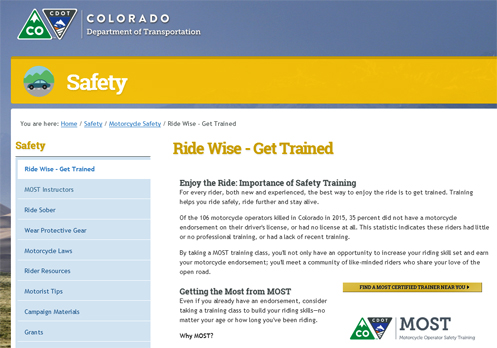
CDOT's MOST webdsite

Part of CDOT’s MOST website.

The Colorado Legislature officially moved the Motorcycle Operators Safety Training (MOST) program from the Colorado Department of Transportation (CDOT) to the Colorado State Patrol (CSP) during this recent legislative session but that doesn’t mean CDOT is casting it aside during the transition. In fact, it seems like they may even have kicked things up a bit.

MOST is a program intended to promote rider training, with the idea that a rider who receives real training in operating the bike will be a safer rider than one who just learns by doing. I know this to be the case because I learned by doing and years later took some training courses. Guess what: I learned a bunch of stuff. I became a better and a safer rider.

May is commonly declared Motorcycle Safety Awareness Month and so with that theme in mind I was recently contacted by Megan Tobias, a public relations rep working with CDOT to promote the safety effort. She was asking if I could do something in this space to help promote training efforts. And in fact, she offered that if I wished, they could set me up to take a course on their dime. “Even if you’re a skilled motorist, we have an array of more advanced classes that can help fine tune your skills. Locations and class levels can all be found here: https://www.codot.gov/safety/live-to-ride/get-training.html/.”

This is a new level of promotion that I haven’t seen before. And I suspect I’m not the only one Megan has contacted to try to get this information out to the public. I say good on CDOT.

So initially I declined Megan’s offer but thinking about it now I may take her up on it. For one thing, I know that the Motorcycle Safety Foundation, whose curriculum the MOST instructors follow, has revamped its programs, so if I take the Experienced Rider Course a second time it is presumably going to be different from the first time. Plus, I don’t care how good or experienced you are, there’s always more you can learn. You’ll read about it here if I do.

Biker Quote for Today

Never twist the throttle with your ego.

Fighting The Wind Blast From Oncoming Trucks

Monday, May 22nd, 2017
Car passing motorcycle

The wind blast from this guy isn’t going to do much; it’s very different with trucks.

During this last ride Judy and I did I made some interesting observations I want to pass along.

It was kind of windy as we set out but not bad. The road we were on was not too busy, either, until we reached Limon and turned southeast down US 287. This is a major highway and that translates into “lots of trucks.”

Anyone who has ridden a motorcycle for long knows how powerful the wind blast can be on you as trucks go by in the opposite direction. Accordingly, I braced myself every time one came along but after awhile I started noticing that not all truck wind blasts were the same. Judy noticed it, too.

Sometimes a truck would go by and the blast would like to blow you off the road. Other times they just seemed to slip by and you hardly felt it. Once I got my mind focused on the question it didn’t take long to recognize the answer.

Very simply, the more aerodynamic the truck, the less the wind blast. It’s pretty dang intuitive, if you think about it.

You know those fairings that many trucks now have, the ones on top of the cab that deflect the wind from hitting the flat surface of the trailer? Those things help semis get better gas mileage because they reduce the wind resistance. No surprise there. But the real issue is that the more smoothly the truck can just slice through the wind, the less turbulence is created. And the less turbulence created, the less wind blast felt by vehicles going the other direction.

Now surprisingly, this is not as predictable as you might think. I found that almost universally, the big trucking companies all have their trucks faired and stream-lined and they kick up very little wind. The you-rent guys apparently don’t care so much about gas mileage since you are buying the gas, not them, and they generally are not faired.

And then it matters what the truck is hauling. If it is an enclosed unit, the wind is minimized. Very open and/or oddly shaped loads kick up more wind. So a truck hauling a bulldozer on its bed can be expected to rattle you a bit as it goes by.

So I got pretty good at knowing when to brace myself and when it was not likely to matter. But every now and then, I would be expecting one thing and get the other. I can’t explain that. All I can say is that this business about aerodynamics is a good rule of thumb but there are exceptions.

Biker Quote for Today

Tunnel? Allow me to play the song of my people.